


Harvesting season for beekeepers is here, but many farmers fear poor yields due to erratic rainfall patterns resulting from El Niño, which began in June 2026, colony losses, and commonly used low-yield traditional log hives.
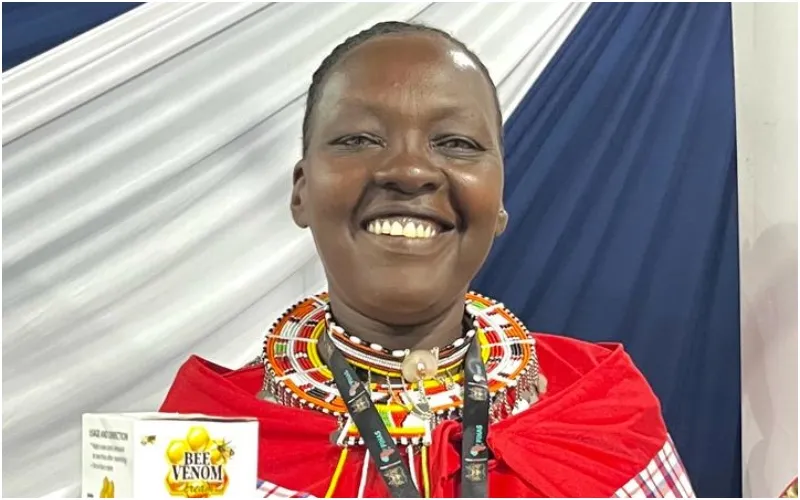
But Jacinta Mugambo and her group of 38 beekeepers in Laikipia County have no reason to worry, as they expect a larger harvest this year.
Speaking to News Nine at the sidelines of the Financing Agri-Food Systems Sustainably (FINAS) Summit 2026, Mugambo said they are anticipating a harvest of up to 800 kilogrammes of honey compared to what they earned last year.
“Our harvest this year will come from 200 beehives, which are all colonised. Before, we had 50 beehives – which were traditionally made and we produced 100 kilogrammes of honey from just 25 hives.”
“This was in 2025, when we enrolled at the NURTURE Project facilitated by Swisscontact Kenya and Wyss Academy for Nature. Here, we were engaged in training on climate-smart solutions for high-yield beekeeping, harvesting and navigation of the beekeeping value chain,” Mugambo explained.
The chairperson of Osuguroi Self-Help Group, a Community Based Organisation (CBO) in Laikipia, narrated how they started from Aloe Vera farming, but later ventured into apiculture.
“We started our group as Aloe Vera farmers but the crop was not yielding much, just KSh 30 per kilogramme. We then shifted to beekeeping which promised us up to KSh 500 per kilo, however, we did not realise its potential because we lacked proper training, skills and investment.”
“We started with 50 hives, with only 25 of them being colonised. This could give us on average 100 kilogrammes of honey. The other challenge we faced was refining and selling the produce… we did not have proper refining and storage equipment, and accessing a ready market was not easy. We were dependent on our neighbours, fellow members and passers-by, and sometimes it could go months without even a single buyer.”
But the NURTURE Project ignited the business for Mugambo and other CBO members when they learnt that bees produce other valuable products other than honey.
Through Swisscontact, the group was linked to commercial actors in the beekeeping sector, helping rural producers move from informal local sales into structured national and international markets where they could access training, quality inputs, financing and reliable buyers.
“During the NURTURE Project, we met experts from Savannah Honey, who taught us about modern beehives – Langstroth hives and Kenya Top Bar hives- and cleaning and harvesting to maintain the colony.
“Most beekeepers are used to burning the whole hive to chase away the bees. This is what we used to do until we learnt that it destroys the queens and chases away the colony. We learnt how to puff a little smoke from the side of the hive, picking combs capped with white wax, removing bees, cutting the honey and leaving some for the bees.
“This is made possible with the modern beehives like Langstroth, which has a wire that separates the honey from the queen, eggs or larvae.”
Mugambo said that the initiative, in partnership with Savannah Honey and Kenya Commercial Bank (KCB), enabled the CBO to acquire more hives.
“We purchased an additional 70 beehives from Savannah Honey this year, after KCB bank came in to support us financially. We now have a total of 200 hives, and we are hoping to produce more honey, bee pollen, venom, propolis, royal jelly and wax.”
“Savannah Honey helped us in proper colonisation of all the 200 hives and building of an apiary to help protect them from theft or animal damage.
Now, the beekeepers are guaranteed to make KSh 500 per kilo of honey, KSh 4,000 per gram of venom, KSh 6,800 per kilo of pollen, KSh 1,900 per kilo of propolis, KSh 3,800 per kilo of jelly and KSh 700 per kilo of wax.
Osuguroi Self-Help Group and 70 other CBOs in the county are getting these market offers from Savannah, which has eliminated market barriers in the beekeeping value chain.
“Savannah Honey not only provides the equipment, installation, and technical support, but also the market for the products. Since we joined the NURTURE Project, we no longer have to worry about who will buy our products. All we have to do is call them and let them know that we have harvested a certain amount of honey, and they come in with packaging solutions ready for market.
In an exclusive interview with News Nine, Savannah Honey CEO Kyalo Mutua affirmed the company’s commitment to ensuring that their beehives are colonised, the colonies are strong, and the queens are healthy.
“Then we go ahead also to make sure that they now get the market. We are currently not only buying honey, but we are also buying the bee pollen and propolis.”
“We have a programme in Laikipia County in collaboration with Swisscontact and Wyss Academy for Nature, where we are supporting over 70 groups. We are also supporting groups across the country, and now we have partnered with KCB Bank to support this programme,” said Kyalo.
Kyalo assured beekeepers of a ready market, noting that the company deals in the export of honey both locally and internationally.
“We give farmers a contract, so that when they buy our equipment, it is a guarantee that we shall provide them with the market. Because as we have got the export market, it is relatively lucrative. It is making us now be able to buy at good prices from our farmers. So yes, it is a big anchor, the export market.”
The partnership with Swisscontact has helped connect rural beekeepers in Laikipia to training, finance and reliable commercial markets, enabling them to move beyond informal sales and participate in the wider honey value chain.
However, he cited challenges of low production across the country, noting that the export market demand is higher than supply from farmers.
“The main challenge that we are having now is the quantity. The international market demand is high… it requires high quantity. And yet our production is very minimal. This is why we are collaborating with development partners and financial institutions to support more farmers for increased production.
According to the Food and Agriculture Organisation (FAO), Kenya produces 17 million metric tonnes of honey annually, which falls short of the local demand of 47 million metric tonnes per year. This, Mutua said, needs increased interventions by both the government and investors in upscaling the production to meet both the local and international demand.







Discussion about this post