Wote Technical Training Institute in Makueni County has transitioned from fuelwood to Liquefied Petroleum Gas (LPG), a move expected to significantly reduce deforestation, lower carbon emissions, and improve health outcomes for learners and staff.
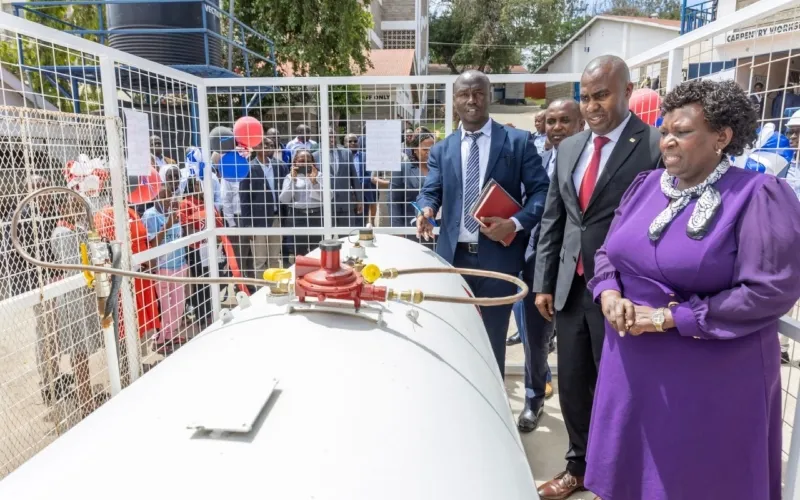
Officials from Equity Bank and Wote Technical Training Institute in Makueni County during the launch of a Liquefied Petroleum Gas (LPG) cooking system at the institution. Photo: Courtesy
The shift to clean cooking has eliminated thick smoke that previously filled the institution’s kitchen and nearby classrooms, exposing cooks and students to respiratory risks. Beyond health benefits, the migration is expected to ease pressure on forests in the semi-arid county, where institutions remain among the biggest consumers of fuelwood.
The clean cooking system, comprising a one-tonne LPG bulk cylinder and related accessories, was installed at a cost of Ksh3.5 million financed by Equity Bank through Equity Group Foundation, in partnership with Heatmax Energy. Currently, the facility serves more than 3,300 trainees and staff.
Speaking during the commissioning of the facility, the Principal Secretary (PS) for Technical and Vocational Education and Training (TVETs) Esther Muoria said the continued use of fuelwood in learning institutions undermines national climate goals by accelerating deforestation and increasing carbon emissions.
The PS said that while awareness about clean energy exists, adoption has been slower because institutions often fail to explain why change is necessary. Her remarks were delivered by Anne Kamonjo, Director of Greening TVETs at the State Department, who represented her at the event.
“If people are not shown the reason for adopting a new way of doing things, transformation of mindset becomes slow. Wote TTI is setting the pace by demonstrating that LPG is cleaner, healthier and environmentally sustainable. When young people see this in practice, they carry that knowledge home and into the wider community,” Muoria said in the statement.
She noted that embedding clean cooking solutions in learning institutions offers a powerful pathway for climate action, given the scale of Kenya’s education sector.
“We cannot be telling students to plant trees while at the same time cutting millions of trees in our institutions without offering alternatives. That contradiction weakens climate education” the Principal Secretary added.
Fostering climate sustainability in learning institutions
Kenya has over 23,000 secondary schools, 45,000 primary schools and about 250 TVET institutions.
According to the State Department, learning institutions alone consume an estimated 10 million trees annually for cooking fuel, even as the country pushes a national target of planting 15 billion trees to restore forest cover.
The Liquefied Petroleum Gas (LPG) project at Wote Technical Training Institute was launched following a visit by the Equity Bank team to Makueni Governor Mutula Kilonzo Junior, who said the initiative positions the institution as a climate leadership hub in the county.
“Wote Institute is a trailblazer in skills training, and there is no doubt other TVETs will emulate this transition to clean cooking. This will allow our trees to grow and improve forest cover in the county,” the Governor said.
On his part, Equity Associate Director for Energy, Environment and Climate Change Julius Kamau said the initiative is part of a wider effort by Equity Group Foundation to advance sustainable development and climate resilience.
“To date, 214 institutions have transitioned to clean cooking solutions, while more than 1,856 have expressed interest,” said Kamau, who is also the acting Equity Group Director of Sustainability.
“Clean energy adoption is critical not only for environmental conservation but also for improved health and long-term economic sustainability,” he added.
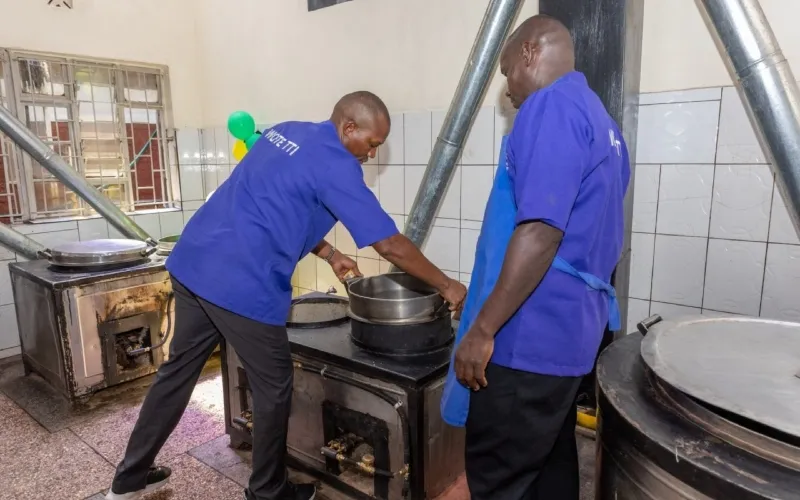
The shift to clean cooking has eliminated thick smoke that previously filled the institution’s kitchen and nearby classrooms, exposing cooks and students to respiratory risks.Photo: Courtesy
A determined Wote Technical Training Institute
On the other hand, the Chairperson of Wote TTI Board of Governors Joseph Mwinzi said the LPG facility positions the institution as a centre of excellence in environmentally responsible training.
“This exposure to modern energy systems and improved safety standards opens doors for employment and entrepreneurship in the growing clean energy sector,” he stated, urging students to become ambassadors for climate-conscious practices.
Furthermore, College Principal Joshua Munyoki said the transition marks the end of decades of reliance on firewood, which saw the institution consume two lorryloads every month.
“This is the most significant development we have had in over ten years. Apart from environmental gains, it will lower costs and improve efficiency,” he remarked.
A Liquefied Petroleum Gas (LPG) cooking system at Wote Technical Training Institute in Makueni County in use. Photo: Courtesy
Present at the commissioning were principals from other institutions in Makueni County, many of whom said the project had strengthened the case for adopting clean energy in schools as part of Kenya’s broader climate response.
Anne Manyatta, who is an ICT student and vice chairperson of the Wote TTI students council, welcomed the shift to gas cooking, saying it had eliminated smoky meals and dining halls while improving time management.
Additionally, plumbing student John Omolo noted that the gas ensures meals are prepared on time, taste better, and has inspired him to promote clean cooking at home where his family still uses firewood.
Marion Doreen is the co-founder of News 9 Kenya. She holds a Bachelor's Degree in Communication and Journalism from Moi University. Marion specializes in writing news and lifestyle articles.
















Discussion about this post