


Nairobi, Kenya – Kenya is actively pursuing a new funded programme with the International Monetary Fund (IMF).
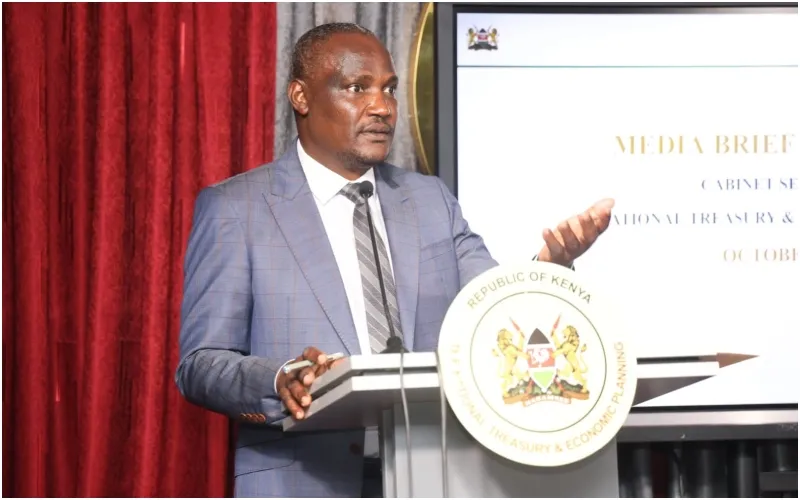
According to Treasury Cabinet Secretary (CS) John Mbadi, this will secure affordable financing and provide external oversight for its economic strategy.
Kenya’s public debt
Discussions for a new IMF programme began in September 2025, as the country faces a public debt stock of KSh 11.81 trillion, equivalent to 67.8% of its Gross Domestic Product (GDP) as of June 2025.
Speaking at a Treasury briefing on Tuesday, October 7, and attended by News Nine, CS Mbadi gave a detailed breakdown of the nation’s debt.
He stated that the total comprises KSh 6.33 trillion in domestic debt, mainly held by commercial banks through Treasury Bonds, and KSh 5.48 trillion in external debt from creditors, including the World Bank, the African Development Bank, China, and Eurobond holders.
The government’s debt service payments for the fiscal year ending June 2025 totalled KSh 1.72 trillion, with KSh 1.14 trillion paid to domestic lenders and KSh 579 billion to external creditors.
The Cabinet Secretary added that high global and domestic interest rates have significantly increased these costs, with interest payments for the 2025/26 fiscal year projected to exceed KSh 1 trillion.
Despite the heavy burden, Mbadi assured the public that Kenya is meeting all its debt obligations on time and is implementing a robust strategy to ensure long-term sustainability.
The government aims to reduce public debt to a target of 55% of GDP by 2028 through fiscal consolidation. Key strategies include liability management for maturing Eurobonds, slowing the accumulation of expensive commercial debt, and exploring debt-for-development swaps.
“We will diversify our funding sources by issuing bonds in Asian and Middle Eastern markets while prioritising concessional loans from multilateral and bilateral institutions,” said Mbadi.
Why Kenya needs IMF loan
Addressing the question of why an IMF programme is necessary when Kenya’s economic situation is improving, the CS said the country needs the IMF, noting that the goal has shifted from economic survival to achieving an “investment grade” credit rating, which would lower future borrowing costs.
Mbadi described the engagement with the IMF not as a sign of weakness, but as a strategic partnership.
He noted that Kenya pays annual subscriptions to the IMF and World Bank and should leverage the concessional loans they offer. He also highlighted the value of external assessment.
“You also need someone to continuously engage with you, to look at you and tell you that we think you are losing track,” he explained.
Acknowledging public apprehension about harsh IMF conditions, CS Mbadi vowed to protect citizens from undue pressure.
“I guarantee that the conditions we agree with the IMF are not putting pressure on ordinary Kenyans, but instead helping ordinary Kenyans receive better services,” he promised.
Kenya-IMF fresh discussions
Discussions with the IMF are reportedly progressing well, with the Treasury expressing hope of securing a new funded programme soon.
IMF staff visited Kenya in September 2025 and are holding talks with the authorities on a possible financing arrangement.
The staff mission, led by Haimanot Teferra, Mission Chief for Kenya, met at the request of the Kenyan authorities and marks the beginning of initial discussions on a possible financing arrangement.
The IMF reaffirmed its commitment to working with Kenya to bolster economic stability and reform efforts, even after terminating the 2021 programme in March this year.










Discussion about this post