


NAIROBI, Kenya – The High Court sitting in Nairobi has issued conservatory orders suspending the implementation of the Kenya-U.S. Health Cooperation Framework.
This is after the Consumers Federation of Kenya (Cofek) raised concerns about the government’s new deal, arguing that the pact could expose Kenyans to risks to data privacy and sovereignty.
In a statement, Cofek argues that the agreement requires stronger safeguards before implementation.
Justice Bahati Mwamuye issued a conservatory order suspending, staying and/or restraining the Respondents, whether by themselves, their agents or assigns, from implementing, operationalising or howsoever giving effect to the Health Cooperation Framework executed between the governments insofar as it provides for or facilitates the transfer, sharing or dissemination of medical, epidemiological or sensitive personal health data.
“The Petitioner shall serve the Respondents with the Application, the Petition, and this Court Order in both hard copy and soft copy and file an Affidavit(s) of Service in that regard by close of business 17/12/2025,” Justice Mwamuye declared.
The Respondents have also been ordered to enter an appearance and file and serve their respective responses to both the Application and the Petition by January 16, 2026.
“The Petitioner shall have leave to file and serve a rejoinder, if need be, and it shall do so by close of business 30/01/2026.”
The mention of the case will come before Justice Lawrence Mugambi on February 12, 2026, to confirm compliance and to take directions on the expedited hearing and determination of the Application and/or Petition.
How President Ruto reacted to the Kenya-US Health Cooperation Framework
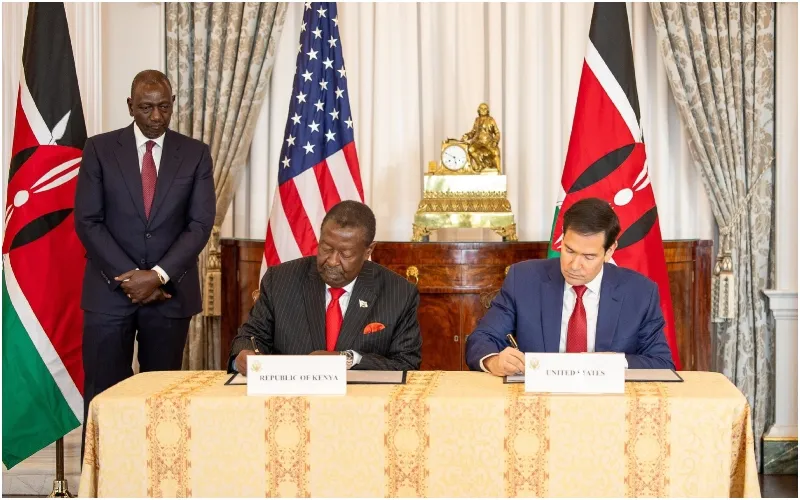
After witnessing the signing of the pact in Washington, D.C., signed by Secretary of State Marco Rubio and Prime Cabinet Secretary Musalia Mudavadi, President William Ruto said the move “marks a significant strengthening of our commitment to the full actualisation of universal health coverage.”
“This transformative framework prioritises the supply of modern medical equipment to our hospitals, the efficient and timely delivery of essential health commodities to our facilities, the upscaling of our health workforce, and the expansion of health insurance to ensure that every Kenyan is protected,” President Ruto said.
Under this agreement, the United States will commit 1.6 billion dollars to Kenya over the next five years – resources that will be channelled directly through government institutions, eliminating third-party intermediaries and guaranteeing that support reaches the intended beneficiaries for maximum impact and accountability.
“We express our deep appreciation to the Government of the United States, under the leadership of President Donald J. Trump, for choosing Kenya as the first nation to sign such a Framework. This decision reflects growing confidence in the strength, sustainability, and reform momentum of our healthcare systems,” President Ruto added.
He further conceded that the partnership builds upon Kenya’s long-standing health cooperation with the United States, an enduring collaboration spanning more than 25 years and backed by over 7 billion dollars in investment.
Why Cofek is against the Kenya-US Health Cooperation Framework
But Cofek says the cooperation must reflect Article 46 of the Constitution, the Consumer Protection Act, and public-participation requirements under Articles 10 and 118.
It wants full disclosure from private-sector players, including pharmaceutical firms and laboratories, as well as tech and cloud-storage companies that will access or process Kenyan health data.
The lobby also demands clarity on the types of data to be collected, how long it will be stored, and the purposes for which it will be used, warning that transparency is a legal obligation, not an option.
This comes even as Health Cabinet Secretary Aden Duale announced that the government will soon publish the full details of the Sh 208 billion health partnership recently signed between Nairobi and Washington, DC.
CS Duale said the documents would be tabled in Parliament, describing them as public records intended to ensure transparency, adding that the National Treasury, the Attorney General, and the Ministry of Health legal teams have already examined their contents.












Discussion about this post