


NAIROBI, Kenya – More than 150 senior leaders drawn from Kenya’s diverse faith traditions and institutions have converged in Nairobi for the Interfaith Dialogue Forum on Climate Change.
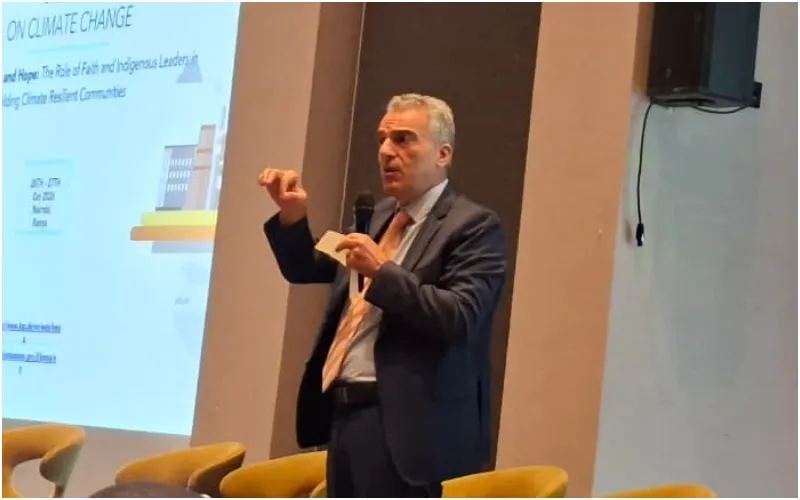
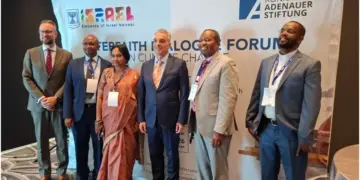
The forum organised by Israel Embassy Nairobi and Konrad-Adenauer-Stiftung (KAS) in collaboration with the and the Interreligious Council of Kenya (ICK) kicked off on Monday, October 26, at TradeMark Hotel, Village Market and will end on Tuesday, October 27.
Speaking during the official opening attended by News9.africa, Ambassador of Israel to Kenya Gideon Behar emphasised the conference theme, which is “Faith, Stewardship and Hope: The Role of Faith and Indigenous Leaders in Building Climate-Resilient Communities”.
Climate change is man-made
“Climate change clearly is man-made, and anything that is man-made can be changed. Faith leaders have an extremely important responsibility. They are the ones that carry moral leadership, moral guidance, moral lessons to us. And this is something that we need. We need your voices. We cannot leave the battle against climate change only in the hands of policy makers or many scientists. You are very important as well,” said H.E. Behar.
Behar noted that the forum will create a trusted space for different traditions to move from acknowledging the climate challenge towards practical responsibility, learning and achievable action.
He urged the participants to network and create partnerships that will bring lasting solutions to climate change.
“My hope is also that this gathering will be an annual one, but not only that it will be an annual one, but that it will produce reactions on the ground. I implore you to look around and find the partners that you want to work with. The people with whom you feel comfortable and that you want to make the change with,” he said.
The ambassador said the embassy is committed to offering expertise in water, agriculture, science, technology, and sustainability for any climate action undertaken by the religious leaders.
Konrad country director Matthias Kamp emphasised that in the face of climate challenges, the world should acknowledge that climate change is not merely a technical or political problem, but fundamentally an ethical, a moral, a spiritual issue.
“Across virtually every spiritual tradition and indigenous world, one truth remains constant. We are the first of these stewards of the earth. Faith teaches us compassion, equity, and care for creation. Religion is the foremost generation of pre-ecological knowledge, teaching us to live in harmony with the natural world.
“As leaders of faith and indigenous communities, your voices vary. We need moral authority. You are the army of local resilience. When disaster strikes, your institutions are often the first to open their doors. When hope falls, your traditions, your values provide the answer,” said Kamp.
Kamp added that the forum aims to bridge ancient religious violations with modern climate action, deepen collaboration, build strong networks between diverse faith traditions and indigenous communities, amplify local voices, highlight grassroots resilience strategies that are already protecting land, water and life and organise action to move from dialogue to concrete commitments that foster climate resilience.
Ministry of Environment, Climate Change and Forestry, Kenya, welcomed the forum, saying it will double its efforts to implement the Climate Change Act 2016.
Deputy Director, Climate Change Directorate, Thomas Lerenten Lelekoiten, from the ministry explained that the government cannot work alone, noting that it opens doors for partnership, working with partners, communities and everyone else to ensure climate change solutions.
“This forum is really very important. The faith-based institutions, the indigenous communities are the ones that are actually in touch, in contact with the communities. They experience the impact, they interact with the communities as they go through this impact. And in most cases, they first respond to this impact.
“So it’s really very important that we are on the same platform discussing these issues and coming up with solutions that are going to help us,” said Lelekoiten.
IRCK Board Member, Deliverance Church-Langata Bishop Geoffrey Njuguna shared the interfaith leaders’ commitment to spearhead the climate change declarations discussed at the conference.
He said they are committed to using any space that you have to plant trees, adopt clean energy and mobilise congregants to ensure climate change solutions such as climate farming and protecting water sources.
“We commit to speak truth to power – hold the government to account so that climate funds reach the community in need,” said Bishop Njuguna.
Israel’s role in Kenya’s climate change solution
According to Ambassador Behar, for decades, Israel has been involved in Kenya’s climate crisis adaptation.
“Even before this, the topic was called climate adaptation. We have been sharing information and know-how about smart irrigation, better usage of water, renewable energies and protecting the environment. We are here to help Kenya and the Kenyan people to move forward in that direction,” he said.
Behar revealed multiple initiatives the country has undertaken in Kenya’s agriculture, water, and environmental sectors.
He estimated that about 10,000 Kenyans have left for training in Israel in the last few decades, in the fields of agriculture, water and environment.










Discussion about this post