


For years, the rhythmic “tuk-tuk-tuk” of three-wheelers has been the heartbeat of Nairobi’s side streets and Mombasa’s coastal lanes.
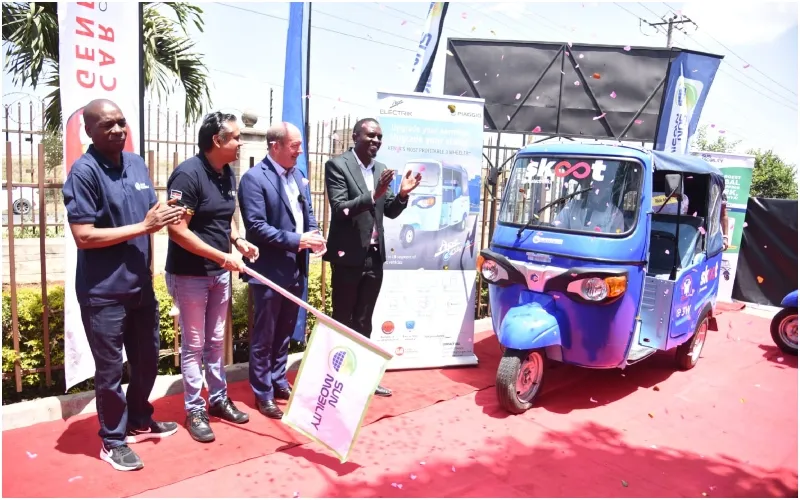
But that familiar sound, and the accompanying puff of diesel smoke, is being replaced by a quiet, digital-first hum.
The launch of the Skoot e3W, a smart electric tuk-tuk, marks a significant shift in Kenya’s transport landscape.
It is not just a new vehicle, but a strategic alliance between Scoot Technology, SUN Mobility, and Car and General (C&G) aimed at solving the three biggest hurdles to going green: cost, charging downtime, and reliability.
Turning fuel into profit
For the average driver, the transition to electric is motivated by financial considerations, not just environmental concerns.
George Rubiri, General Manager at Car & General, is clear about the benefits: “You are able to save 20–30% directly on fuel costs.”
The figures support his claim. A typical driver covers 150 km daily. On diesel, this costs roughly KSh 850. With the Skoot e3W and SUN Mobility’s energy network, the same distance costs about KSh 650.
Beyond fuel, the total cost of ownership decreases because electric motors do not have the complex oil filters and gaskets that frequently fail in combustion engines.
To address the high upfront cost of EVs, Scoot has introduced a “Buy to Earn” model. Drivers can pay a deposit of 20–25% to own the vehicle or choose flexible daily leases starting at KSh 1,200, which include maintenance.
“It is a smarter way to earn more daily,” said Sacha Cook, CEO of Scoot, in an exclusive interview with News Nine.
Solving the “Battery Headache”
The “Achilles’ heel” of electric mobility has always been the battery, which is expensive to purchase and slow to charge. The partnership addresses this by decoupling the vehicle from the power source.
SUN Mobility serves as the “fuel station” for the electric age. Instead of waiting hours to charge, drivers visit a “Swap Point” and exchange a depleted battery for a fully charged one in under three minutes – faster than refuelling with petrol.
“We sell energy and rent the battery. The rider does not buy the battery; it remains our responsibility to maintain and stock,” explains Gaurav Anand, Sun Mobility’s Country Head.
With 10 stations already operating in Nairobi and a plan to reach 200 stations by the end of 2026, the “range anxiety” that once troubled early adopters is disappearing.
The e3W is equipped with two batteries, offering a range of 100–120 km, and has been specifically adapted for Kenya’s rugged road conditions.
Green energy for a green grid
The environmental case for Kenya’s transition is particularly compelling. Unlike many Western countries that depend on coal, Kenya’s grid is over 90% renewable, powered by geothermal, wind, and hydroelectric sources.
“The country spends a lot of foreign exchange importing oil. Going electric means we use energy generated right here in Kenya,” said Rubiri.
For both driver and passenger, the difference is tangible. There is no smell of diesel, no vibration, and near silence.
As urban populations grow, Sacha Cook observed that this is the only viable path forward.
“Pollution is a negative aspect… we are introducing a product that can help clean the cities,” he said.
With Kenya’s new National Electric Mobility Policy set to launch in 2026, the Skoot e3W is no longer a pilot – it is the new standard for Kenyan roads.











Discussion about this post