


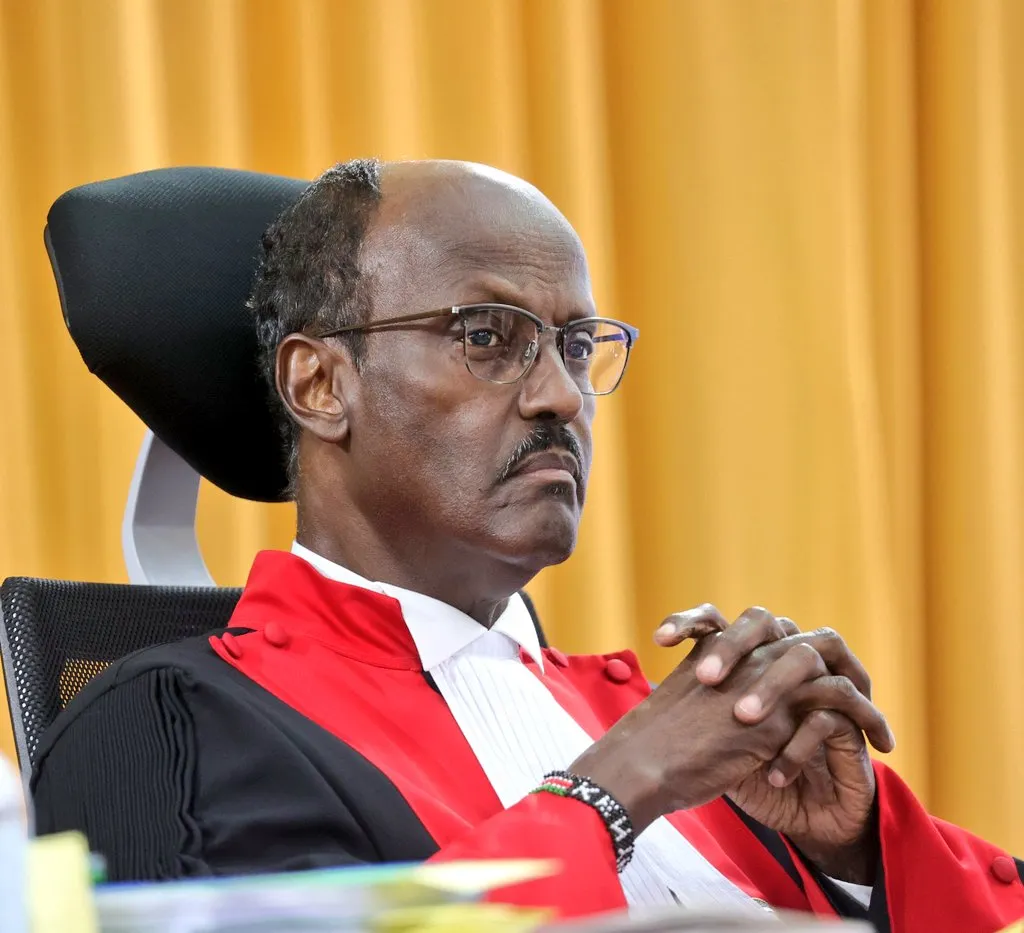
Justice Mohammed Khadhar Ibrahim was a distinguished jurist whose career reflected deep commitment to justice, constitutionalism and inclusion. His passing while serving as a sitting judge of the Supreme Court of Kenya marked both a moment of national mourning and a constitutional transition guided by clear legal processes.
Justice Ibrahim was appointed a judge of the inaugural Supreme Court of Kenya on June 16, 2011, following an open and competitive interview process under the 2010 Constitution. He served on the apex court until his death, contributing to landmark decisions on constitutional interpretation, electoral justice, and governance.
In addition to his judicial role, Justice Ibrahim held key institutional responsibilities. He served as Chairperson of the Judiciary Committee on Elections after his appointment on August 16, 2021, and was elected on May 17, 2022, to represent the Supreme Court on the Judicial Service Commission. These roles reflected the confidence placed in his judgment, experience and leadership within the Judiciary.
Justice Ibrahim studied law at the University of Nairobi before entering private practice. He joined Waruhiu & Muite Advocates in November 1982 and was admitted to the Roll of Advocates on January 11, 1983, becoming the first Kenyan of Somali heritage to be admitted to the Bar. He rose through the ranks to become a salaried partner in 1985 and a full partner in 1987 before establishing Mohammed Ibrahim & Associates in 1994. The firm later evolved into Ibrahim & Isaack Advocates, specialising in civil and constitutional litigation, banking, commercial and company law, property, conveyancing, insurance and bankruptcy matters.
Throughout his legal career, Justice Ibrahim demonstrated a strong commitment to social justice and equality before the law. He invested both professionally and personally in advancing the rights of minority communities, particularly challenging policies that discriminated against Kenyan Somalis, including the use of secondary identity documentation that undermined equal citizenship.
His dedication to justice extended to pro bono work and community service. In July 1990, during the one-party era, Justice Ibrahim was detained without trial and held in solitary confinement at Kamiti Prison for one month after providing legal advice and support to pro-democracy advocates. The experience became a defining chapter in his lifelong advocacy for constitutional freedoms and human dignity.
Justice Ibrahim was appointed a Judge of the High Court of Kenya on May 22, 2003. He served in the Civil and Commercial Divisions at Milimani Law Courts before joining the Judicial Review and Constitutional Division in 2004. He later served as Resident Judge in Eldoret, presiding over matters across the North Rift Valley and was subsequently posted to the High Court in Mombasa, where he served until his elevation to the Supreme Court.
What happens after the death of a sitting supreme Court Judge
Under Kenya’s constitutional framework, the death of a sitting Supreme Court judge creates an automatic vacancy by operation of law. The Judiciary formally notifies the Judicial Service Commission, which then declares the vacancy and initiates the process of filling the seat in accordance with the Constitution.
The Supreme Court, established under Article 163 of the Constitution, continues to function provided it meets the required quorum of five judges. There is no provision for an acting Supreme Court judge and vacancies can only be filled through a substantive appointment process.
The Judicial Service Commission publicly advertises the vacancy, shortlists qualified candidates, and conducts public interviews to assess integrity, competence, and judicial temperament. The Commission then forwards its recommendation to the President, who formally nominates the candidate for vetting and approval by the National Assembly before appointment and swearing-in.
While the Constitution does not prescribe a fixed timeline for filling the vacancy, prolonged delays may place additional demands on the remaining judges and affect the court’s capacity to handle complex constitutional matters.
As Kenya reflects on the life and legacy of Justice Mohammed Khadhar Ibrahim, the constitutional process ensures continuity, stability and public confidence in the Supreme Court. His contribution to the development of Kenya’s jurisprudence remains part of the foundation upon which the country’s justice system continues to evolve.







Discussion about this post