

KWALE, Kenya – The Kenyan government aims to greatly increase fish production, processing, and value addition for both domestic and international markets to fully realise the potential of the Blue Economy through the Sh2.6 billion Shimoni Fish Port.
The fish port in Kwale County is situated in the Indian Ocean and features a causeway that is 135 meters long and 7 meters wide, as well as a contemporary jetty that is 75 meters by 30 meters. The state-of-the-art building features a special warehouse that functions as a fish processing facility.
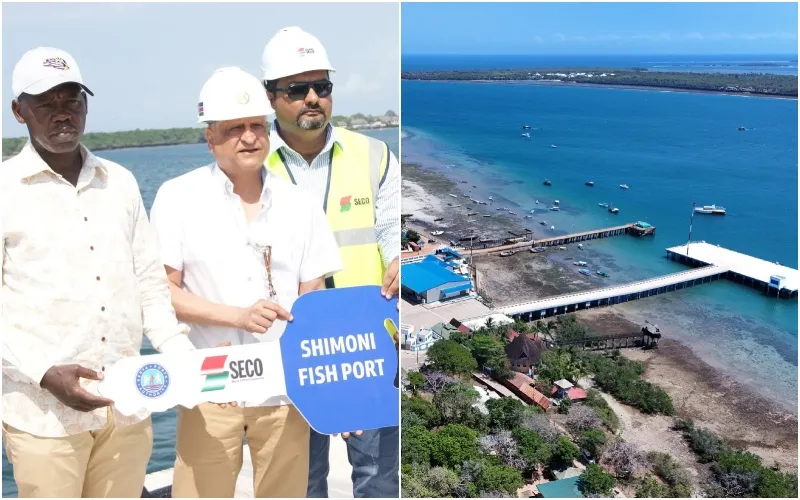
The Shimoni people, who live near Tanzania on Kenya’s southeast coast, rely primarily on fishing for their daily livelihood.
However, due to processing and storage challenges, which lead to resource loss and waste, the community has long been limited to subsistence fishing.
This week, the newly completed fish port reached full operational status as a flagship Blue Economy project, drawing attention from officials, investors and coastal communities.
What are some of the facilities at the Shimoni Fish Port?
Some highlight the facility’s modern fishing infrastructure, export potential and tourism value, while supporters promote it as evidence of economic progress and renewed investment opportunities along Kenya’s southern coast.
The Organisation for Economic Cooperation and Development estimates that by 2030, the traditional maritime economy—of which ports are a part—will have doubled to 3 trillion dollars by “business as usual”.
James Odongo, a resident engineer for the Kenya Ports Authority (KPA), told news9.africa in an exclusive interview that the causeway has a capacity of handling vessels between 60 metres and 70 metres while highlighting the port’s potential.
“The project has created employment opportunities for the locals. For example, fishermen now have access to the facility regarding their fish, which are processed locally,” explained Odongo, adding that the port also has a fish auction market to help the local community.
The engineer disclosed that during the construction of the port, KPA employed approximately 60% of the local community, and the expertise and skilled staff who were unavailable from the local community constituted about 40% of the project.
According to Interior Principal Secretary Raymond Omollo, “The now-complete transformation of Shimoni Port stands as a strong testament to President William Ruto’s commitment to revitalising Kenya’s fisheries sector and advancing the Blue Economy as a key pillar of national growth.”
“Implemented and now fully managed by KPA, the modernised port has shifted Shimoni from traditional fishing practices to a structured, efficient and sustainable marine economy,” said PS Omollo.
Why are the facilities at the Shimoni Fish Port essential?
Additionally, the facility features a modern fish landing and processing complex, cold storage infrastructure, ice production, upgraded administrative offices and jetties that separate commercial fishing activities from public use, ensuring safety, hygiene and operational efficiency.
“With value addition at its core, the port supports cold-chain preservation, fish processing and responsible waste management, significantly improving product quality, market access and incomes for local fishing communities,” the PS added.
Community storage warehouses and improved sanitation facilities further strengthen trade and working conditions for fishers and traders, according to PS Omollo.
In October 2025, the port on Kenya’s South Coast docked its first-ever cruise vessel, SH Diana, marking a milestone for the recently completed port.
The luxury cruise liner, carrying 249 passengers, made her inaugural voyage to the port, where she was warmly received by port officials, county leaders, and tourism stakeholders.
The tourists had an opportunity to enjoy a range of renowned Kwale attractions along the south coast, whose beaches have been ranked as the ‘Best in Africa’ for five consecutive years by the World Travel Awards.
Inside Kwale County’s cruise tourism
These included excursions to Kisite Mpunguti Marine Park and Reserve, Wasini Island and other historical sites along the coastline.
KPA Acting Manager for Corporate Communication, Dave Jones Buchere, representing the Managing Director, Captain William Ruto, commended the landmark docking.
“Shimoni Port has elevated Kwale’s potential for cruise tourism, reflecting the government’s commitment to expanding the sector, which is among the fastest-growing tourism segments in the country,” said Buchere.
Buchere further emphasised that the facility has stimulated job creation, investment in hospitality, and community-based tourism initiatives that will uplift the livelihoods of residents, given the port’s strategic position near the marine parks and islands.
SH Diana became a regular caller to Kenya’s coast, with annual visits to the ports of Mombasa and Lamu. This marked her first call to Shimoni, enhancing the South Coast’s profile as a cruise tourism destination.
Kenya’s plan to expand the Blue Economy potential
The welcoming ceremony brought together key players in the tourism industry: representatives from the County Government of Kwale, led by Kwale Governor Fatma Achani; the Kenya Wildlife Service (KWS); and other government agencies.
Ali Fadhili, a fisherman from Mkwiro, a village on the eastern side of Wasini Island, told news9.africa that ports like Shimoni are essential to the long-term growth of this maritime economy through their numerous functions as landlords, operators, regulators, and environmental stewards.
“The Shimoni Fish Port contributes to the sustainable growth of the maritime economy not only in our region but in Kenya as a whole by fulfilling these functions within the framework of a public-private partnership,” explained Fadhili.
The Kenya Kwanza Bottom-Up Economic Transformation Agenda (BETA) Plan targets expanding the contribution of the Blue Economy value chains to the country’s Gross Domestic Product (GDP) from Sh 37 billion currently to Sh 80 billion annually by the end of 2026 and thereafter to Sh 150 billion by 2027.
Mining, Blue Economy, and Maritime Affairs Cabinet Secretary Ali Hassan Joho said the port is one of the strategic projects in “our efforts to leverage the blue economy sector as the new frontier in the country’s economic transformation”.
Fish ports serve as environmental champions
For her part, Principal Secretary, State Department for the Blue Economy and Fisheries, Ministry of Mining, Blue Economy and Maritime Affairs, Betsy Njagi, stated that the Shimoni Fish Port is harnessing the potential of the blue economy by enhancing fish production, processing, and value addition for both domestic and export markets.
“The Shimoni Fish Port is part of a broader initiative to develop several fish landing sites in the coastal region supporting the livelihoods of thousands of households relying on the fishing industry,” the PS explained while on a project tour.
When reached for comment, Kwale County Commissioner Stephen Orinde said the Shimoni Fish Port is a major government project in the region, located within the Lunga Lunga sub-county.
“One of the main economic activities of the Kwale people is fishing. Today, the fish landing port allows fish to be processed and exported,” said Orinde.
news9.africa has established that ports such as the Shimoni Fish Port can also serve as environmental champions by using innovative technologies and collaborations with business partners and communities to protect and enhance coastal ecosystems, which are mutually beneficial to the economy, the environment, and communities.
This helps to support new and emerging activities such as developing resilient coastal infrastructure, aquaculture, and marine technology.
“As operations continue, the State Department for Internal Security and National Administration plays a key role in securing the maritime border environment around Shimoni, supporting safe port operations, curbing illegal activities and safeguarding livelihoods along Kenya’s southern coastline,” PS Omollo added.








Discussion about this post