


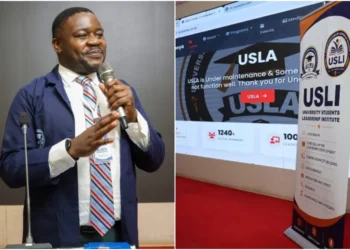
NAIROBI, Kenya – The Universities Student Leaders Association-USLA has embarked on an ambitious program of empowering future leaders.
Albert Maloba, the Chairman and Chief Executive Officer (CEO) of USLA, says the future belongs to leaders who are innovative, ethical, visionary, and prepared.

“At USLA, we are developing the next generation of Leaders, economists, scientists, innovators, entrepreneurs, high-level diplomats, policymakers, business leaders, public servants, and global changemakers through leadership development and mentorship,” says Maloba.
This comes as USLA Secretariat Reps and the Information Technology Department continue working around the clock to advance the integration of Virtual Reality (VR) technology into the University Student Leadership Institute Curriculum Training Systems.
Last week, the team held a highly productive engagement with Prof. Eng. Jean Bosco Byiringiro (PhD, Reg. Eng.), Professor of Mechatronics Engineering, Founding Director of the Siemens Centre, and Founder of the Virtual Reality (VR) Lab at Dedan Kimathi University of Technology.
Inside the USLA highly productive engagement
Maloba disclosed that the meeting focused on developing an innovative curriculum to support immersive leadership training for young leaders using emerging technologies.
“Discussions centered on leveraging Virtual Reality (VR), Artificial Intelligence (AI), Digital Twin technologies, and Industry 4.0 solutions to create practical, interactive, and globally competitive leadership development experiences for university students and young professionals,” explained Maloba.
He reiterated that the engagement marks a significant milestone in USLA’s vision of building a future-ready generation of leaders equipped with the skills, knowledge, and technological competence required to navigate the rapidly evolving global landscape.
“USLA remains committed to transforming comrades’ power through leadership, mentorship, innovation, technology, and strategic partnerships with institutions of higher learning and industry leaders,” he further said.
The difference between various online platforms
Maloba also observes that not all content online follows the same system.
“Some platforms are freely accessible because they are built on an attention-driven model, where time, clicks, and engagement become the real currency. Others, like Netflix, operate on a subscription model where value is exchanged directly through payment, leading to more structured and intentional viewing,” he explained.
In real life, Maloba notes that this difference is easy to observe.
“Unrestricted content often encourages endless scrolling and unplanned consumption, while paid platforms tend to create more mindful and selective viewing habits,” Maloba adds.
The key lesson Maloba emphasises is simple:
“What we consume regularly shapes our mindset, discipline, and direction in life. Attention is one of the most powerful assets a person has, and it must be protected with intention. Choose content that strengthens your focus, supports your growth, and builds your future.”







Discussion about this post