


NAIROBI, Kenya – The Universities Student Leaders Association (USLA) has called upon the government and other educational stakeholders to move with speed and urgently address the mounting wave of secondary school unrest and arson incidents.
A wave of violent student unrest and suspected arson attacks has swept across secondary schools in Kenya, leading to property damage, mass closures, and a tragic fire at Utumishi Girls Academy that claimed 16 lives.
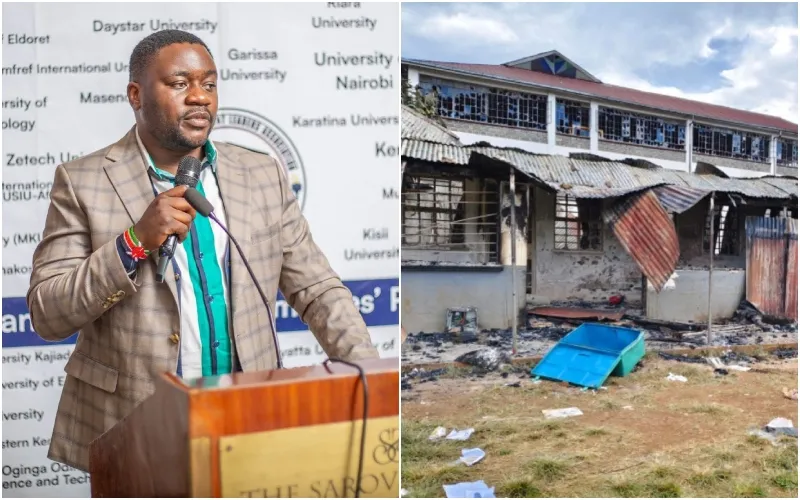
In a statement, Albert Maloba, the Chairman and Chief Executive Officer (CEO) of USLA, urged the Government of Kenya, Parliament, county governments, educational institutions, parents, religious organisations, civil society, student leaders, and all political actors—including both the Government and the Opposition—to place the safety and future of learners above political divisions.
“The education of our children must be a unifying national agenda. Studies conducted globally have consistently demonstrated that comprehensive student support systems can reduce disciplinary incidents by up to 30%, while strong mentorship and counselling programmes significantly improve learner well-being, school engagement, and conflict prevention,” Maloba said.
Similarly, Maloba observed that investment in school safety infrastructure and emergency preparedness has been shown to substantially reduce risks associated with fires and other emergencies.
USLA expresses sorrow over arson incidents
USLA, representing student leaders and young professionals across Kenya’s institutions of higher learning, expressed profound sorrow and concern over the recent fire incidents in schools that have led to the loss of young lives, destruction of educational facilities, disruption of learning, and closure of institutions across the country.
“We extend our deepest condolences to the families, friends, schools, and communities that have lost their beloved children. No parent should have to bury a child whose only mission was to attend school and pursue an education. We stand with all affected families during this painful period and pray for healing, comfort, and strength,” added Maloba.
As a nation, Maloba observed that there is a dire need to acknowledge that every school fire represents more than the destruction of buildings.
“It is a signal that demands deeper reflection on the state of our education system, student welfare structures, mental health support mechanisms, leadership engagement, and institutional preparedness. The closure of schools following these incidents, while necessary in certain circumstances, disrupts learning calendars, affects academic performance, increases anxiety among learners, and places additional burdens on families,” explained Maloba.
He noted that it is, therefore, imperative that preventive action become the primary national focus rather than reactive interventions after tragedy has occurred.
What reforms USLA wants in schools
In light of these realities, USLA proposed the following national actions:
- 1. Establish a National Student Safety and Well-being Framework. A coordinated framework should be developed to integrate safety, mental health, student welfare, leadership development, and emergency preparedness across all learning institutions.
- 2. Increase Investment in Guidance, Counselling, and Mental Health Support
- 3. Strengthen Student Representation and Dialogue Mechanisms. Every institution should have accessible professional counselling services. We recommend that at least 10% of student welfare budgets be dedicated to psychosocial support, mentorship, and preventive interventions. Students should be engaged as partners in education rather than passive recipients of policy decisions. Constructive dialogue platforms can help identify concerns before they escalate into crises.
- 4. Modernise School Safety Infrastructure: All schools should undergo periodic fire safety audits, install functional emergency systems, improve dormitory safety standards, and conduct regular emergency response drills.
- 5. Expand National Mentorship Programs. Kenya possesses thousands of professionals, academics, innovators, entrepreneurs, public servants, and community leaders willing to mentor learners. This resource should be systematically mobilised to support young people.
- 6. Review the Emerging Challenges Facing Learners. The digital age presents new realities, including social media pressures, mental health challenges, identity concerns, economic uncertainties, and rapidly changing career pathways.
“Your future is too valuable to be sacrificed through acts of destruction, violence, or despair. Schools are not merely buildings; they are gateways to opportunity, leadership, innovation, and national transformation. We encourage every learner to choose dialogue over destruction, responsibility over recklessness, and leadership over reaction,” the statement further reads.
Maloba reiterated that as student leaders who have successfully navigated the education system, they understand the challenges learners face.
“We also know that every challenge can be addressed through conversation, support, mentorship, and collective problem-solving. The Universities Student Leaders Association further commits itself to being part of the solution. As a national student union bringing together individuals from diverse academic and professional backgrounds, including education, engineering, medicine, law, psychology, business, technology, governance, social sciences, and community development,” said Maloba.
How USLA plans to partner with education stakeholders
Maloba indicated that USLA is ready to partner with government agencies, schools, faith-based institutions, development partners, and communities to provide the following:
- 1. Student mentorship programs.
- 2. Career guidance and exposure forums.
- 3. Leadership development initiatives.
- 4. Peer counselling and psychosocial support advocacy.
- 5. Civic education and values-based leadership training.
- 6. Community engagement and youth empowerment programs.
He emphasised that the future of Kenya will not be built by policies alone.
“It will be built by a collective commitment to raise a generation that is educated, emotionally resilient, morally grounded, innovative, and patriotic. This moment calls for action rather than blame, collaboration rather than division, and long-term solutions rather than temporary reactions,” explained Maloba.
USALA, through Maloba, also explained that in the spirit of togetherness, there is a need to protect learners, strengthen schools, support educators, empower parents, and build an education system worthy of the dreams of every Kenyan child.










Discussion about this post