


KWALE, Kenya -In order to raise awareness about elephant protection, a group of conservationists are leading a conservation campaign called the “East-South of Africa Elephant Awareness and Campaign Walk”.
The journey that started in Mombasa, on August 16, 2025 is being spearheaded by Jim Justus Nyamu.
The goal of the roughly 130-day multi-country walk, which was organised under the hashtag “#IvoryBelongstoElephants,” is aimed at promoting elephant conservation and stop the illegal ivory trade.
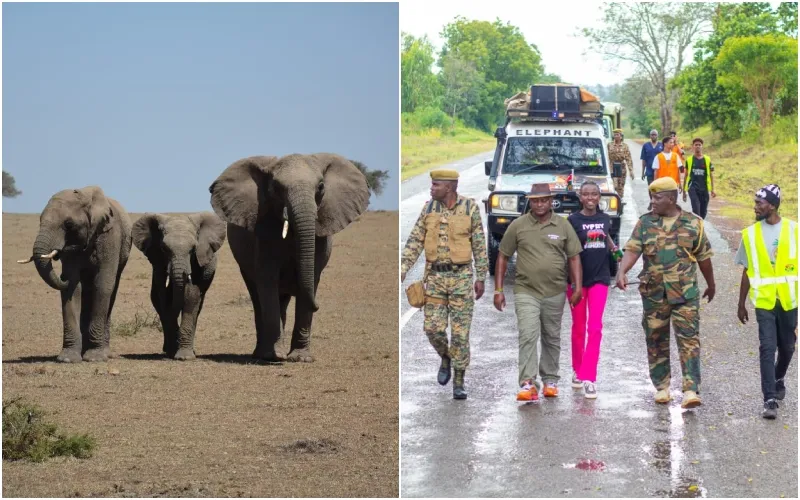
News Nine knows that the journey started in Mombasa, travelling through Tanzania and Mozambique, and is sent to end in Gonarezhou National Park in Zimbabwe.
Kenya Wildlife Service (KWS) is supporting the 3,900 km walk championed by Nyamu aimed to raise awareness on the critical role of elephants in our ecosystems, the threats of poaching, and the urgent need to mitigate human–elephant conflict.
This ambitious 150-day campaign walk, crossing seven critical elephant habitats and connecting diverse ecosystems, underscores the importance of protecting landscapes where elephants and communities coexist.
“In collaboration with grassroots partners, the walk advances cross-border conservation and strengthens a united African voice for elephants. Join us in fostering human–wildlife coexistence and safeguarding Kenya’s rich wildlife heritage by standing together for the jumbos!” KWS said in a statement.
What happened during the official flagging off of the walk
During the official flagging off of the walk, Nyamu termed the event a historic milestone in elephant conservation.
“The launch was filled with unity, and purpose, as we took our very first steps in this monumental journey,” said Nyamu.
On the day 13 of the walk, Nyamu said everyone has a responsibility to protect endangered species, both for their sake and for the sake of our own future generations.
“The hope of sustainable future trials lies not in curbing the influence of human understanding and aspirations that it is already too late for that, but in creating a better understanding of the extent of that influence and a new ethic for its #governance and change in #perceptual understanding. It’s in our hands for any execution!” Nyamu further said.
Nine News has established that the 3,900 km walk, set to take place over 150 days, has so far covered 114 km from Mombasa, with 16 community meetings held across Mombasa and Kwale counties.
How the Jim Justus Nyamu’s team will cross over to Tanzania
The team is now approaching Tanzania through the Lunga-Lunga Horo Horo border point.
The community engagements focused on raising awareness about human–elephant coexistence and promoting positive interactions between people and elephants.
“Let’s all walk the talk and commit to safeguarding our rich wildlife heritage for future generations,” a statement from KWS reads in part.
In Lunga Lunga, the team was officially flagged off from Perani on its route to Lunga Lunga road by Assistant County Commissioner AbdiKadir and Park Warden a one Mr. Mohammud at the KWS offices.
The Lunga Lunga road is a vital coastal route that winds up through Kwale County towards the Kenya-Tanzania border.
“The weather was a bit chilly at the start as it was drizzling but after a few steps the sun was out and we were on the move. The smooth tarmac, proper drainage and beautiful trees along the road made our walk safe and more vibrant with the cool music playing behind us,” Nyamu further said.
What is the current state of elephant conservation in the region
News Nine understands that the team made two impactful stopovers at Perani Market and Lunga Lunga Market where they shared conservation messages, and felt the warm embrace of the people who joined us along the way.
“We now proceed to the border where we are crossing over to Tanzania continuing this journey of raising awareness and championship Conservation .Every step is a reminder that,” explained Nyamu, the leader and founder of Ivory Belongs to Elephants Campaign Walk.
Community-based conservation, habitat connectivity, human-wildlife interaction, and reducing risks like habitat degradation and poaching are the main focusses of elephant conservation in East and Southern Africa.
Creating ecological corridors to connect protected areas, lowering human-elephant conflict through better land use and community benefit initiatives, and including local communities as collaborators in conservation initiatives are important tactics.
These strategies, which also include scientific study, monitoring, and the creation of protected areas, are being carried out by organisations like the WWF and the South African government.











Discussion about this post