


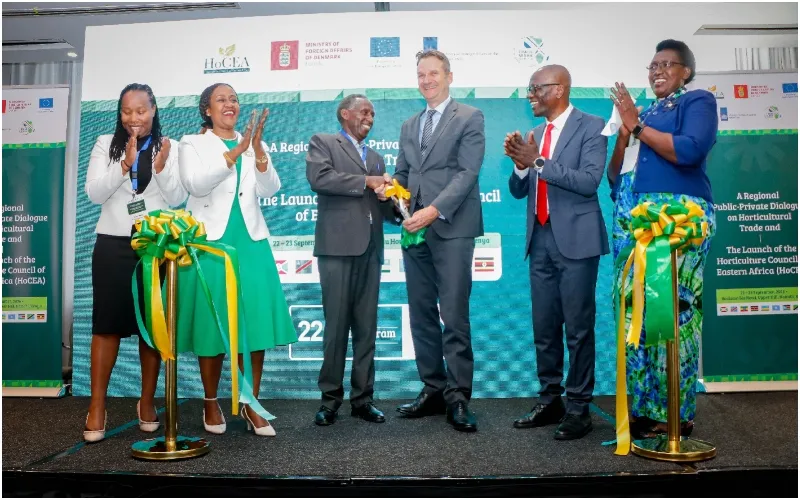
NAIROBI, Kenya – The Kenyan government has called for stronger regional cooperation to unlock Eastern Africa’s horticulture trade potential, as the Horticulture Council of Eastern Africa (HoCEA) was officially launched in Nairobi.
Representing the Principal Secretary, State Department for Trade, Matthew Komen, Deputy Director for Internal Trade at the State Department of Trade, said the challenges affecting horticultural trade could not be addressed by individual countries or businesses acting alone, calling for coordinated public-private action at the regional level.
“These challenges cannot be resolved by any single country or firm acting alone. They demand coordinated public-private action at the regional level,” Komen said.
The launch took place during the Regional Public-Private Dialogue on Horticultural Logistics and Trade Facilitation, bringing together government representatives, national horticulture associations, private-sector leaders, development partners, logistics and cold-chain operators, regulators and regional institutions from across Eastern Africa.
HoCEA brings together horticulture associations from nine Eastern African countries under the theme “Nine Countries. One Region. One Vision.”
The Council is intended to provide the sector with a unified regional voice on issues that transcend national borders and to strengthen coordination on trade, logistics, market access, investment and sustainability.
The government outlines priorities for horticulture competitiveness.
Representing the Government of Kenya, Komen highlighted horticulture’s contribution to foreign exchange earnings and employment, particularly for women and young people.
Kenya exports approximately 467,000 metric tonnes of horticultural produce valued at about US$1.143 billion annually, according to the government remarks delivered at the launch.
The government outlined several areas of action to strengthen the systems supporting horticultural trade, including:
- • Expanding cold-storage capacity along the Northern Corridor and at Inland Container Depots;
- • Strengthening single-window systems and electronic cargo tracking;
- • Expanding the use of Authorised Economic Operator (AEO) programmes; and
- • Translating trade agreements, including the EU–Kenya EPA, UK–Kenya EPA, UAE CETA and AfCFTA, into practical export growth
Komen also emphasised the need for Eastern Africa to retain greater value from its horticultural production through processing, packaging, branding and other forms of value addition, rather than focusing primarily on raw commodity exports.
The government subsequently formally declared the Horticulture Council of Eastern Africa officially launched and called on HoCEA and stakeholders to develop an actionable regional roadmap with clear timelines, institutional responsibilities and mechanisms for monitoring progress.
Development partners back regional coordination and measurable results.
Development partners supporting the initiative emphasised that regional coordination must translate into practical improvements across the horticulture value chain.
Anataria Uwamariya, Director of Business Competitiveness at TradeMark Africa, noted that global and regional shocks, including the COVID-19 pandemic, the Ukraine-Russia conflict and rising logistics costs, had underscored the importance of regional collaboration.
She highlighted four areas requiring greater attention: logistics efficiency, climate-smart and resilient supply chains, digital trade adoption, and integration of horticulture into the AfCFTA framework.
Edwin Chachi, Programme Manager at the Royal Danish Embassy, stressed that green logistics, effective cold chains and environmental considerations need to be incorporated into commercial strategies from the outset. He also called for HoCEA to establish concrete, time-bound priorities and deliver measurable results for farmers and exporters.
Representing the European Union Delegation to Kenya, Rodrigo Romero Van Cutsem, Connectivity Team/Investment Officer, highlighted the importance of strengthening competitiveness across the entire horticulture value chain, including cold chains, warehousing, SPS compliance, quality infrastructure and the transition from air to sea freight where it is commercially viable.
He also highlighted the Northern Corridor as a critical trade artery connecting Kenya, Uganda and Rwanda to global markets.
Henk Jan Bakker, Ambassador of the Kingdom of the Netherlands to Kenya, highlighted the complementarity between Eastern Africa’s horticultural production capacity and the Netherlands’ expertise in logistics and greenports.
He also pointed to the EU–Netherlands co-financed FRESH (Fostering Resilient Exports in
Sustainable Horticulture) programme, which is supporting cold-chain infrastructure, digital corridors and sustainable transport along the Northern Corridor.
HoCEA to provide a unified regional voice
Speaking at the launch, HoCEA Chairperson Dr. Jacqueline Mkindi said the Council would build on the expertise of national horticulture associations while providing a collective platform to address challenges that cross borders.
“Our national platforms bring considerable expertise; HoCEA gives us the collective voice to address challenges that cross our borders.”
Mkindi identified several priorities for the Council, including elevating smallholder farmers,
strengthening cross-border trade, unifying the region’s voice in standards and policy negotiations, and catalysing local and international investment.
She called for greater access to markets, finance, technology, knowledge and value-addition.
opportunities for farmers, while emphasising the importance of stronger regional trade and investment.
Five priorities for an integrated regional horticulture ecosystem
HoCEA Secretary General Clement Tulezi, who outlined the Council’s journey from its inception in Arusha in November 2024 through consultations in Entebbe in April 2025 to its formal launch in Nairobi, said the Council brings together nine countries around a shared regional vision.
He outlined five strategic priority areas for the Council:
- • Market access and trade facilitation, including SPS harmonisation and reducing trade barriers;
- • Cold-chain infrastructure and trade corridors;
- • Digital trade, traceability and paperless systems;
- • Inclusive value-chain development, particularly for smallholders, women and youth; and
- • Climate resilience and sustainable production standards.
These priorities reflect the need to address horticultural competitiveness across the entire journey from production to market, rather than treating individual trade and logistics challenges in isolation.
Regional cooperation to strengthen market power
The launch also featured a special regional leadership conversation examining why Eastern Africa needs a unified horticulture platform. Industry leaders from Kenya, Ethiopia, Rwanda, South Sudan and Burundi highlighted the importance of greater regional cooperation in building market power and improving the movement of horticultural produce.
The discussion highlighted the potential of aggregating regional volumes to create greater negotiating power in global markets, alongside the need to streamline border procedures, establish joint cargo consolidation centres, strengthen SPS capacity and connect emerging producers and smallholders with international buyers and logistics infrastructure.
The discussions come at a time when horticulture is increasingly shaped by the efficiency of the systems that connect producers to markets. Improving cold chains, border processes, digital systems, standards compliance and trade corridors therefore has implications not only for exporters but also for farmers, logistics providers and other businesses across the value chain.
From dialogue to action
The two-day regional dialogue is designed to move beyond identifying challenges towards practical action. Sessions are examining AfCFTA market access, trade logistics and cold-chain competitiveness; digital trade and smart horticulture corridors; air-to-sea freight, SPS measures and harmonisation; non-tariff barriers and regional trade facilitation.
The second day will focus on translating the priorities emerging from these discussions into a Nairobi Horticulture Action Roadmap, followed by validation of the roadmap and consideration of a Nairobi Communiqué outlining priority actions, institutional responsibilities and proposed timelines.
For HoCEA, the objective is to ensure that the launch becomes a starting point for sustained regional engagement and measurable progress.
The dialogue continues through 23 September 2026, with stakeholders expected to define the practical priorities and responsibilities needed to strengthen Eastern Africa’s horticultural trade, improve competitiveness, attract investment and create greater opportunities across the regional value chain.






Discussion about this post