BARINGO, Kenya – Stung by human activities that favour economic gain over the preservation of traditional medicinal biodiversity, a local community in Baringo County has moved to save Kamngoin Conservancy, located on the outskirts of Kabarnet Town.
The Kamngoin Conservancy, which embodies the idea that “trees are more important than houses”, is a beautiful beacon of conservation tucked away in an urban context.
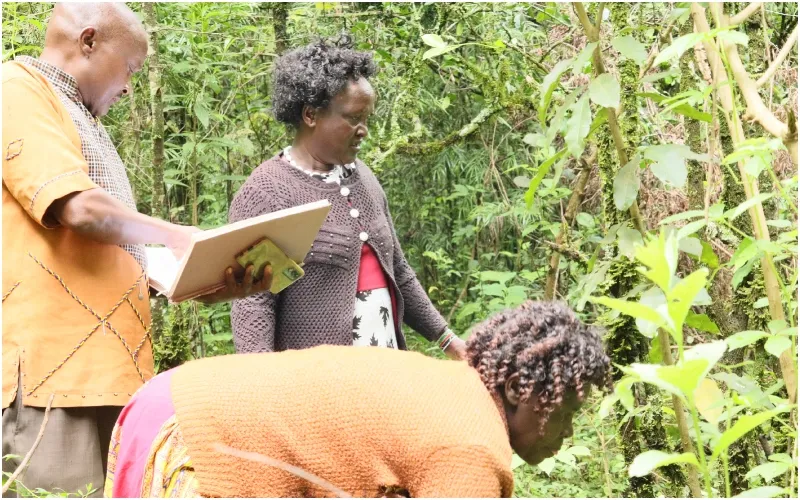
Herbalists search for traditional medicine at the Kamgoin Conservancy in Baringo County. Photo by Dennis Lubanga.
This special conservancy is more than just a preserved piece of land; it is a living example of the Kamgoin community’s deeply ingrained customs and knowledge, where culture and nature coexist in harmony.
The elders of the Chelagat Porkibir, Kurware Kipsetim, Chepng’orim Chepyegon, and Cheptogoch Chepkangor clans have long fiercely guarded the Kamngoin Forest as a sacred area.
These forest stewards have long understood that the forest is more than just a group of trees; it’s a source of resilience, culture, and life, and they acknowledge its critical role in the community’s well-being.
An estimated 90% of Kenyans rely on traditional medicines for primary healthcare, demonstrating the profound cultural roots of herbal therapy. These native plants, which come from the nation’s great biodiversity, are essential for treating ailments, especially in remote areas where access to traditional clinics may be restricted.
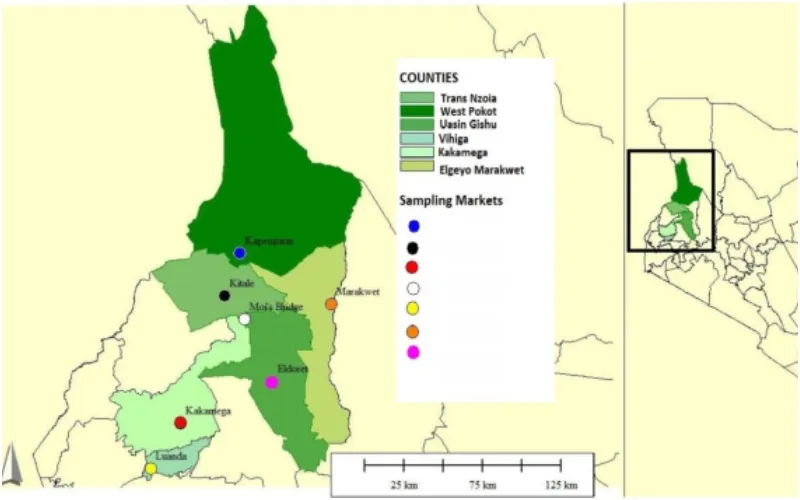
The governance of traditional medicine and herbal remedies in the selected local markets of Western Kenya | Journal of Ethnobiology and Ethnomedicine | Springer Nature Link.
Today, the locals, who make up the majority of herbalists in the region, have ensured that the Kamgoin forest remains a flourishing haven. They are aware that the forest serves as a granary for vital crops like millet, a haven during clan disputes, a source of herbal medicines, and a source of pure springs used for rituals and cleansing.
It is worth noting that the loss of herbal medicine due to the expansion of exotic forests is a critical environmental and healthcare issue, particularly in regions where indigenous plants are being replaced by fast-growing commercial species.
How the government supports the conservation of Kamgoin
For a long time, the government has played a pivotal role in supporting Kamgoin’s conservation initiatives. From capacity development to providing essential infrastructure like water tanks, chain-link fencing, and beehives, these partnerships have been instrumental in sustaining the conservancy.
For centuries, the use of herbal medicinal products and supplements has increased tremendously, with most people relying on them for some part of primary health care. Despite the adoption of a modern health system in Baringo County, the majority of the locals still prefer seeking medical care from the herbalists.
However, the herbal medicines, which were once plentiful, can hardly be found these days. This is attributed to the degradation of natural resources as a result of rising population and human activities, including logging for charcoal.
Jonathan Kiplagat, a respected herbalist with over 40 years in the trade, states that the trees, mainly classified in the herbal category, have been destroyed. Kiplagat says locals have been removing indigenous plants from their settlements and growing exotic trees like cypress and blue gum for commercial purposes because they mature faster.
It's a multimillion-dollar industry.
The global herbal medicine market is worth roughly 87 billion dollars today. It is growing at over 20 percent a year faster than oil, faster than banking.
Like other herbalists in the region, Kiplagat, who is in his 70s and who has been forced to crisscross other counties like Elgeiyo Marakwet, Nandi and Kericho in search of herbal medicines, says that government forests were the only places where one could get the medicinal trees for extraction.
“Most of our natural forests are not fenced, and this exposes them to intruders who destroy indigenous trees and encroach on forest land. In the process, medicinal plants that are rare to find are destroyed,” says Kiplagat, who doubles as the secretary-general of the Baringo County Herbalists Association.
Some of the endangered tree species in Kamgoin Forest?
But now, with two volunteer rangers and 120 active members, the 35-acre Conservancy is a vital component of the community’s environmental and cultural preservation because these initiatives benefit 672 members of the community. Men, women, and young people work together to drive Kamngoin’s conservation efforts under the guidance of elders.
Kiplagat further says that some of the vital trees that no longer exist in the locality include the murguiywet (Anacardiaceae), whose leaves are used to make concoctions to treat skin rashes and coughing in children. Patients from as far as Nairobi, Kisii, Kisumu, Trans Nzoia and Kericho counties travel to Baringo to seek their services.
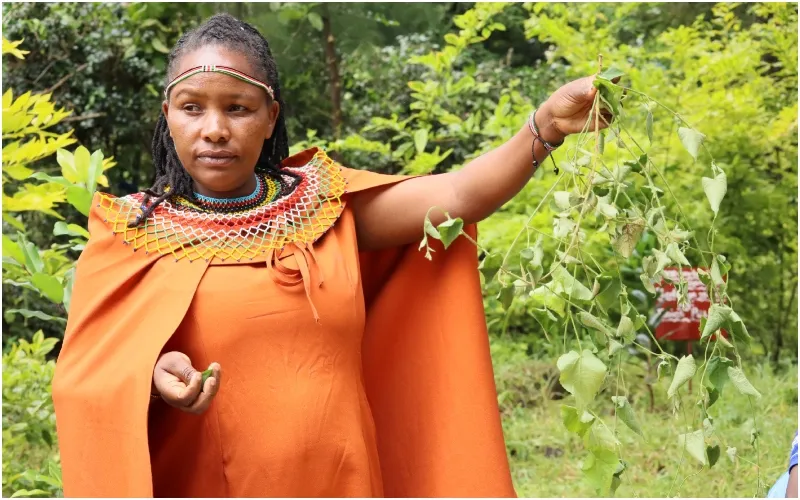
Naturalist, herbalist, and trail guide Esther Chepkurui displays a fresh traditional medicine at the Kamgoin Conservancy in Baringo County. Photo by Dennis Lubanga.
The World Health Organisation (WHO) seeks to improve health and save lives by guaranteeing the safety, effectiveness, and appropriate use of all medications, including complementary and alternative therapies. Additionally, WHO promotes fair and long-term access to necessary medications, especially for the underprivileged and impoverished.
According to the Baringo County Herbalists Association, over 4,000 traditional home medicine men and women have found it impossible to access government forests to extract the medicine following the implementation of the environmental policies, which banned the encroachment of forests in the country.
Inside Kamgoin’s conservation of indigenous knowledge
Naturalist, herbalist, and trail guide Esther Chepkurui revealed that although she is still young, she brings the medication from the forest(s) and supplies it to her clients, who deliver it to patients in different parts of the country.
“From time immemorial, our communities have kept indigenous knowledge, which is transferred from generation to generation. These communities are trying to develop associations and documents so that we don’t lose indigenous knowledge. So, the conservancy model is handy to further their efforts in conserving and making sure this rich diversity of plants in Baringo flourishes; it helps improve the health of our people and also helps generate income,” Chepkirui further explained.
She disclosed that the sustainable exploitation of plants has long been one of the methods employed by indigenous communities.
“However, native plants are in danger due to commercialisation by the herbal industry,” Chepkirui added.
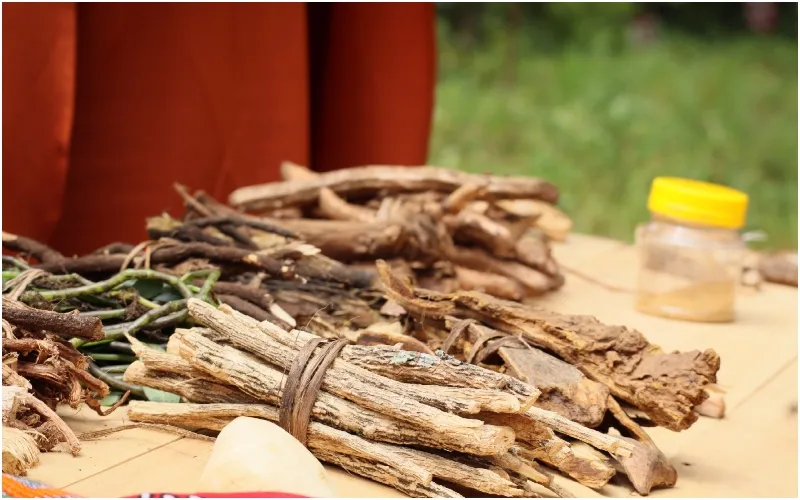
Some of the herbal medicines on display at the Kamgoin Conservancy in Baringo County. Photo by Dennis Lubanga.
Meanwhile, Kiplagat, who doubles as a member of the Herbalists Society of Kenya, disclosed that they are working with owners of tree nurseries by providing them with tree seedlings and planting the trees on their farms so that they don’t run out of herbal trees.
“There is no doubt that herbal medicine is helping many people. I have practised for so many years. I harvested herbal medicine from more than 200 species of trees. We have sensitised our people to embrace herbal medicine,” Kiplagat added.
Endorois community develops a bio-cultural protocol
On the other hand, Susan Jepkemoi, the Chief Executive Officer (CEO) of the Baringo County Conservancies Association (BCCA), disclosed that the organisation is encouraging conservancies to identify critical tree species that are endangered and endemic to the area to be protected for more sustainable use.
“So far, we are happy that the Endorois community has developed a bio-cultural protocol to ensure good access and equitable, accessible utilisation of these natural resources within their area. We are promoting this even within the Pokot and Tugen cultures so that we can have protocols that protect them from exploitation of natural resources,” Jepkemoi explained.
BCCA is stepping into 2024 with a renewed commitment towards community engagement for biodiversity conservation. Guided by our unwavering vision, we strive to contribute towards thriving ecosystems, wildlife and communities. pic.twitter.com/of9nUXPCSC
— Baringo County Conservancies Association (@Bconservancies) January 11, 2024
She also encouraged the local communities to develop tree nurseries and harvest seeds from the indigenous trees.
“With the 15 billion trees target that the government aims to achieve by 2030, I think conservancies stand a high opportunity to be able to venture into the tree nursery business, seed collection and storage, and selling as an enterprise that they can use to also continue maintaining their species and creating income,” Jepkmeoi said.
Jepkemoi also admitted that in Baringo, tree species are almost becoming extinct.
“One of these trees is the African oak and the sandalwood, prevalent many years ago. It is becoming extinct because no tree nursery propagates the particular species. Also, it isn’t easy to get the seeds. So that makes it hard for us to sustain its growth,” she said.
Regulation and integration of herbal medicine by Kenyan MPs
It was revealed in August 2025 that the Kenya Medical Research Institute (KEMRI) would be at the center of the regulation, research, and approval of a new law that would formally include traditional and alternative medicine in Kenya’s healthcare system.
The Kenya Medical Research Institute Bill, 2025, which was submitted by Seme MP James Nyikal, describes a legal framework that would provide oversight to a field that many Kenyans have long used but frequently lacks scientific support or quality control.
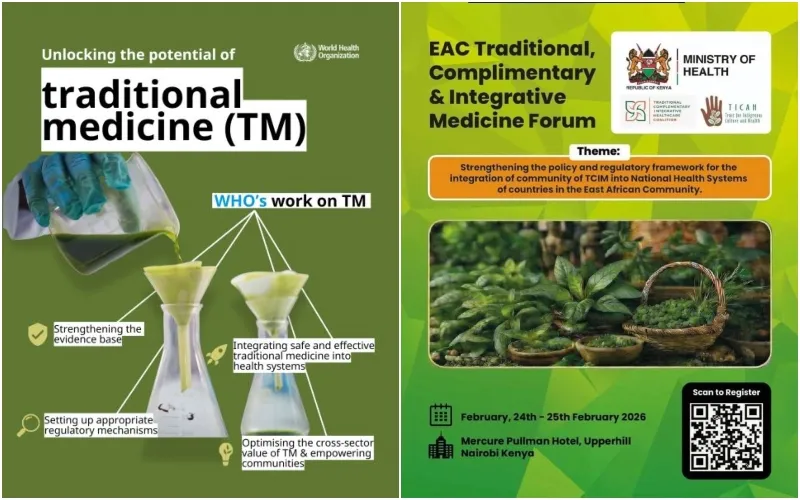
Integration of traditional medicine into Kenya’s primary healthcare. Photo collage – courtesy.
The plan seeks to preserve indigenous knowledge and ensure public safety while incorporating traditional methods into contemporary healthcare.
“The government shall recognise and integrate traditional medicine in a manner that complements the conventional healthcare system,” the Bill states.
If the law is approved, Kemri will be required to carry out biochemical and clinical studies on conventional therapies to confirm their efficacy and safety.
Communities to get organised into community-based organisations
Meanwhile, Jepkemoi reiterated that it is very important to sensitise the local communities to those species with medicinal value that cannot be replaced.
“With the emergence of many complicated diseases in the world, pharmaceutical companies from developed countries are now coming back to Africa to be able to engage communities or landowners to see avenues in which they can utilise this indigenous knowledge and indigenous trees in developing molecules that can help advance the pharmaceutical industry and develop new drugs that can help cope with the emerging diseases,” said Jepkemoi.
Recently, Jepkemoi revealed that, as the BCCA, they were approached by one of the foreign pharmaceutical companies.
“We stood our ground firmly that communities are now organised into community-based organisations that require a very high-level kind of engagement, and any interested industry or company needs to present its case to the target communities, and it’s up to the communities to either agree or disagree on their terms of engagement,” said Jepkemoi.
One million species are in danger due to unsustainable use of nature. This also impacts the livelihoods of billions of people who rely on biodiversity for food, medicine or fuel.
Here are 5 groups of species that are listed as threatened and require our urgent attention.
One thing that BCCA encourages communities to do is that any company that wants to do business with the local communities should prioritise free, informed consent and be able to clearly outline its interests within the community.
She said the community must be given the first say to agree or disagree with the terms. With all hands on deck, Kamngoin Conservancy will continue to be a dynamic, living organisation where cultural heritage is actively conserved, and conservation is a shared responsibility, thanks to this intergenerational cooperation.
Dennis Lubanga is a seasoned journalist with over 15 years experience. He has a rich and extensive focus on politics, climate change, environment, and food security. He has previously held positions at Y News Digial (Editorial Lead), TUKO.co.ke (Current Affairs Editor) and Nation Media Group (News Correspondent). He is affiliated with respected journalism programs such as The Nature Conservancy African Journalism Programme, Thomson Reuters Foundation, and African Uncensored Investigative Journalism Programme. His work has been honored in the Annual Journalism Excellence Awards (AJEA) among other platforms.









Discussion about this post