


NAIROBI, Kenya – A sudden corporate downsizing in December 2023 became the catalyst for 33-year-old Martin Njung’e to build a premier interior finishing empire.

Today, the former front-line salesman sits at the helm of Marnju Investment Company Ltd as its founder and chief executive officer.
His flagship brand, Marnju Tiles, has rapidly evolved from an ambitious startup into a household name for real estate stakeholders in Kenya.
Operating out of Libra House along Mombasa Road, Njung’e has successfully converted a painful career termination into a sprawling, multi-category corporate footprint.
Before stepping out on his own, Njung’e spent more than five years on the front lines selling ceramic tiles for various local manufacturers.
Martin Njung’e notices a severe flaw within the industry
Rather than treating his employment as just a job, he utilised it as an intensive apprenticeship to master the nuances of global raw material sourcing, fragile product packaging, and regional contractor pain points.
“While my contract guaranteed a modest basic salary of Sh26, 400 per month, my focus on relationship-driven commerce earned me huge performance commissions,” said Njung’e.
During his sales career, Njung’e noticed a severe operational flaw within the industry: logistics. High-value buyers spending millions on premium finishes were frequently left stranded for days because internal manufacturer fleets were insufficient.

Instead of letting his clients look elsewhere, Njung’e took a calculated entrepreneurial gamble. He saved his performance bonuses and used them to secure a competitive commercial bank loan. He then bought three commercial delivery trucks to run a quiet side hustle.
Martin Njung’e builds his premier interior finishing empire
When his employer unexpectedly announced a restructuring programme that laid off half the workforce in a single day, Njung’e did not panic. He possessed an asset far more valuable than liquid capital: a loyal network of 20 to 30 active real estate developers who trusted him.
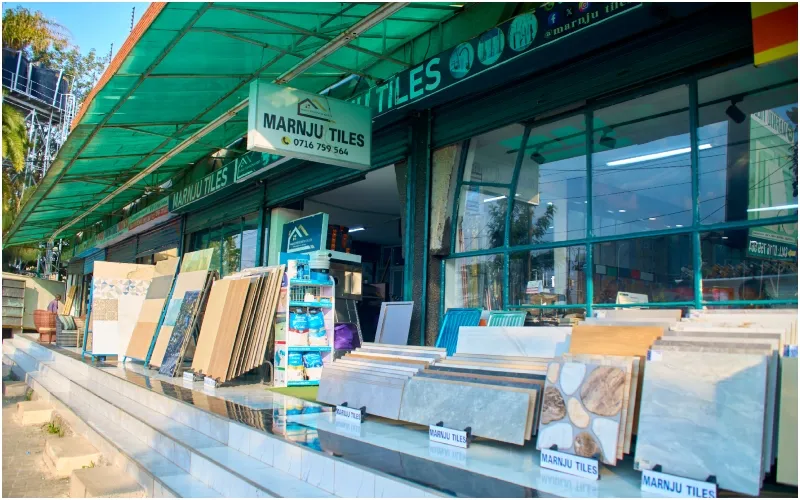
In late 2023, Njung’e signed a lease on a neglected commercial space inside Libra House along Mombasa Road. The initial market response was disruptive; within 30 days, order volumes spiked so rapidly that his entire inventory was completely depleted.
Recognising a critical growth window, Njung’e poured 100% of his immediate profits into acquiring four adjacent retail shops. He knocked down the dividing concrete walls, fully renovating the spaces into a single, modern exhibition hall.

Later, the entrepreneur pivoted the business from a single-category tile vendor into a diversified, one-stop interior finishing supplier, converting his original transport fleet into an internal logistics arm with drivers specifically trained in fragile cargo handling.
From a workforce of fewer than three people when he started, Njung’e has managed to scale his permanent workforce to 20 professionals—including architects, quantity surveyors, and interior designers.
Inside the challenges that Martin Njung’e grapples with
This success has not come without steep external challenges. The company battles fierce defensive pricing wars against large-scale importers who comfortably absorb razor-thin profit margins.
Internally, operational overheads are punishingly high; the monthly rental obligation alone for the Mombasa Road-based showroom surpasses Sh 400,000.
Furthermore, an aggressive domestic tax regime creates friction. Decentralised county government regulations require inter-county distribution levies—often costing up to Sh 25,000 per transit movement—simply for crossing borders to deliver building materials to sites in neighbouring counties.
Despite these high-stakes hurdles, Njung’e’s ultimate dream is to transition Marnju Investment Company Ltd into a fully fledged, national construction and real estate development firm.
For aspiring entrepreneurs looking to enter the trade, Njung’e offers a strict reality check:
“This business requires a lot of patience. It is not like fast-moving consumer goods. A client can enquire about tiles, but it could take up to three months before their building is ready to install them. If you do not keep engaging them, someone else will.”







Discussion about this post