

MOMBASA, Kenya – Global leaders mobilised over 320 commitments and over $6.4 billion (Sh828.9 billion) for marine action at the conclusion of the 11th annual Our Ocean Conference in Mombasa in late June 2026.
Policymakers and development partners reaffirmed their commitment to fight illicit fishing, safeguard marine biodiversity, lower pollution, and promote climate resilience during the high-stakes summit.
Industry analysts warn that the long-term success of maritime governance will depend solely on successful community-level implementation, even while these strategic policies and capital allocations are fundamental.
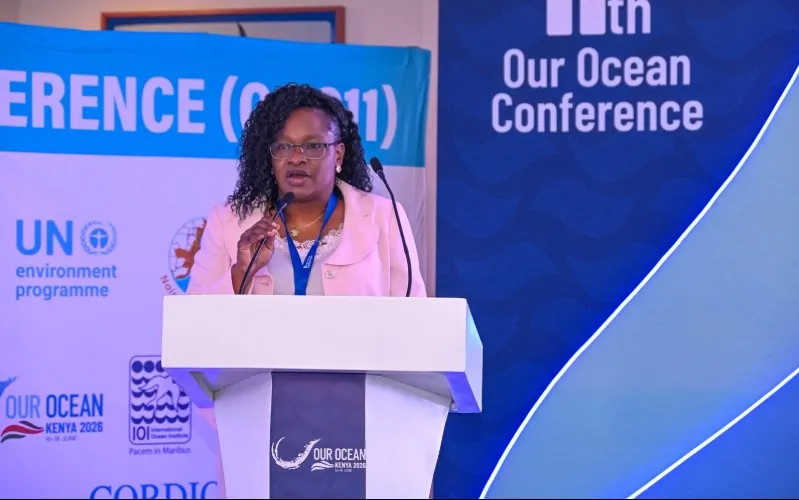
“International environmental summits excel at drafting macro-level solutions, such as the newly adopted Mombasa Declaration aimed at curbing illegal, unreported, and unregulated (IUU) fishing,” said Nancy Ogonje, Executive Director, East African Wild Life Society (EAWLS).
Ogonje indicated that there’s often a big gap between what’s discussed in international negotiations and the actual struggles of vulnerable coastal communities.
“Yet, a severe disconnect often exists between international negotiating tables and the real-world realities of vulnerable coastal populations,” she added.
According to Ogonje, ocean governance must engage coastal communities and civil society organisations (CSOs) as foundational partners rather than passive bystanders to successfully move from high-level conversation to concrete reality.
The need for a community-led necessity
A depleted fishery cannot be rebuilt by policy alone, nor can it patrol a marine ecosystem.
The implementation phase must give localised institutional support top priority if the Mombasa summit is to be recognised as a true milestone rather than a performance diplomacy exercise.
“Lasting environmental stewardship occurs when the people whose food security and livelihoods depend directly on the ocean are equipped to protect it,” Ogonje explained.
Ogonje further reiterated that when local people are put in charge, conservation stops feeling like something forced on them by outsiders and starts feeling like something they choose to do themselves.
“By empowering local actors, the conservation movement shifts from an elite external imposition to a community-led necessity,” she added.
Civil society serves as the crucial conduit in the blue economy, linking international commitments to significant local activity.
CSOs are essential for monitoring the implementation of environmental policies because government transparency often breaks down at the seashore. They make sure conservation resources and state financing get to where they’re supposed to.
Preserving marine resources at the coast
In the meantime, local people have the crucial traditional knowledge needed to successfully secure funds for marine resource conservation.
“We must be intentional about building platforms that elevate marginalised voices—especially those of women, youth, and the vulnerable—to harness their invaluable knowledge and lived experiences,” Ogonje urged.
Ultimately, preserving marine resources demands teamwork at every level. While top-down policies and grassroots efforts fall short on their own, cohesive frameworks can successfully empower local villages to execute the broad environmental visions of the state.
“Only when local communities are active, well-funded, and legally recognised partners will the tide truly turn in favour of marine preservation,” Ogonje concluded.
Meanwhile, when the conference mobilised global action on ocean challenges, maritime security in the Indian Ocean was a clear priority. Nearly a decade on, the European Union–backed Programme for the Promotion of Maritime Safety (MASE) shows how sustained investment and regional cooperation can deliver real results.
In 2017, the European Union committed €37.5 million (KSh 5.5 billion) to counter piracy and strengthen maritime security along the south-eastern African coastline and across the Indian Ocean. The programme was designed to go beyond naval patrols, tackling both the drivers and mechanics of maritime crime.
Support for alternative livelihoods in coastal regions
A central pillar of MASE has been support for alternative livelihoods in coastal regions of Somalia. By creating economic opportunities, particularly in fisheries and related sectors, the programme has helped reduce the incentives that once pushed communities toward piracy.
This reflects a broader shift in thinking: maritime security begins on land. At the same time, MASE has strengthened institutional capacity across the region.
Working through organisations such as the Intergovernmental Authority on Development, the Common Market for Eastern and Southern Africa, the East African Community, and the Indian Ocean Commission, the programme has improved maritime surveillance, enhanced information-sharing, and built the capacity of law enforcement and judicial systems to investigate and prosecute maritime crimes.
Partnerships with the United Nations Office on Drugs and Crime and INTERPOL have further strengthened cross-border cooperation.
Amid all these, Ogonje argues that local communities need legal know-how to understand environmental regulations and protect their water with confidence.
“Additionally, we must equip local communities with the legal knowledge required to navigate complex environmental regulatory frameworks, so they can defend their waters with confidence,” she added.







Discussion about this post