


NAIROBI, Kenya – Stung by the rising number of cases related to Gender-Based Violence (GBV), the president’s advisor on women’s rights, Harriette Chiggai, is calling on the private sector to join the fight against the vice, saying it remains a big hindrance in realising women’s full potential.
Speaking at a high–level leaders’ breakfast meeting in Nairobi, bringing together key industry players involved in championing women’s rights empowerment, Chiggai said there was a clear need for concerted efforts in combating GBV, thus, the need to form partnerships for a bold and inclusive future.
“We all need to ask ourselves, what is our task ahead? What have we achieved so far? Our task is to build systems that safeguard women’s rights and deliver results on scale,” said Chiggai.
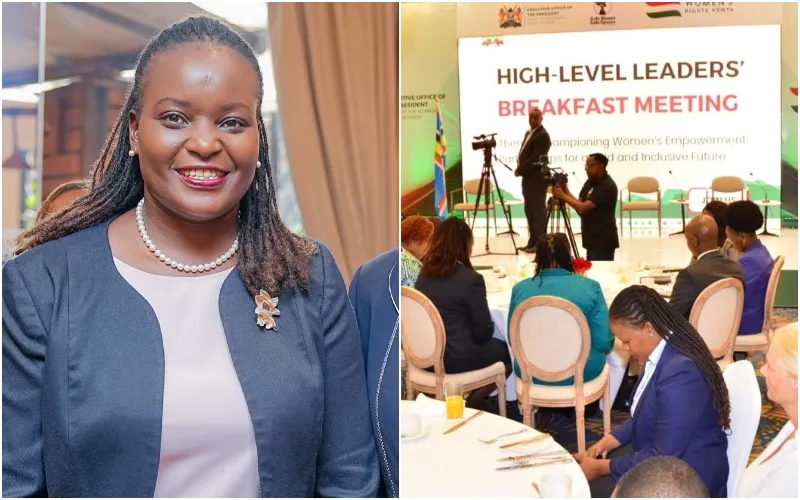
According to Chiggai, since 2022, the ruling Kenya Kwanza administration has moved from making promises to driving tangible impacts through interventions across the country.
“We have touched widows. And the reason why we chose widows and orphans in our office as a CSR component is because no one was doing it. It was a neglected group among the vulnerable groups. And when you look at the society at large, if you leave one segment of the society out, there is nothing we are solving, it is a roller-coaster, and we are going to demonstrate that,” she explained.
Speaking at the same time, the president’s advisor on national security, Ambassador Monica Juma, painted a picture of a dire situation for women at home while calling for their protection.
“The question of GBV, we know, is not just the person who is being inflicted. It weakens families, it scars generations. And now we are having a situation where the family is under serious affliction,” Ambassador Juma said.
Why the COVID-19 pandemic was a big blow to the Kenyan girl child
According to Ambassador Juma, statistics show that about 300,000 women were under serious threat in their homes during the COVID–19 era, showing that homes, which are believed to be safe spaces, are being turned into bastions of gender-based violence.
“One of the most striking things during COVID-19 was when by September 2020, it became apparent that over 300,000 girl children had fallen pregnant in the home space, supposedly, the secure space. These are the things that we have to look at. So, who is looking out for those children? What is the meaning of that in the next 10-20 years?” she posed.
In her own words, Ambassador Juma went on: “How are we intervening to restore that stolen childhood? What is going on here, and what is going to be the implication of this in terms of us as a nation? And that was just the beginning of September. This is the reason why we had to open schools earlier, because we felt the girls were safer in school than at home.”
Ambassador Juma also called for the recruitment of more female officers who would be critical in the fight against GBV.
How the Kenya Kwanza administration plans to empower women
Meanwhile, according to Chiggai, it is time to create safe homes and safe spaces, not just at home, but also at workplaces and through this, the private sector would be plugging into an ecosystem that aims at zero-rating GBV.
“Additionally, through interventions across counties, we have touched widows and orphans, survivors of GBV and communities. Our mission is large to empower 5 million women socio-economically, and that is our target,” explained Chiggai.
She further indicated that they seek to ensure rights women’s representation in leadership stands at 40%.
“We are keen on eliminating violence against women and children and ensuring gender data drives planning and budgeting at every level,” Chiggai added.
The meeting also brought on board financial institutions that provide financial literacy to women, as well as a call for women to access finances to better their businesses.










Discussion about this post