


Editor’s note: In this piece of work, Kimutai Kirui examines how, in this era of viral outrage and procedural half-truths, justice is increasingly misread through the lens of OB numbers and court file references—reduced to slogans by those who mistake administrative entries for evidence and legal process for social media theatre.
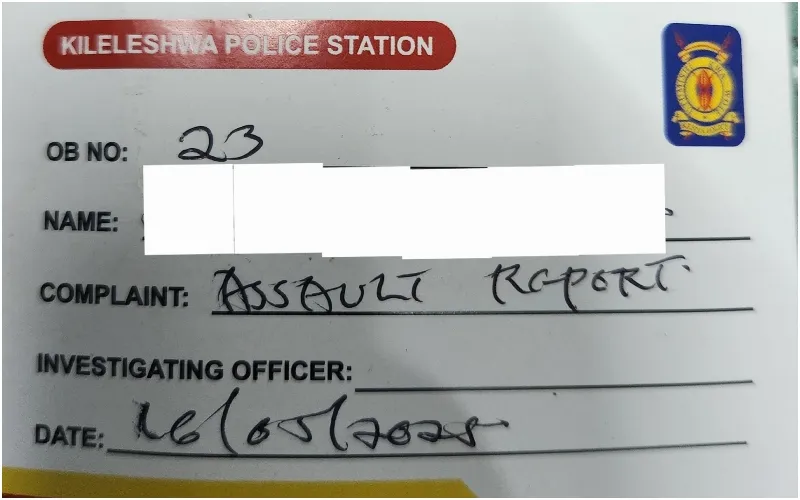
Occurrence Book Numbers, Court Files, and the Weaponisation of Ignorance in Digital Spaces must be pointed out. An OB has no evidentiary value anywhere, let alone on social media.
We seek to engage and educate many digital commentators on the justice system, beginning with criminal procedure today and civil matters thereafter. This awareness and advocacy initiative forms part of our broader access-to-justice programme, undertaken in collaboration with key institutions, including the police, the Office of the Director of Public Prosecutions (ODPP), and the Judiciary.
There is a persistent, ill-informed, and often malicious fixation in digital spaces, rooted in assumption and conjecture, that an Occurrence Book (OB) number constitutes the entirety of a criminal investigation. Or that every matter discussed must, as a matter of course, be accompanied by an OB number, a court or case file reference, and formal citation. Far from it.
What is a police file?
The police case file is the official record of an investigation, capturing evidence collection, witness accounts, and prosecutorial decisions. The OB number only confirms that a report was made and has no evidentiary value. In misinformed digital spaces discussions, this distinction is often overlooked, leading to an undue focus on OB numbers rather than the full investigative record.
Equally misplaced—and at times bordering on insinuation—is the expectation that human rights organisations should be treated as constitutional duty-bearers in the same manner as the State, to the extent that they are subjected to demands for accountability as though they exercise public authority.
This reflects a clear category error: conflating civil society actors with organs of the state, despite their fundamentally distinct constitutional roles. Both assumptions reflect a broader need for legal literacy on how justice systems and constitutional roles are actually structured.
Human rights organisation: watchdogs, not state actors
Human rights organisations are not constitutional duty bearers like the state. Constitutional obligations bind public authorities that exercise coercive power—courts, police, regulators, and other state institutions. These bodies can arrest, prosecute, enforce laws, and make binding determinations. For that reason, they are held to strict constitutional standards of due process and accountability
Human rights organisations do none of this. They do not wield sovereign authority. Their mandate is to document violations, advocate for rights, and scrutinise the exercise of state power—not to execute it.
They are governed by ethics, internal governance structures, and the ordinary law, but not by constitutional duties reserved for public authority. In constitutional design, the state is the duty-bearer; civil society is the watchdog.
The limits of the OB number
In criminal justice practice, an OB entry is merely the point of initiation—a formal record that an incident has been reported. It is administrative, not determinative. It does not constitute a finding of fact, proof of wrongdoing, or a completed investigation. The real substance of criminal justice lies elsewhere: “The police case file: Where investigation actually lives!”
A police case file is the official investigative record compiled by law enforcement and, where necessary, reviewed by prosecutorial authorities. It forms the evidentiary backbone upon which decisions are made to investigate, charge, prosecute, or close a case.
To ensure structure, accountability, and evidentiary integrity, the file is typically organised into specialised components, including:
- – Initial reports and OB extracts
- – Documentary and physical evidence
- – Forensic and expert reports
- – Witness statements
- – Suspect interviews and statements
- – Investigation diary entries
- – Charge sheets and court documents
- – Exhibits and chain-of-custody records
- – Prosecution summaries
- – Administrative correspondence
Each component serves a distinct procedural function within the broader justice process.
The Core Principle
Criminal justice is not built on a single number, document, or social media reference point. It is a layered system of investigation, evidence, procedure, and judicial oversight. An OB number marks the beginning of a process—not its conclusion. And human rights organisations, while vital to accountability, are not substitutes for the state.
They observe, document, and challenge power; they do not exercise it. Understanding this distinction is not legal sophistication—it is basic constitutional literacy.
A recurring misconception in digital spaces is the “rogue assumption” that an Occurrence Book (OB) number constitutes the entirety of a criminal investigation and, second, demands to demand accountability from human rights actors.
This is what a police file looks like
SUB-FILE A:
- Initial Reports and Incident Records
- This section contains the foundational records that trigger the investigative process, including:
- Occurrence Book (OB) extracts
- Crime and incident reports
- Situation reports
- Preliminary complaint documentation
SUB-FILE B:
- Documentary and Physical Evidence
- This section preserves documentary exhibits and scene-related materials, including:
- Exhibit memos
- Documentary evidence
- Title deeds and ownership records where relevant
- Sketch plans and scene diagrams
- Photographic evidence and supporting documentation
SUB-FILE C:
- Expert and Technical Reports
- Contains specialised evidentiary material generated by technical experts, including:
- Forensic examination reports
- Cybercrime analyses
- Ballistics reports
- Post-mortem findings
- P3 medical reports
- Other expert assessments
SUB-FILE D:
- Witness Documentation
- This section consolidates:
- Witness statements
- Identity parade proceedings
- Identification records
- Supplementary witness evidence
SUB-FILE E:
- Suspect Documentation
- Contains:
- Statements by suspects
- Confession statements where lawfully obtained
- Statements under inquiry
- Interview and interrogation records
SUB-FILE F:
- Investigation Diary
- Often regarded as the operational heart of the file, this section contains:
- The investigating officer’s inquiry diary
- Chronological records of investigative actions
- Leads pursued and outcomes obtained
- Progress notes and investigative observations
SUB-FILE G:
- Charge and Court Process Documents
- Includes:
- Charge sheets
- Summons
- Bail and bond documentation
- Related court process records
SUB-FILE H:
- Exhibits and Criminal Records
- Contains:
- Exhibit inventories
- Property registers
- Chain-of-custody documentation
- Criminal history records where relevant
- Sub-file I: Covering Report
This section provides:
The investigating officer’s case summary
Evidentiary assessment
Recommendations regarding prosecution
Briefing notes for supervisory and prosecutor review
Sub-file J:
- Correspondence and Administrative Records
- Contains:
- Internal memorandum
- Correspondence with prosecutors
- Supervisory instructions
- Administrative updates and minute sheets
- The Jurisprudence Significance.
What we read on social media is often less about accountability and more a blend of ignorance, misrepresentation, and the weaponisation of legal terminology.
The misuse of these terms reflects a deeper distortion: legal language stripped of context and repurposed for insinuation rather than inquiry, creating confusion where there should be clarity.
Ultimately, OB entries and court file references are tools of procedure, not instruments of public theatre.
Demanding them as proof of everything is not legal literacy—it is manufactured confusion bordering on frustration.
The author is Kimutai Kirui, a Kenyan political analyst and human rights activist known for his work in Uasin Gishu County, where he has championed justice in cases ranging from police brutality to land disputes affecting widows.
Views expressed in this article are solely those of the author and do not represent the editorial position of news9.africa.













Discussion about this post