


The Kenya National Examination Council (KNEC) has warned schools against providing inaccurate analysis of the Kenya Junior School Education Assessment (KJSEA) results.
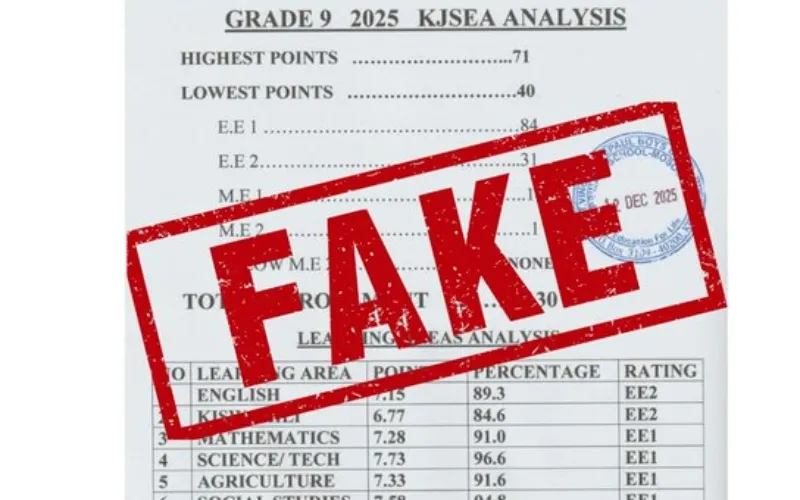
In a statement, KNEC explained that the new competency-based curriculum(CBC) is different from the previous 8.4.4. system, saying that KJSEA does not provide an aggregate score.
“Unlike the former system, KJSEA does not provide an aggregate score. Why? Because CBC is about nurturing individual potential, not ranking learners. Each Subject is assessed independently, and learners’ achievements are reported using performance levels, not totals,” the statement read in part.
KNEC also elaborated that the new curriculum, which includes (KJSEA), does not involve mean scores.
“This approach ensures that a child’s excellence in one subject is not overshadowed by weaker performance in another. There is, therefore, no school mean score as is depicted in the attached fake analysis,” it added.
This comes as the CBC system continues to be rolled out across schools in Kenya, considering the 8.4.4 curriculum has been in use for decades.
A first of its kind
The KJSEA assessment has replaced the old KCPE examinations, which had Class 8 learners tested in six subjects a mean score provided. This year’s KJSEA results were the first of the new CBC system, which targets individual capabilities of learners and not academics only.
With the new education system, KJSEA assessment has a different grading system: Exceeding Expectation (E.E.), Meeting Expectation (M.E.), Approaching Expectation (A.E.), and Below Expectation (B.E.).
Each level is then divided into two sub-levels, creating an eight-point scale from 1 to 8, where 8 is the highest.
With the 8.4.4. curriculum, which was adopted in 1985, primary and secondary school examination results were graded into A, B, C, D, and E, with A being the highest mark and E the lowest.
CBE implementation challenges
The implementation of CBC started in 2017, before it was changed to the Competency-Based Education (CBE), and has faced its share of challenges. While some of the hurdles have been handled, others remain to be solved as schools and the government adapt.
For example, the government had to set aside funds to build new classrooms to accommodate learners in the new curriculum. It also had to figure out where junior secondary school learners would be situated. Parents were concerned that these learners were too young to be placed in high schools with older students.
Additionally, there were issues with textbook content, which the CBC implementation team needs to clarify to prevent confusion among learners, teachers, and parents.
Concrete benefits of the CBC system are yet to be seen revealed even as its rollout continues. Nevertheless, many are excited by the fact that the curriculum goes beyond academics and encourages the wholesome development of learners, both in class work and outside the classroom.











Discussion about this post