


KIAMBU, Kenya – “Do you see a point on the dam marked A? Yes, I believe you do! Why did I mark it? That used to be our home until we were displaced by the Karimenu 2 Dam!”
These were the exact words of prominent Kiambu politician Mathew Mukuha Mwangi, uttered as he narrated to News Nine about the agony he and his entire community, comprising at least 6,000 families, were subjected to after being evicted from their ancestral homes to pave the way for the construction of the dam.
The renowned Karimenu 2 Dam is a 59-metre-high water reservoir located in Gatundu North constituency within Kiambu County.
Karimenu Dam, which sits on 600 acres, was built at Sh24 billion, jointly funded by the Kenyan Government and the China Exim Bank.
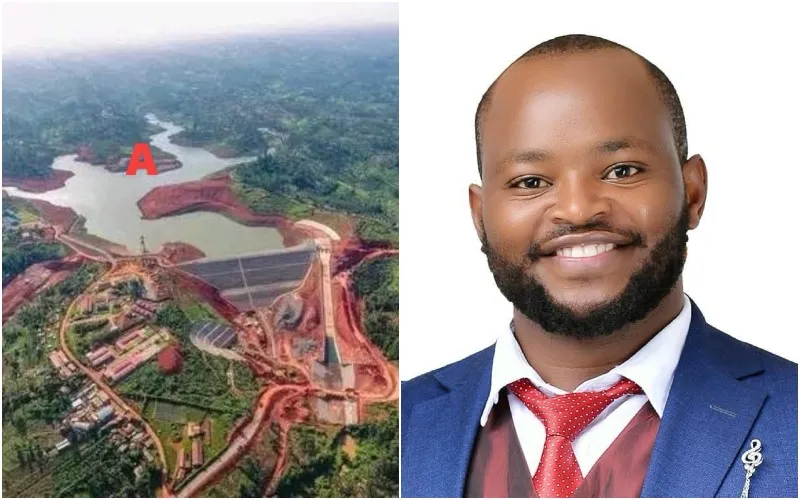
However, today, Mukuha, an engineer by profession, appears not to have moved on completely after being evicted from the land.
“This was our ancestral land. The only place I knew as home for decades. Well, we paved the way for the dam because we knew it would benefit locals and other counties! But guess what… Our family were scattered; some went to Thika, others to Nyandarua, and others to Juja,” he recalls.
He further narrated: “Imagine a community that lived together, sharing basic commodities like fire, salt, cooking oil, vegetables, and flour, among others. Honestly speaking, we enjoyed the community. Most of us enjoyed the community in which we were brought up.”
How Mathew Mukuha Mwangi coped with his early life
Mukuha vividly remembers that even without a single coin, they could manage meagre foods.
“Sometimes we went to work to get paid, plucking tea (a kg we could earn Sh5) and picking coffee (a full bucket we could get paid Sh20). Half a day’s work would fetch one Sh200, which we used to combine as a family to enable us to get money to save for Sunday movies and sliced mandazi with beans soup, which was served in polythene bags,” he added.
This particular platter, Mukuha recalled, needed no special cutlery.
“You only needed to cut a full one edge, tie the top and suck from the edge as we watched Dj Movies in Kanyoni village at Sh5. We always longed for this Sunday,” said Mukuha.
Back home, Mukuha recalled that their meals consisted mostly of a mixture of bananas with half a kg of rice.
“It wasn’t delicious, but we managed it as it sustained us! We even sometimes went to our neighbours to pick the remains of potatoes after picking the good ones. Boil and eat. The lucky thing is that we never lacked an avocado,” he said.
Schooling, he recalled, was the best part since he was from an extended family.
“Coming from a family of 12 siblings, affording to carry food to school was a miracle because even the available food was insufficient for dinner. So, every morning, we passed by the shambas and picked the fallen avocados or half-ripe sugarcane. Sometimes we lengthened our hands to our neighbour’s farm; we needed to survive the class time,” Mukuha further said.
How the Karimenu 2 Dam in Kiamcu County came to be
Moving back forward, Mukuha said that when they grew up, he realised that they had also grown into a complete community.
“Fast forward, when the dam came, we were displaced, and some people compensated; many are yet to receive a coin! They even arrested me because of agitating for the timely, fair and just compensation of the project-affected persons,” he lamented.
News Nine understands that the 26,540,000 cubic meter dam was officially opened in August 2022 after three years of work, according to a deal signed by stakeholders in May 2017.
Karimenu 2 Dam, whose construction began in April 2019 but stalled several times following protests by residents led by Mukuha over unsettled compensation, is located 50km west of Thika town and supplies about 70 million litres of water daily for irrigation and domestic use.
“People surrendered their ancestral lands to pave the way for this particular dam project. We had to exhume the bodies of our grandparents. The exhumation process was difficult, emotional torture and had a huge impact on us,” lamented Mukuha.
Why Mathew Mukuha Mwangi is a disappointed man
He reiterated that after surrendering their parcels of land, they hoped that all the local villages, wards and the whole constituency would benefit from the water reservoir.
“But alas, no single home was connected with this water! Our resource! Rivers we went to swim in became inaccessible, rivers we fetched water from and cleaned clothes in became inaccessible, and our tea plantations, pineapple farms, coffee farms, livestock and women reduced productivity due to extreme cold weather. The area is extremely cold; you cannot differentiate it from the forest. People lost productivity, some people became extremely poor, and families broke apart,” said Mukuha.
Mukuha regrets that a dam that was supposed to be a blessing to the residents of Gatundu North has now become a nightmare for them.
“All the water from the dam was diverted to Ruiru and Juja. Residents have no taps, let alone running water. Our roads were closed, and the promised bridges are not yet done. The contractor left the site. Well, we may have memories from this place, but we don’t have water,” he further lamented.
Meanwhile, Mukuha, who unsuccessfully contested for the Gatundu North parliamentary seat in the August 2022 elections on an independent ticket, believes he can turn around the fortunes of his people if given an opportunity in the next elections.
“These memories will transform into piped water once I inject into power. I will supply clean water and establish a TVET institution for the affected community. I will do all those and more because these are resources that we can benefit from abundantly if the will and drive are true to the course. I believe that life will be given back to the people,” he said, adding that nowadays, he sits on his balcony as he views the ridges that gave him life.







Discussion about this post