


NAIROBI, Kenya — A new World Resources Institute (WRI) issue brief has lifted the lid on the real cause of Nairobi’s flood crisis, a situation that has become a recurring urban challenge.

According to the central findings of Flooding in Nairobi’s Informal Settlements: Advancing Equitable and Resilient Solutions, the flooding is driven not only by heavy rainfall but also by systemic drivers.
These systemic drivers include the city’s topography and hydrology, volcanic (mollic nitisols) soils which have low permeability, unplanned development in flood-prone areas, inadequate drainage, the loss of wetlands and green spaces, weak enforcement of land-use regulations, fragmented governance and weak institutional management in flood risk management, and limited investment in climate resilience.
WRI Africa, a global research organisation that works with governments, businesses and communities to develop practical solutions that improve people’s lives and ensure nature can thrive, says the issue brief highlights the growing severity of flood impacts in Nairobi.
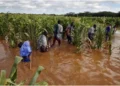
For instance, in 2024, nearly 21,000 families were displaced, more than 90 kilometers of roads and nine bridges were damaged, and more than 147,000 cases of waterborne disease were reported. In March 2026, flooding claimed 37 lives in less than three weeks.
Inside the factors driving flood risk in Nairobi City
WRI Africa observes that these events underscore the need for long-term systemic solutions rather than emergency response alone.
Drawing on flood modelling and mapping alongside exploratory surveys and discussions with 98 households in Kibera, Mukuru Viwandani and Mathare, the issue brief examines the factors driving flood risk in Nairobi City, with a special focus on informal settlements and the associated gender, social, economic, environmental, physical and psychological impacts, using the 2024 floods as the case study.
Residents reported losing livelihoods and personal belongings while identifying gaps in early warning systems, preparedness and their involvement in flood risk management.

The findings also show that women, children, older persons and persons with disabilities often face the greatest impacts because they encounter additional barriers to accessing information, evacuation support and recovery assistance.
These impacts, WRI Africa observes, demonstrate that flooding is not only an environmental challenge but also a housing, public health and urban resilience challenge requiring coordinated action across planning, infrastructure and service delivery.
The launch of the Nairobi Rivers Nature-based Solutions
To advance a coordinated approach of climate risk response, including flooding, the Nairobi Rivers Commission (NRC) and WRI also launched the Nairobi Rivers Nature-based Solutions (NbS) Strategic Framework, a toolkit for providing practical guidance, tools, and resources to design, invest, implement, and scale NbS projects and mainstream these in city policies, plans and strategies.
The framework analyses four climate risks in Nairobi – flooding, urban heat, biodiversity loss and air pollution – and identifies priority interventions that reduce these climate risks while supporting biodiversity restoration, public health, gender equity and social inclusion, and quality of life.
NRC is a presidential initiative under the Office of the Deputy President aimed at rehabilitating, protecting, and managing river ecosystems, serving as a multi-agency coordinator to restore the city’s waterways.

Bishop Margaret Wanjiru, Chairperson of the Nairobi Rivers Commission, indicated that Nairobi’s rivers cannot be restored through isolated projects or short-term interventions.
“Through this framework, the Commission and its partners now have a shared, evidence-based roadmap to coordinate action across the river basin, direct investment to priority areas and track results. Our ambition is to restore river corridors that reduce flood risk, improve public health, support livelihoods and become safe, productive assets for the people of Nairobi,” said Bishop Wanjiru.
What the new evidence from Nairobi’s floods means
The Commission works across five counties—Nairobi, Kiambu, Kajiado, Machakos, and Makueni—to enforce environmental regulations, coordinate stakeholders, and implement restoration programmes. Learn more about the organisation’s vision and mission at the Nairobi Rivers Commission Official Website.
Meanwhile, during the launch, WRI Africa, which works across the continent to advance sustainable, equitable and climate-resilient development through evidence-based research, partnerships and action, also signed Memoranda of Understanding with the Nairobi City County Government and the Kenya Forestry Research Institute to strengthen collaboration on climate action, data and research, knowledge transfer, stakeholder engagement, resource mobilisation; city and landscape restoration, nature-based solutions, capacity building, and livelihoods and restoration
Finance.
Wanjira Mathai, Managing Director, Africa and Global Partnerships at World Resources Institute, emphasised that the evidence from Nairobi’s floods is clear: climate resilience cannot be separated from housing and basic services.
Maathai reiterated that safer communities require risk-informed planning, reliable drainage and sanitation, healthy rivers and wetlands, and residents who are partners in designing and stewarding solutions.
“This launch connects evidence, public leadership, local knowledge and finance so Nairobi can move from repeated emergency response to investable action that protects both people and nature,” said Maathai.
Together, the issue brief, the NbS strategic framework and the formalised partnerships provide the evidence, practical guidance and collaboration needed to support Nairobi to transition from reacting to floods to coordinated planning for long-term disaster risk management and resilience.






Discussion about this post