



Nairobi, Kenya – The government has officially ended the use of One-Time Passwords (OTP) in authorising healthcare services under the Social Health Authority (SHA), as part of sweeping reforms to digitise and secure the national health insurance programme.
Health Cabinet Secretary (CS) Aden Duale announced on Monday during the launch of the national biometric verification system at Kenyatta University Teaching, Referral and Research Hospital (KUTRRH).
Effective immediately, all SHA claims and service authorisations will be processed exclusively through biometric verification or the newly launched Practice 360 mobile application.
According to CS Duale, these changes are part of a broader initiative to streamline healthcare delivery, eliminate fraud, and enhance patient data security across Kenya’s healthcare system.
“Biometric registration is now fully operational in all Level 4, 5, and 6 public health facilities across the country,” said Duale. “Patients will no longer need to present physical documents to receive services. Their biometric health ID will be all they need to access care.”
The transition from OTPs to biometrics marks a significant shift in how patients interact with the national health system.
It also signals the government’s intent to leverage technology to create a more accountable, efficient and patient-centred healthcare infrastructure.
The Practice 360 app, also launched on Monday, has been developed to support healthcare professionals in managing patient services more effectively. Duale noted that the app is now live and geo-tagged to specific healthcare facilities to ensure proper usage and security.
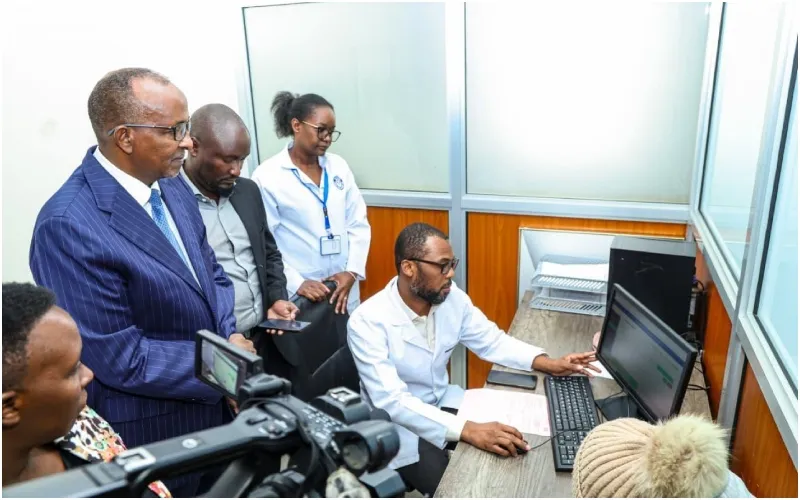
“Healthcare workers can now view, approve, and manage service authorisations and claims in real time,” said the CS. “The app eliminates delays and manual paperwork, freeing up more time for quality patient care.”
The Ministry of Health also unveiled the National Product Catalogue, a centralised digital inventory system aimed at eliminating counterfeit drugs from Kenyan health facilities.
By requiring pharmaceutical companies to upload certified product data, the system will allow health providers and pharmacies to verify the authenticity of medicines before dispensing them to patients.
“The SHA will not reimburse facilities for drugs that were never dispensed,” warned Duale. “We are serious about protecting patients from substandard or fake medications. Any pharmaceutical firm that fails to upload certified product data within the next 30 days will face deregistration.”
Additionally, the Health Information Exchange (HIE) was introduced to enable seamless and secure sharing of patient data between accredited facilities.
This digital network will ensure that patients’ medical histories are accessible to authorised providers regardless of location, allowing for faster diagnoses, better treatment decisions and fewer repeated tests.
CS Duale emphasised that these digital innovations are not just about technology, but about putting patients first.
“This biometric system will help us eliminate fraud and misuse of benefits; it will also reduce paperwork, shorten queues at hospitals, and ensure that more time is spent on actual patient care. It is part of our commitment to build a modern, transparent, and effective healthcare system, which we are calling the ‘digital superhighway’ of health,” he explained.
So far, the reforms appear to be gaining traction. More than 25 million Kenyans have already enrolled in the SHA programme, with over 10,000 healthcare facilities, including public, private and faith-based institutions registered to provide services under the new model. The government is now working to onboard Level 3 and Level 2 health centres to ensure universal access across all counties.
Duale’s announcement is the latest in a series of reforms under the Universal Health Coverage (UHC) agenda, which aims to provide all Kenyans with access to quality, affordable healthcare without financial hardship.











Discussion about this post