


ELDAHIR, Somalia – Since 2019, the Eastern Migration Route—the main migration corridor from the Horn of Africa through Yemen to the Gulf states—has seen over 280,000 people set out on dangerous journeys.
Due to the unstable economic conditions, violence, and severe consequences of climate disasters like protracted droughts, migrants flee their countries in pursuit of better opportunities for employment abroad.
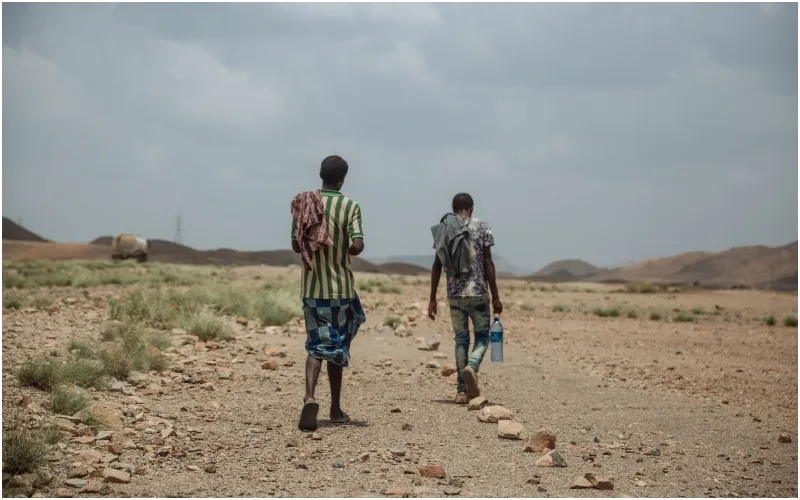
One of the primary transit nations for migrants using this route, which is used more than the Mediterranean route to Europe, for people leaving the Horn of Africa is Somalia.
Yusuf Adam wished for two things. The first was to reunite with his family. It seems that he was unable to recall the date of his departure from Ethiopia.
He was persuaded that travelling to Saudi Arabia would be his best chance of succeeding in life due to financial challenges in his homeland. Because some of his neighbours had done so, family members were able to flourish in life.
Adam’s second desire was to secure a steady career that would enable him to complete his education and provide for his loved ones. He was stuck at Bosaso, a major transit hub for migrants travelling to the Gulf states and a seaside city in northern Somalia.
“It is a fact that most people are going to Saudi Arabia. In my case, I crossed the sea myself three times. We left Bosaso on a boat to Yemen. Then, from Yemen, we walked to the border with Saudi Arabia. And from there, it was up to your luck. You can either make it, be captured or be deported to Ethiopia, so we had to start walking again,” narrated Adam, an Ethiopian migrant.
Adam said that some make it safe and get some work to make ends meet.
“You find that some who make it to Saudi Arabia might be doing well financially. This makes the ones left behind feel some pressure to leave and make it out as well. That is why many risk it,” explained Adam.
Like thousands of other migrants before him, Sufyan Ali, another Ethiopian migrant, left all he knew behind to pursue the dream of a better life. What he didn’t know was that the road ahead would be treacherous.
“I started walking from Wajale to Hargeisa. Hargesia to Berbera. From Berbera to Burco. We stayed in Burco for two days and then went to Las Anod. The conflict started while we were there. We somehow escaped from them,” recalled Sufyan.
Migrants risk a game of chance
Adam further narrated how he took the boat three times. He says that one time there were 120 on the boat, another time 95 people, and another time 150.
“I can tell you that it is a game of chance. The boat is risky, there is nothing to eat, and you are between life and death. The moment you board the boat, you give up on your life. No food, no water, and people are sitting very close to one another. The slightest increase in weight makes the boat capsize,” Adam painfully recounted. “I just wanted to take a risk; if I die while taking it, it would be fine. We were just taking a chance.”
Most migrants use smugglers to get over borders and checkpoints; some journey on their own. Human rights breaches, such as human trafficking, torture, and different types of violence and abuse, are experienced along the way.
“I was walking alongside five ladies, and I was the only man. When we left Burao, there was a village, whose name I have forgotten, where the women I was with were kidnapped. They took them far away, and the women came back crying. They told us that they were raped and harassed. They were sexually abused. When we got to Garowe, we were apprehended by three men, one of whom had a gun. They searched us all and took our mobile phones,” Adam further said.
Women and girls are particularly vulnerable to gender-based violence, and children travelling alone face significant hazards such as being detained, held against their will by criminals, forced into labour, or living in appalling conditions on the streets.
Jana Abdul, a female Ethiopian migrant, narrated how they spent one night in the bush before reaching Las Anod in the morning.
“The traffickers woke us up and told us to collect firewood. But they were disappointed afterwards and shouted, saying we brought nothing. They even beat one kid. After we finished fetching the firewood, they told us to call our families and ask them to send money,” Jana narrated.
Another Ethiopian migrant, who sought anonymity for fear of public backlash and deportation, narrated what those who are unable to raise money to secure their freedom are subjected to.
“They asked for money, and those who did not have money were beaten and were not allowed to take a shower. We were in this situation for one month.”
Inside IOM’s Eastern Route 2026 Report
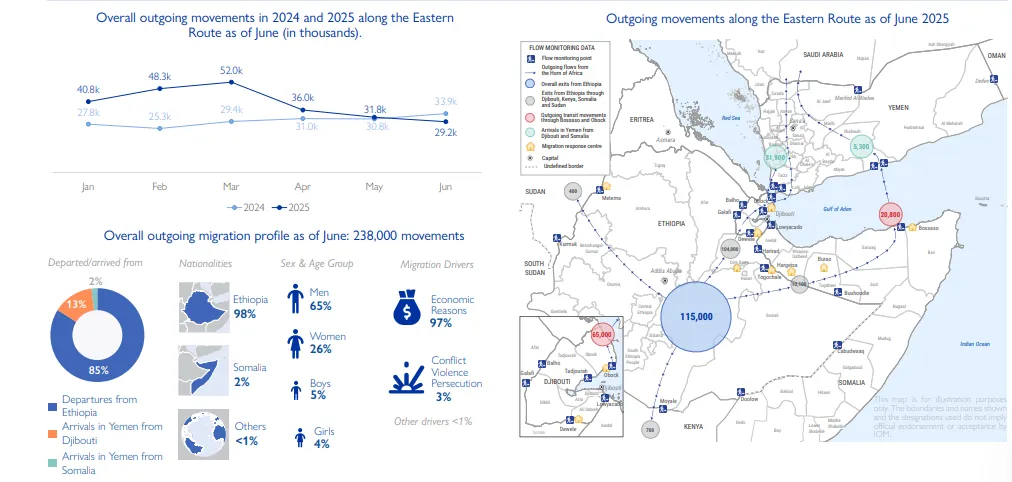
According to the International Organisation for Migration (IOM) Migration Along the Eastern Route 2026 Report, outgoing movements along the Eastern Route increased by one-third (+34%) between 2024 (178,300) and 2025 (238,000) for the period January-June, driven by increased arrivals in Yemen via new landing points in Ta’izz, faster transit through Obock to avoid border authorities, and a moderate rise (+6%) in exits from Ethiopia.
More recent trends show a one-third decline (-31%) in movements between the first (141,000) and second (97,000) quarters of 2025. This decrease is partially attributed to the suspension of data collection in Yemen since April, which limits visibility into actual movement volumes, seasonal slowdown post-Ramadan, intensified enforcement operations against irregular migration in Djibouti and Somalia, and adverse weather conditions in key transit areas.
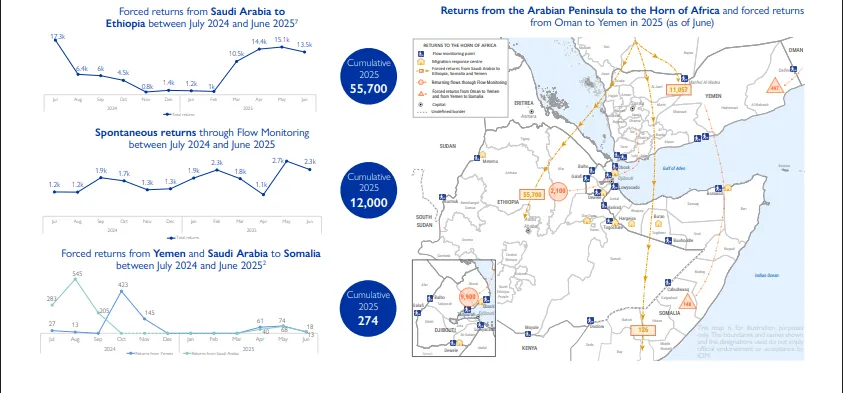
As of June 2025, (55,700), there was an overall decrease in the number of Ethiopian migrants forcibly returned from Saudi Arabia (-2% from 2024); however, returns of boys (+31%) and girls (+18%) increased. Returns surged between the first (12,800) and second (42,950) quarters of the year, with most returnees heading to conflict-affected regions of Amhara (36%), Tigray (35%), and Oromia (25%), which also host large displaced populations (1.7 million).
The number of migrants spontaneously returning, as tracked through flow monitoring in Obock, increased (+62%) from 7,400 in 2024 to 12,000 in 2025 for the period January-June. Additionally, around 21,500 return movements from Djibouti to Ethiopia were reported, although it remains unclear what proportion of these migrants were initially en route to the Arabian Peninsula or had been residing in Djibouti.
Thousands of migrant testimonies collected over the years have shown that the Eastern Route is one of the hardest – and most overlooked – migration routes on earth.
“People are tortured along the way. The tormentors light a fire and burn you with heated plastic and ask you to tell your family to send them money. I have been stabbed four times, my friends have been stabbed even more,” lamented Adam.
According to Adam, those who have money are freed, but those who don’t can even have their eyes gouged out of their sockets.
“Back home, the parents will be forced to sell land or ask for help from the extended family to help get the ransom money and send it,” Adam further said.
Although migrants on the Eastern Route are offered better employment prospects overseas, they frequently experience exploitation and forced labour even before they depart the continent.
“For instance, they might tell the employer that this is my wife, don’t give her a mobile phone, let her work for you, and you send me the money. Since the lady does not speak Somali, she does not know what they are talking about. After working for three months and learning some basic Somali, she will ask for her pay, and then she will be told the money was sent to her husband,” Adams also revealed.
However, after the Tadjourah Call to Action was successfully adopted in Djibouti in late April 2026, irregular migration and illicit journeys along the Eastern Migration Route might be something of the past.
Why the Tadjourah Call to Action matters
Still, the adoption of the Tadjourah Call to Action marked the successful conclusion of a recent High-Level Technical Experts Meeting on Irregular Migration and Migration Management along the Eastern Route (Red Sea Route Crisis) at Tadjourah.
The Tadjourah Call to Action aims to advance rights-based migration governance while stepping up efforts to stop irregular migration, human trafficking, and migrant smuggling.
The management of irregular migration along the Eastern Route was discussed by the Government of Djibouti, the Intergovernmental Authority on Development (IGAD), IOM, the European Union, JICA, Sida, INTERPOL, Japan, Sweden, and a number of other partners.
The meeting, which took place from April 27 to 30, 2026, brought together IGAD technical specialists, member state leaders, and representatives from regional and international organisations that specialise in marine security and migratory governance.
Strengthening regional collaboration to address the irregular migration situation on the Red Sea Route was the meeting’s primary goal. Said Nouh Hassan, the Chairperson of IGAD and Minister of Interior of the Republic of Djibouti, formally inaugurated the conference.
“The Eastern Route remains one of the busiest yet most dangerous migration corridors, where migrants are exposed to trafficking in persons, smuggling, violence, death from the desert temperatures, drownings at sea and various forms of exploitation,” Said Nouh Hassan, the Chairperson of IGAD and Minister of Interior of the Republic of Djibouti.
He also emphasised in his opening remarks the scale and urgency of the situation. The minister stressed the need for collective and coordinated action to protect migrants and combat criminal networks. He also underlined the specific challenges faced by Djibouti due to its strategic geographic location, calling for increased support to strengthen the infrastructure and migrant reception and assistance capacities of the government and communities.
Between 2024 and 2025, recorded arrivals in Yemen from the Horn of Africa more than tripled from January to June (from 10,400 to 37,200). This increase is mainly due to underreporting of arrivals from Djibouti for most of 2024, caused by limited access to new landing points along the Ta’izz Governorate until September 2024.
However, the suspension of flow monitoring data collection since April 2025 due to funding constraints has resulted in a data gap for the second quarter of the year.
For many years now, IOM has collaborated with governments and humanitarian partners in the Horn of Africa to provide protection and assistance to migrants along the route.
“These migrants go through a lot. They come to us in very bad shape. Some have skin diseases or diarrhoea since they consume contaminated food and water during their journey. We screen and assess their situation. Migrant Response Centers then provide support and help solve their problems,” explained Fariida Musse, a health officer in Somalia.
Mohamed Abdi, an official at the Tadamun Safe House in Bosaso, disclosed that they work with the IOM to provide children with housing, food, protection, and psychological support.
“We also provide them with child-friendly spaces and facilitate communication with their families. These are people who have gone through a lot. We even have some who have forgotten how to eat. We can only give them water to drink just to teach them how to eat again. Some become non-verbal,” Abdi lamented.
Safe houses care for migrants in distress
Abdi also revealed that they receive many pregnant women who come to seek help in the center and put them in safe houses.
“These are people who have been held hostage for a couple of months, and they suffer from trauma. So, we provide them with a safe space to rebuild their lives, including unaccompanied minors, until their situation gets better and they voluntarily return to their countries of origin,” Abdi added.
Speaking on behalf of the IGAD Executive Secretary, Mohamed Ware, the IGAD Deputy Executive Secretary emphasised the urgency of a collective response to the Red Sea humanitarian crisis, with particular focus on strengthening cooperation among IGAD Member States as well as transit and destination countries, including the Republic of Yemen and the Kingdom of Saudi Arabia.
As of June 2025, approximately 800 stranded migrants were in Djibouti (+8% from May), with a notable rise in stranded girls (from 19 to 57). In Somalia, 3,400 stranded migrants were reported (-10% from May), including a significant increase in stranded boys (+85%). While the number of stranded migrants in Yemen is difficult to estimate, the January 2025 Humanitarian Needs and Response Plan indicates approximately 132,300 stranded migrants in the country.
Ambassador Moussa Ali Meigague, Director of the Health and Social Development Division at IGAD, highlighted the importance of coordinating regional and international efforts, notably through existing legal and policy frameworks such as the United Nations Convention against Transnational Organised Crime, the IGAD Convention on Extradition (2012) and the IGAD Convention on Mutual Legal Assistance in Criminal Matters (2012).
Through the report, IOM also revealed that the number of people seeking assistance at MRCs increased (+78%) compared to the previous quarter. Women and girls more than doubled (+158%), while men and boys increased with a smaller change (+60%).
The number of children receiving assistance doubled (+111%) from the previous quarter, with a pronounced increase in girls (+184%). Of the girls receiving assistance, more than half (61%) were under 14 years of age, compared to two-fifths (44%) of boys.
This suggests a population facing heightened exposure to exploitation, underscoring the need for comprehensive protection and assistance measures. Additionally, around half (49%) of children receiving assistance were unaccompanied, with variation across MRCs in Djibouti (48%), Ethiopia (64%), and Somalia (25%).
The legal, humanitarian, institutional, security, and socioeconomic aspects of the migratory problem were also investigated by experts.
The United Nations Convention against Transnational Organised Crime, the Global Compact for Safe, Orderly, and Regular Migration, and the IGAD Regional Migration Policy Framework are just a few of the regional and international pledges made by participants to protect migrants and combat human trafficking and smuggling.
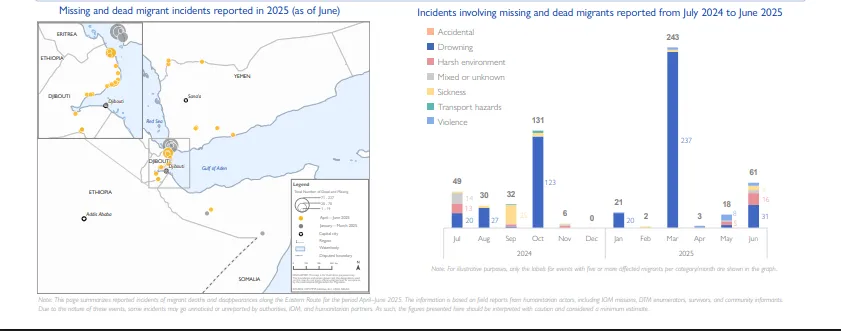
The growing number of fatalities and disappearances along the route also worried participants. The Eastern Route saw 922 migrant deaths or disappearances in 2025, the highest number since comprehensive data gathering started in 2014, according to the IOM’s Missing Migrants Project. Between 2014 and 2025, almost 4,300 migrants died en route.
Experts move to address the Eastern Route issue
During a field visit conducted in Obock-Godoria on 28 April 2026, experts observed more than 500 migrants waiting to cross the Red Sea towards Yemen, illustrating the magnitude and urgency of the situation. The Experts visited a Mass Grave in the desert of 34 drowned migrants.
In response to these challenges, participants called for strengthened:
- Peace and security;
- Resilience against natural disasters;
- Regional and cross-border cooperation and integrated border governance;
- Protection mechanisms for vulnerable migrants;
- Maritime security, search and rescue capacities on land and sea;
- Voluntary return and reintegration programmes;
- Legal and institutional frameworks to combat trafficking in persons and smuggling of migrants;
- Youth mobilisation and innovation for green jobs/employment
- Migration data collection and analysis systems.
IOM also shows that the number of people seeking assistance at MRCs increased (+78%) compared to the previous quarter. Women and girls more than doubled (+158%), while men and boys increased with a smaller change (+60%). The number of children receiving assistance doubled (+111%) from the previous quarter, with a pronounced increase in girls (+184%). Of the girls receiving assistance, more than half (61%) were under 14 years of age, compared to two-fifths (44%) of boys.
This suggests a population facing heightened exposure to exploitation, underscoring the need for comprehensive protection and assistance measures. Around half (49%) of children receiving assistance were unaccompanied, with variation across MRCs in Djibouti (48%), Ethiopia (64%), and Somalia (25%).
Also, during the second quarter of the year (2025), at least 78 migrants died or went missing while travelling along the Eastern Route in Djibouti (66), Yemen (11), and Somalia (1).
As of June 2025, 348 migrants have died or gone missing along the Eastern Route, compared to 310 during the same period in 2024. The extent of the Eastern Route migrant catastrophe has deeply alarmed experts. More than one-third of the more than 500,000 migratory trips between the Arabian Peninsula and the Horn of Africa in 2025 involved women and children, according to data given during the meeting.
“I was informed that there were farm jobs in Eldahir, and I moved here and started working on this farm. Every month, I send some money to my family,” Adam, who is quietly rebuilding his life after surviving the treacherous journey, says with pride.
The impact of the Tadjourah Call to Action
The Swiss Embassy in Ethiopia, which also participated in the IGAD High-Level Meeting in Tadjourah, welcomed the Call for Action to strengthen migration governance along the Eastern Route.
“Human mobility challenges along the Eastern Route continue to underline the importance of regional cooperation,” the Embassy posted on its official X account (formerly Twitter) after the three-day engagements.
IGAD’s official regional contribution to the second International Migration Review Forum (IMRF), which was held from May 5 to 8, 2026, at the United Nations Headquarters in New York, USA, was the Tadjourah Call for Action on the Red Sea Route Crisis and the Report of Progress on the Implementation of the Global Compact on Migration (GCM).
Based on the values of shared responsibility, regional solidarity, and human dignity, the High-Level Team of Experts reaffirmed their shared commitment to advancing safe, orderly, and regular migration.
Sufyan further strongly warned migrants against taking this perilous journey, which is coupled with a lack of regular migration pathways and the complex realities in a region where many suffer from the worst effects of conflict and climate change, including cutting through deserts, the sea and war-torn Yemen.
“We have gone through a lot of problems on this journey; therefore, I would advise those planning to make such a journey to stay where they are and look for job opportunities there. Use the money you would give to smugglers to work. Let them use the money they would have paid to the traffickers to start businesses,” advises Sufyan.
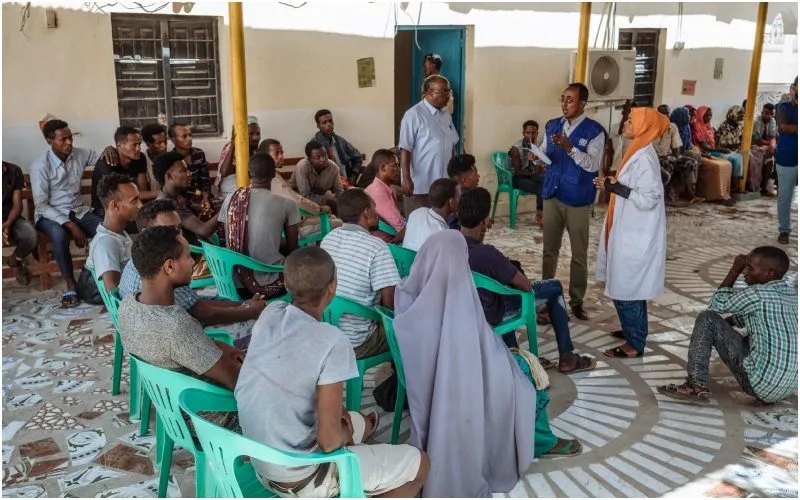
With the adoption of the Tadjourah Call to Action, it is expected that funding to assist migrants in the Horn of Africa will drastically increase, while the needs of the migrant population will decrease.
Through the Tadjourah Call to Action, IGAD, alongside its partners, is pushing for the prioritisation of programmes that provide long-term solutions to strengthen their resilience so that migrants won’t be forced to leave their communities in the first place.







Discussion about this post