


With the unveiling of the government’s areas of focus for the next 5 years, the stakeholders in the agricultural landscape are elated with the identification of agriculture as a key driver to spur economic growth.
The agenda, thus titled the “big four”, identified pillars that include food and nutritional security, affordable housing, manufacturing
and affordable healthcare will be relied upon to create and sustain inclusive economic development.
In a bid to improve food security, both large-scale and small-scale farmers are supposed to be at the forefront of not only farming but also farming smartly.
This ensures that there is enough food for consumption and also for sale and for some farm produce processing to add value so that the intended industries have raw materials.
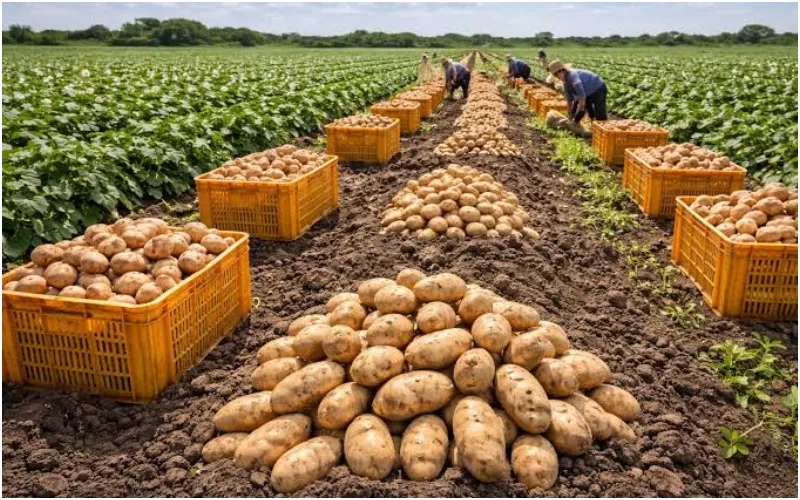
Among the crops largely grown to realise the national goal on food security are potatoes.
Potato farming in Kenya
Potato is the third most popular food in Kenya besides maize and banana. With the increase in population and shortage of maize
in Kenya, citizens are turning to potatoes as an alternative food.
Potato farming in Kenya is also gaining ground as demand for potatoes grows due to rapid urbanisation and the increase in population. The good price the crop fetches is another major factor why many farmers are now warming up to the crop.
The growing of potatoes is also increasing across the world, with China being the leading producer globally. The tubers have both domestic and commercial uses.
Due to their high levels of production, Irish potato is the second most grown staple food in Kenya after maize.
It fetches high prices in the market, and they are very nutritious since they are known to contain fat, sodium, proteins, vitamins and proteins as well slowly releasing carbohydrates and phytonutrients.
Potato farming in Kenya is gaining ground as demand for potatoes grows due to rapid urbanisation and the good price the crop fetches. The growing of potatoes is also increasing across the world, with China being the leading producer globally. The tubers have both domestic and commercial uses.
Due to their high levels of production, Irish potatoes are the second most grown staple food in Kenya after maize. They are very nutritious since they are known to contain fat, sodium, proteins, vitamins and proteins as well slowly releasing carbohydrates and phytonutrients.
The recent rising demand for the tubers is attributed to rapid urbanisation creating a growing middle-class population and the increasing appeal of fast foods such as crisps (chips) and French fries.
Irish potatoes are the second most consumed staple in Kenya. They are generally grown in the higher altitude areas, on rain-fed land, where they compete favourably with maize production.
According to statistics, more than 800,000 people in Kenya directly benefit from potato farming production, while potatoes provide a source of income for over 2.5 million people employed in the value chain.
Unfortunately, 90% of potatoes are grown on smallholdings on less than 0.5 acres of land. Farmers are turning to mechanisation to meet the rising demand for potatoes by improving cultivation and reducing harvest losses.
However, there are other problems beyond land preparation and the quality of seeds and fertilisers that lead to farmers’ harvesting losses.
Coupled with pests and diseases, this greatly affects the quality and the quantity of the potatoes. Some of the common diseases and their signs, which are a threat to the crop, are discussed below.
News 9 visited a potato farmer in Timau Meru, and one of the things that struck us about the crops on one section of her plantation was that some crops were wilting, starting from the tips of the leaves or where the stems branch out, and then spreading to all parts of the plant.
This led to their leaves becoming yellowish at their bases, then the whole plant wilting and dying.
To help us understand what was happening, we decided to sample a few crops and cut the stems. On cutting, a brown coloured ring was evident. The brown ring we noted on the potato stem is caused by
Bacterial wilt.
Disease symptom
The symptoms of bacterial wilt infection can be seen on all parts of infected plants.
The infected plant begins to wilt, starting from the tips of the leaves or where the stems branch out, and then spreading to all parts of
the plant.
Leaves become yellow at their bases, then the whole plant wilts and dies. When stems are cut, a brown coloured ring will be visible.
When a tuber is cut in half, black or brown rings will, however, be visible. If left for a while or squeezed, these rings will exude a thick white fluid.
A further symptom is fluid coming out of tuber eyes. This can be signified by soil sticking to tuber eyes when crops are harvested.
Serious infection causes tubers to rot.
This can be controlled by burying or burning the affected plants and tubers far away from the potato field. It is advisable not to put diseased plants in a compost heap. As an alternative, the farmer is encouraged to burn them.
The best option to avoid loses is to choose a good planting field: Potatoes should never be grown in low-lying or waterlogged areas.
Potatoes are also predisposed to Porcupines which mainly eat roots and tubers, for cultivated root crops. Cassava and carrots are also part of the crops threaten by this wild animal. Every so often, they will even take carrion back to the burrow to nibble on.
In a bid to improve food security, Bayer E. Africa and TingA, East Africa’s largest network of tractors and equipment, among other organisations, have partnered to empower smallholder farmers through potato farming in a project dubbed the smallholder farming initiative. The project that is now changing the farmers’ lives in various counties kicked off in Meru in 2017.
Diana Gitonga a farmer from Timau area within Buuri sub-county, Meru County said “while TingA mechanization has helped us get better yields, our other problem here is porcupines.
“They come from the bushes and the valleys around this area. They are a real problem here I tell you. We have to devise a way of fighting them. They can really make you harvest losses.”
She added, “We are actually forced to chain our dogs here during the day and night. At least this can scare them. We have been able to overcome most of the pests affecting our crops as a result of the partnership between TingA, Bayer and there other partners that ensure we get quality seeds and pesticides.”
TingA field manager Meru Branch Joakim Mutai said, “We have actually been helping the farmers to mechanize their farms. We realised that just renting farm equipment to the farmers is not enough and that is why we partnered with other key stakeholders to make mechanization a reality.
“Through this partnership we ensure that farmers get certified seeds that keep at bay all crop diseases as well as training them in best practices. For the past 6 months we have trained at least 3500 farmers in groups across the nation. We have trained farmers from Mau Narok to Meru on how
to tackle these diseases and pests that threaten their harvests.”
“We couldn’t stand seeing farmers losing their hard-earned coins after doing everything humanly possible to have good harvests. Our partner Bayer East Africa, has been very helpful in supplying the farmers with proper pesticides to protect the crops from stubborn pests,” added the TingA Rental Store Meru Branch Manager.
“Since we partnered with TingA, Quipbank’s project, in 2017, land preparation has become cheaper and easier TingA provide farm support and advisory.”







Discussion about this post