


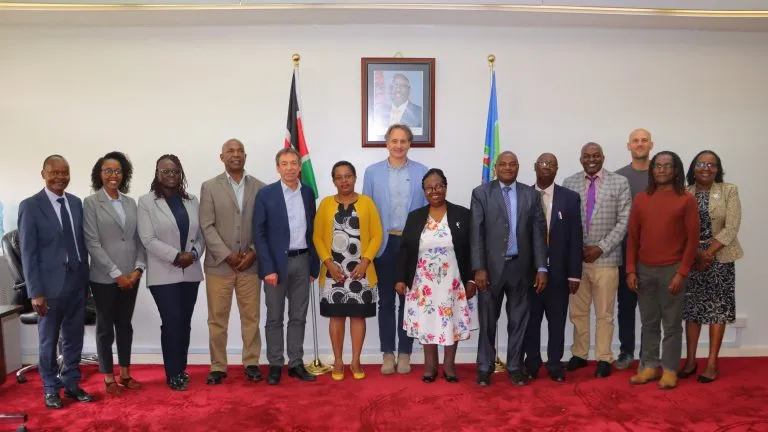
Jomo Kenyatta University of Agriculture and Technology (JKUAT) has reaffirmed its commitment to advancing food and nutrition security research through its continued partnership with KU Leuven (Catholic University of Leuven) and Vrije Universiteit Brussel (Free University of Brussels).
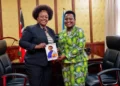
The delegation from the two Belgian universities, visiting under the Legume Centre of Excellence for Food and Nutrition Security (LCEFONS) initiative, paid a courtesy call on the Vice Chancellor, Prof. Victoria Ngumi, during their annual meeting at JKUAT.
The purpose of the visit was to brief the University Management on the progress of the project’s second phase, which spans 2022–2027. The EU-funded collaboration brings together experts in an interdepartmental and interdisciplinary programme focused on the entire legume value chain from production, postharvest storage and processing, to human consumption and its impact on nutrition and health.
During the first phase (2018–2022), LCEFONS achieved notable milestones, including the graduation of six PhD and ten MSc students, as well as the establishment of four state-of-the-art laboratories at JKUAT. Building on this foundation, Phase II has already seen the recruitment of eight new doctoral candidates and the publication of 19 research papers.
Speaking during the meeting, Prof. Ngumi praised the partnership for its impact on JKUAT’s research profile.
“With the many publications arising from the project, JKUAT’s research visibility continues to grow both locally and regionally. The University Management is committed to supporting the project through financial and technical facilitation while assuring stakeholders of continued partnership and collaboration,” she said.
Prof. Ngumi also highlighted her personal engagement with LCEFONS since its inception in 2016, including her 2024 visit to Belgium, where she engaged counterparts on patents, commercialization of research outputs and student exchange programmes.
She noted that the project is helping address real household challenges in Kenya such as the taste and energy costs of preparing legumes, making its outcomes highly relevant to local communities.
Prof. Christophe Matthys, who led the Belgian delegation, echoed these sentiments, emphasizing the project’s role in mentoring young researchers and building sustainable solutions to global food and nutrition challenges.
“It is crucial that graduates from this project are integrated into JKUAT’s systems so that their expertise can continue to strengthen the University’s research capacity and ensure long-term impact beyond the project’s lifespan,” Prof. Matthys said.
The visiting team will also engage in a series of planning and monitoring meetings with various stakeholders as part of their annual review activities.
With Phase II underway, JKUAT and its Belgian partners aim to expand research output, strengthen capacity building and continue transforming legumes into a driver of food security and improved nutrition in Kenya and beyond.








Discussion about this post