


KITUI, Kenya – As Kenyans warm up to the August 2027 General Election, political tensions in the country are sharply escalating.
Already, leading opposition leaders are raising concerns regarding political fraud and the integrity of the elections.
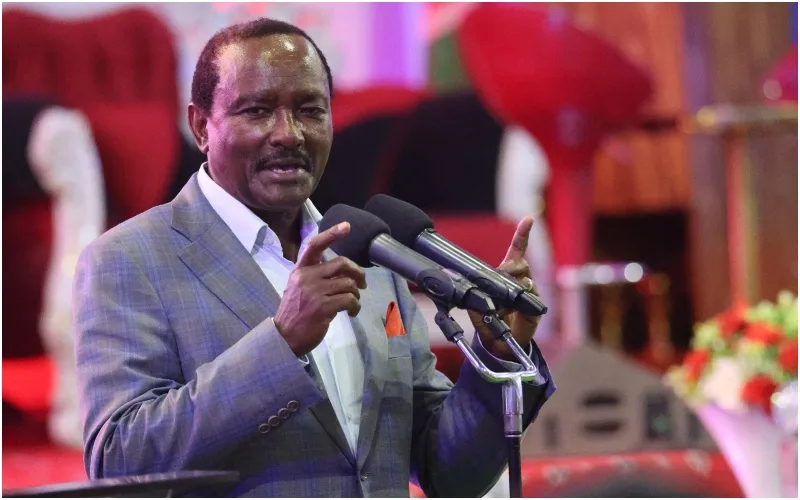
Wiper Patriotic Front leader Stephen Kalonzo Musyoka, who shot the first salvo, said the trend of targeting political opponents is dangerous and threatens Kenya’s democratic stability.
“Not only are we agreeing that President William Ruto will serve one term, but we also need to give reasons for it. The perpetrators of Nazi Germany started by spreading violence accompanied by serious propaganda,” said Kalonzo.
In his own words, Kalonzo went on: “And for the case of Kenya, where we are saying that we cannot allow Nazi Germany to be here, it is because the police have abdicated their responsibility to goonism.”
Governor Wavinya Ndeti calls out MP Oscar Sudi
Speaking while hosting Wiper Patriotic Front professionals from Kitui County, Kalonzo said the growing culture of intimidation during political rallies risks pushing the country in the wrong direction.
Machakos Governor Wavinya Ndeti, who accompanied Kalonzo to the same event, strongly condemned remarks made by Kapsaret MP Oscar Sudi regarding alleged plans to rig next year’s General Election in favour of the Kenya Kwanza administration.
“Let me tell you, Sudi, you’re planting a bad seed by telling Kenyans that you plan to rig the elections. Let us engage in peaceful and sober politics. The person who wins lets them win, and those who lose let them lose peacefully. This Kenya belongs to all of us,” said Governor Wavinya.
In May 2025, during a speech in Eldoret, Sudi allegedly asserted that the United Democratic Alliance (UDA) would add up votes in areas where they might fall short to ensure President Ruto’s re-election.
While critics viewed these statements as a confession of intent to manipulate the election, Sudi later attempted to clarify his comments, defending them as a political strategy rather than illegal rigging.
Kenyan leaders called for caution.
Governor Wavinya termed Sudi’s remarks reckless, dangerous, and likely to incite the public at a time when the country is preparing for elections.
“So, if we defeat President Ruto, he will be treated as a statesman. But you are now even irritating the young people of this country. You are annoying them, yet you know so well what they have gone through. You are looking for a war that is not even there. Sudi, just stop those remarks you are making,” the county boss added.
Governor Wavinya further called on leaders across the political divide to uphold peace, respect one another and exercise restraint in their public utterances as the nation heads towards the next General Election.
She stressed the importance of responsible leadership in safeguarding the country’s democratic process and maintaining national unity.
The governor serving her first term in office also urged the Kamba community to rally behind Kalonzo’s presidential bid, describing him as the most suitable candidate among those who have declared interest in the presidency as political campaigns intensify across the country.
Inside the 2007-2008 Post-election violence
Kalonzo further emphasised that every leader across the political divide must be given enough space to campaign freely and participate in the electoral process without fear or harassment.
“And for those who are interested in running for elective posts on our ticket, I want to tell you as your party leader that we shall have absolutely nothing to do with electoral violence. We want to come and defeat Ruto straight,” added Kalonzo.
The contentious results of Kenya’s December 27, 2007, presidential election set off a significant political and humanitarian crisis known as the 2007–2008 Post-Election Violence (PEV).
Widespread accusations of electoral fraud followed the Kenyan Electoral Commission’s announcement that President Mwai Kibaki of the Party of National Unity (PNU) had defeated Raila Odinga of the Orange Democratic Movement (ODM).
There were between 1,133 and 1,500 fatalities. Still, there were more than 600,000 internally displaced people (IDPs).
At least 900 people experienced widespread sexual and gender-based violence (SGBV) as a result of the violence, which was mostly committed by gangs and security personnel. On the other hand, over 100,000 houses were destroyed.












Discussion about this post