

Kenya’s healthcare sector is staring at a potential crisis as private hospitals warn they may be forced to close their doors or switch to cash-only services by December 2025 if billions in unpaid government debts are not cleared.
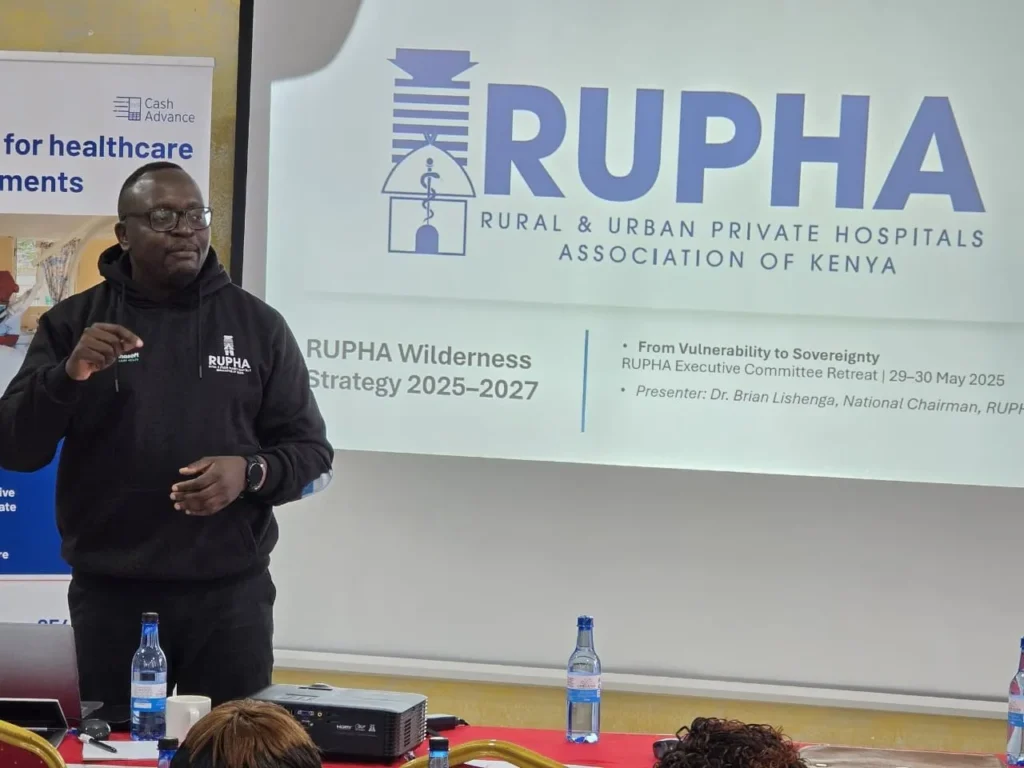
Brian Lishenga, the chairperson of the Rural and Urban Private Hospitals Association of Kenya (RUPHA), sounded the alarm during a televised interview on Monday, September 8.
He described the situation as “unsustainable,” noting that the sector is burdened with a debt of Ksh 76 billion; Ksh 33 billion owed by the National Hospital Insurance Fund (NHIF) and Ksh 43 billion by the newly established Social Health Authority (SHA).
“We have Ksh 76 billion in debt as a sector, Ksh 33 billion NHIF debt and Ksh 43 billion SHA liability. The health sector cannot continue bearing this burden,” Dr. Lishenga said.
He warned that unless urgent action is taken, the consequences for ordinary Kenyans will be devastating.
“What we are saying is this: if this Ksh 33 billion debt is not paid immediately, it is very likely that by December, either you will not have private hospitals, or the entire system will revert to 100 percent cash,” he said.
According to RUPHA, private hospitals serve 80 percent of lower-income Kenyans, making them an essential part of the country’s health delivery system. A collapse of this sector or a shift to out-of-pocket payments could lock millions of Kenyans out of affordable healthcare.
Dr. Lishenga said the warning was not meant to undermine SHA, which was launched earlier this year to replace NHIF, but rather to draw attention to the risks of underfunding and poor debt management.
“The reason why we are giving this notice is not because we dislike SHA. In fact, we are giving this notice because we are scared that SHA will collapse,” he explained.
“If this is not sorted and private and faith-based hospitals start asking Kenyans to pay out of pocket, you will have a vicious circle,he added.
The RUPHA chairperson urged President William Ruto to honour his commitment to settle hospital arrears without delay. He also pushed back against claims that hospitals had inflated invoices or engaged in fraudulent billing, noting that government-owned institutions account for the largest share of unpaid claims.
“Even this issue of verification of NHIF debt, 10 percent of the NHIF debt is owned by two hospitals, MTRH and KNH, both government hospitals. These two alone owe Ksh 15.2 billion, nearly half of the NHIF debt,” he said.
Dr. Lishenga argued that while Kenya must fund other sectors such as infrastructure, health should be prioritised because lives are directly at stake.
“I have sympathy for road contractors, but the health system needs money for it to function. You cannot compare lives to roads,” he added.
Beyond the issue of unpaid claims, RUPHA also questioned the sustainability of SHA’s financing model. Dr. Lishenga highlighted the imbalance in contributions, where salaried Kenyans, who make up less than 10 percent of the population contribute the overwhelming majority of funds.
“SHA has been unable to raise enough money because it is relying heavily on the employed. The 3.4 million salaried workers contribute Ksh 5.4 billion every month, while the informal sector over 80 percent of the workforce brings in just Ksh 600,000,” he said.
He described this disparity as a structural flaw at the core of SHA’s financial troubles. With most Kenyans working in the informal sector and contributing very little, the system cannot sustain the level of payouts required to keep hospitals running.
Current figures show that unpaid claims submitted to NHIF and SHA amount to Ksh 96.2 billion, yet only Ksh 53 billion has been settled. Hospitals say this shortfall has crippled their cash flow, making it difficult to pay staff, stock essential drugs or maintain critical equipment.







Discussion about this post