


ENTEBBE, Uganda – President Yoweri Museveni has showcased a unique vehicle innovated by Ugandans for firefighting.
The Ugandan leader presented the prototype vehicle to a group of foreign dignitaries who paid him a courtesy call at State House, Entebbe.
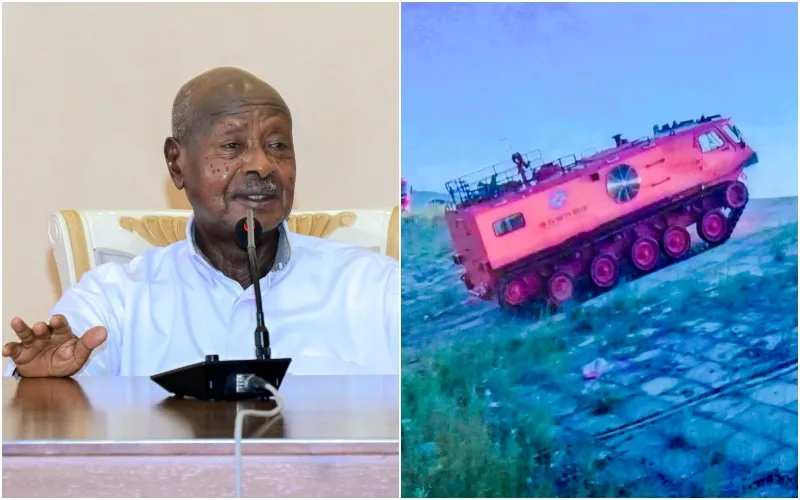
“I was delighted to present our innovative firefighting vehicle, named the “Muliro Eater”, to the Ambassadors of the USA, Russia, the UK, and EU member states.” “We showcased the prototype during the meeting.”
President Museveni disclosed that the innovation followed numerous fire incidents in the region and beyond.
“Having frequently watched on TV as fires devastated towns and regions in these countries, I was inspired to combine our African firefighting tactics with military tank technology to create this fire-eating vehicle,” he explained.
Why President Yoweri Museveni showcased “Muliro Eater” to the envoys
He expressed hope that the envoys would embrace his proposal and convince their countries to purchase the Ugandan firefighting vehicles.
“This initiative represents our commitment to philanthropy and the promotion of African innovations,” said President Museveni.
The largest automobile production facility in East Africa, the Kiira Automobile Plant (KVP) in Jinja, was put into service on October 7, 2024, marking a significant milestone for Uganda. Uganda-themed goods.
President Museveni presided over the ceremony, which was a significant triumph for Uganda’s automotive and industrial sectors and put the country at the forefront of Africa’s sustainable car manufacturing.
What is the potential of the Jinja-based Kiira Automobile Plant
With an initial production capacity of 2,500 vehicles annually and the potential to scale to 5,000, the facility’s remarkable production capacity complements Uganda’s aspirations to become a regional leader in vehicle manufacturing.
This expansion meets the demand for sustainable transportation solutions worldwide by producing high-quality, eco-friendly automobiles. Kiira Motors has manufactured 39 Kayoola buses since its founding, the vast majority of which are electric.
Together, these automobiles have travelled more than 600,000 kilometres, demonstrating Uganda’s dedication to lowering carbon emissions and advancing environmentally friendly urban transportation.
Uganda’s electric transportation industry has also advanced with the training of 145 electric bus operators.
Modern production facilities include a body shop, paint shop, chassis line, trim line, rain test facility and testing track, all part of the 100-acre Kiira Vehicle Plant.
With 163 production stations, the company presently employs more than 200 workers, and as output increases, the workforce is expected to grow to 900.
The project is anticipated to generate more than 14,000 direct and indirect jobs throughout Uganda’s automotive value chain in addition to direct employment.








Discussion about this post