


Editor’s note: In this opinion, Kimutai Kirui argues that a presidency is rarely weakened first by opponents. Kirui observes that it is weakened from within by competing ambitions and an inner circle that mistakes access for influence, power for strength, and intimidation for strategy.
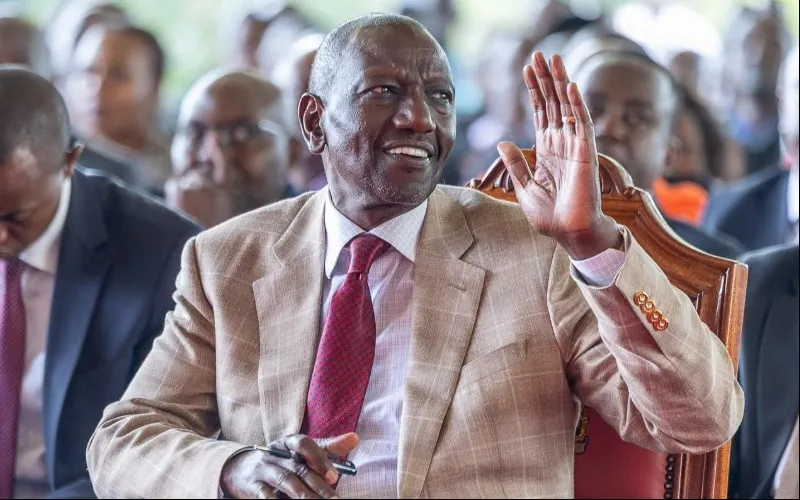
Power can command compliance, but not loyalty. Only humility, persuasion, and delivery sustain legitimacy. President Ruto’s greatest risk may not be external opposition but allies who confuse proximity to power with ownership of it.
The president already has too much on his plate. He cannot govern effectively with a team of political entrepreneurs busy building personal fiefdoms.
President Ruto needs executors, not empire builders
The danger is that some cabinet secretaries appear more focused on expanding personal influence than advancing the president’s agenda. A government cannot move as one when every ambitious player is building a private kingdom.
The greatest threat to any presidency is often not the opposition, but an inner circle that mistakes proximity to power for ownership of it.
Listen to CS Ruku, then listen to his colleague, Murkomen. It raises a serious question: is this the governing culture a nation deserves?
High office demands restraint, dignity, and service. When senior officials adopt a combative tone, they risk diminishing the very institutions they represent.
CS Ruku appears focused on consolidating influence in Mt Kenya East, while Murkomen and his allies are perceived as using the security docket to strengthen political networks in the Rift Valley and beyond.
For a president already carrying the burden of governance, competing centers of influence are a costly distraction.
A government succeeds when its leaders serve one national agenda—not when they build separate political kingdoms.
The greatest threat to a presidency is often not the opposition but the loss of unity and discipline within its own house.
The irony is striking
The same voices that accuse Rigathi Gachagua of tribalism appear equally preoccupied with building their own ethnic and regional fiefdoms. Tribalism does not become leadership simply because it changes beneficiaries.
In the Rift Valley, Hon. Kipchumba Murkomen, CS for Interior, is locked in a perpetual contest with anyone perceived as a rival—from Treasury PS Kiptoo to Senator Mandago, Majority Leader Aaron Cheruiyot, and others.
Murkomen appears to be consolidating smaller Kalenjin communities—Marakwet, Pokot, Tugen, and Keiyo—while positioning himself against the influence of the Nandi bloc. Critics argue he is also seeking to shape Kipsigis politics through preferred allies.
The question is whether this is a path to unity or a strategy for building a personal political base. The impression is of a leader using proximity to the presidency to consolidate a personal political empire, with Oscar Sud, a Marakwet, serving as his principal political point man.
That is a dangerous optic for any presidency. Leaders are elected or appointed to build coalitions, or consensus, not courts; to expand their tent, not fortify their fiefdoms. President Ruto faces two immediate political challenges: a simmering sibling rivalry within UDA that threatens to fracture the party and a weakening center that no longer commands discipline.
- The party secretary general is on vacation.
- The UDA party needs to restructure.
- The UDA increasingly resembles a party where every leader pursues a personal political project so long as they keep chanting “TUTAM.”
- The slogan has become a loyalty ritual rather than a governing philosophy.
Everyone sings the same chorus, but each is composing a different song and building a different empire.
THE OPTICS ARE OF UNITY; THE REALITY IS CENTRIFUGAL POLITICS.
THE PRESIDENT’S INNER CIRCLE MUST PAUSE AND LISTEN IF THEY WANT THE PRESIDENT REELECTED.
President Ruto’s inner circle appears to have stopped listening—not even to itself. They seem intoxicated by power, hearing only their own echoes and forgetting that political power is temporary.
From an ODM in apparent decline to growing unease in the Rift Valley, the president needs to urgently reassess his political strategy. What now defines parts of his inner circle: confidence or arrogance, authority or aggression, or leadership or an excessive display of power?
The concern is a culture of combative politics, opulence, and an obsession with projecting strength at every turn. President Ruto must pay particular attention to the security docket and political mobilisation in the Rift Valley and Mt. Kenya.
Murkomen risks making the president politically costly in areas where he should naturally enjoy goodwill. Together with Oscar Sudi, his style of politics often resembles a carpenter with a hammer—everything in front of him becomes a nail. Politics is not a battlefield where every disagreement must be crushed.
Politics is the art of persuasion
People are won before they are governed. You do not build lasting influence by boasting of wealth while diminishing others or by using the power of office to intimidate opponents. Genuine power produces humility; real influence creates respect.
Many within the president’s circle, including CS Ruku, Kipchumba Murkomen, Oscar Sudi, Kimani Ichung’wah, Betty Maina, Mbadi, and Wanga, have projected a style that critics view as more forceful than persuasive. Being assertive is not a weakness, but leadership without restraint quickly becomes arrogance.
There is an old truth: you become shaped by the company you keep. A leader surrounded by constant applause risks losing the ability to hear uncomfortable truths.
Aden Duale and Joho quietly retreated; the reasons remain their own.
Meanwhile, Maa leaders watch from the sidelines. As Gachagua consolidates Mt. Kenya, ODM appears to be consuming itself. If the trend continues, it risks shrinking from a national party into a regional vehicle. Homa Bay party, leave alone Luo.
Murkomen, meanwhile, appears engaged in political battles within the Rift Valley, including with Mandago and other regional players. Western Kenya is facing its own internal contest, with figures such as the Speaker, Sifuna, Natembeya, Musalia, Atwoli, and others pulling in different directions.
The pattern is clear: internal rivalries are increasingly overshadowing collective political strategy, even in the security docket. Goons and police share shame spaces for the first time in history. Ironically, some of the political traits now criticised in Rigathi Gachagua appear familiar within the broader political ecosystem. It may have been easier to manage a strong mobilizer from within than confront multiple competing centers of influence outside government.
Whatever one’s view of him, Gachagua is a seasoned political operator with experience as President Uhuru Kenyatta’s personal assistant and years of administrative exposure across different governments.
Power is most secure when exercised with restraint. The loudest display of authority is often a sign that authority itself needs reassurance.
The author is Kimutai Kirui, a Kenyan political analyst and human rights activist known for his work in Uasin Gishu County, where he has championed justice in cases ranging from police brutality to land disputes affecting widows.
Views expressed in this article are solely those of the author and do not represent the editorial position of news9.africa.









Discussion about this post