


NAIROBI, Kenya – Stunned by significant voter apathy in his Rift Valley backyard following the conclusion of the Independent Electoral and Boundaries Commission (IEBC) Enhanced Continuous Voter Registration (ECVR), President William Ruto faces a fresh headache.
There is a growing internal conflict within President Ruto’s “broad-based” cabinet, which was formed to accommodate opposition figures. Disagreements on the 2027 succession have caused a serious schism, primarily within the Orange Democratic Movement (ODM) party.
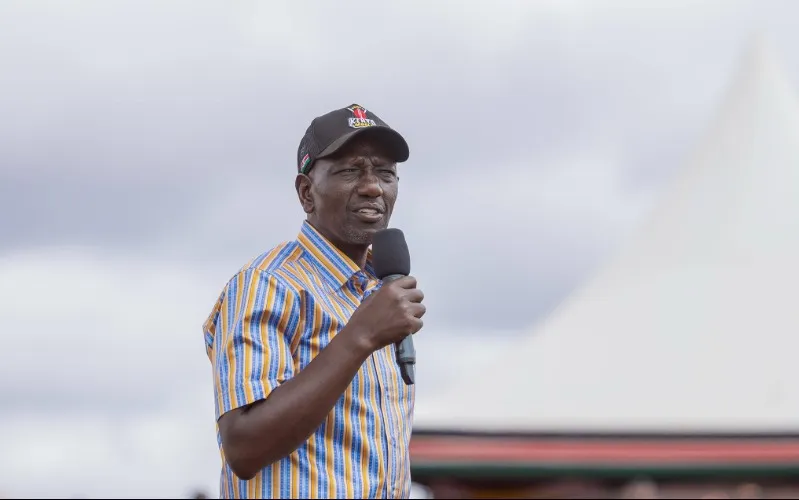
In order to create a “broad-based government” that will promote stability until the 2027 elections, ODM incorporated key “experts” and senior members into President Ruto’s cabinet.
Figures like John Mbadi, Hassan Joho, Wycliffe Oparanya, and Opiyo Wandayi are in Cabinet positions as part of this effort, which is presented as integrating talent rather than a formal coalition.
However, a split is growing between a section (including MPs and young leaders) who are dubious of the collaboration with UDA and top leadership who support the broad-based government.
At the centre of this deepening conflict are two parallel ODM camps. One is allied to ODM party leader Oburu Oginga under the Linda Ground group, while the other is led by embattled ODM Secretary General Edwin Sifuna, who leads the Linda Mwananchi faction.
Busia Woman Representative Catherine Omanyo, who is allied to Oburu’s camp, argues that the Orange party’s move to walk into the broad-based platform was ‘good’ for the country.
“By then, the country was heading in the wrong direction. If it were not for this broad-based arrangement, we would be living in a jungle or somewhere in refugee camps. So, Baba (the late Raila Odinga) went in to calm the situation, and that is why we are here as the ‘broad-based’ government enjoying its comfort,” explained Omanyo.
Omanyo, who insists that she is the de facto ODM secretary general, disclosed that the ‘broad-based’ government was meant to make devolution profound.
“Many times, we had leaders in this country who focused only on developing their regions. But Baba asked us, young politicians, to defend devolution. Baba went into the broad-based government to ensure that devolution was not just a theory but was pragmatically felt across the country. Many people are lazy in their thinking. Before Baba’s demise, if he decided to take any action, it was for everybody and not for himself. He was never egocentric,” Omanyo adds.
Raila Odinga’s focus on the 2027 General election
However, Sifuna sharply disagrees with Omanyo, arguing that ODM has never decided to support Ruto.
“Raila had seen 2027 as the best opportunity for ODM to take up the leadership of this country. For us who know that there is no decision that was made to support Ruto, we must come out and speak out about it. Nobody in ODM can show you a resolution of the party to support Ruto,” maintains Sifuna.
According to Sifuna, the history of the ‘broad-based’ government stems from the Gen Z uprising of June 2024, when Kenya was on the brink of collapse.
“Baba’s thinking then was that we needed to protect our democracy as a country. Baba said we needed to support the government and bring it to a point where we could remove it democratically. But when you hear some of these characters explain it, you may think that ODM and UDA sat somewhere in a convention under very normal circumstances and agreed that we are going to form a coalition government, which is not true,” Sifuna explains.
To win re-election in the 2027 general election, President Ruto has been actively banking on the “broad-based” political system. Additionally, to counter prospective losses in other regions, this strategy, which was expedited after Gen Z protests in 2024, aims to unite the nation by bringing in opposition leaders and unifying support from many regions, especially Nyanza and Western.
Additionally, for Omanyo, ODM’s move to go broad-based has seen some people make it sound like a selfish thing. “But I want to make it clear that it was not created for selfish gains. It was meant to bring sobriety. It was to make sure that the government does not belong to a few people but to all of us,” Omanyo further says.
The woman MP reveals that President Ruto reached out to Raila, the former ODM leader, because he needed help, wisdom and guidance on how to best handle the situation at hand, coming at the backdrop of the Gen Z protests.
“Through the ‘broad-based’ arrangement, we have increased funds in the supplementary budget. Every county will now get something to develop its own little world. In every nation, even in the U.S., people come up with such organs. Here in Kenya, we call it the broad-based government because there is a purpose, drive and doctrine to be followed. This is an organ to base or to drive the government to perform its mandate,” says the MP.
Edwin Sifuna pokes holes into the 10-point agenda MoU
Omanyo also argues that the ‘broad-based’ government is a plus for Kenyans. “There is no way we are going to sit down and see Kenyans suffer when we are in the broad-based government,” she says.
The 10-point agenda memorandum of understanding (MoU) between President Ruto’s UDA party and the ODM party, which was signed on March 7, 2025, at the Kenyatta International Convention Center in Nairobi, is further questioned by Sifuna. The deal included a one-year review period that was expected to end in March 2026 and sought to address important national concerns and ease political tensions.
“By the time we were signing the 10-point agenda MoU, the ODM experts that we loaned to UDA were already serving in government, meaning that the MoU has nothing to do with the broad-based government,” says Sifuna.
Sifuna, who doubles as the Nairobi senator, claims that UDA’s interest is not to implement anything that is in writing.
“They just want an agreement that they can use to run their propaganda on. But for us in the opposition, the case we are making to Kenyans is that the whole ODM base doesn’t support the reelection of Ruto because he is bad for the country, and everybody agrees with that,” states Sifuna.
Sifuna further calls upon leaders to live up to their promises as made to the electorate.
“As a leader, when you promise, you must deliver, but here we have a president who lies about our true situation. You need to be honest with people. You don’t have to mislead the public to earn their support,” he adds.
Sifuna’s remarks are corroborated by Kathiani MP Robert Mbui, who feels that President Ruto is “very good at giving stories”. “If you were to unpack all the things he (Ruto) has promised the electorate and those that he has delivered, it will be a big contrast. Talk of promising to uplift the lives of mama mbogas and boda boda operators,” says Mbui.
Two types of political leaders to contest in the 2027 elections
As the country heads into the 2027 polls, Mbui, who doubles as the National Assembly deputy minority leader, is urging Kenyans to ask themselves, ‘What calibre of leaders do they want to elect?’
“There are two types of people elected to Parliament: people who are determined to make life better for the people who elect them, which is half of the House, and then there is the other group of people intending to benefit themselves at a personal level. So, if you elect people intending to benefit themselves at a personal level, how do you expect them to serve you diligently?” poses the MP serving his third term in Parliament.
But Belgut MP Nelson Koech, a close ally of President Ruto, claims that Sifuna has other interests in mind, which he observed are playing out.
“In my view and where I sit, he (Sifuna) sees himself as having been left out in this broad-based arrangement. Sifuna wanted to be made a cabinet secretary, and I know these things because when I say them, I know what happens behind closed doors in some of these places. So, when he didn’t get the CS position, he became a little bit jittery,” Koech dismissed Sifuna.
In addition, the ODM and UDA are at odds over electoral zoning plans ahead of the 2027 elections. The question of whether parties should refrain from fielding candidates against one another in established strongholds is at the heart of the impasse, which further jeopardises the stability of the existing “broad-based” government coalition.
“The fear about a political party’s dominance should not trigger the push for zoning because that will mean thereafter that we are allocating parties to regions,” cautions political analyst Javas Bigambo.
But in reality, zoning has become less about political courtesy and more about control of numbers and influence ahead of the 2027 polls. In the ‘broad-based’ government, there is a push to field candidates across traditional opposition strongholds, which is being framed as national expansion, but it is also creating friction with allies concerned about internal clashes and weakened support bases.
“If we are honest about our partnerships, we will respect each other and respect each other’s strongholds,” says ODM national chairperson and Homa Bay Governor Gladys Wanga.
Broad-based arrangement threatened by the aspect of zoning
Important battlegrounds are currently feeling the heat of zoning. For instance, Governor Wanga is being challenged by her former deputy, Oyugi Magwanga, who is purportedly supported by Interior Principal Secretary Raymond Omollo. This move has deepened political realignments in the region because Magwanga may run on a UDA ticket.
Additionally, ODM Governor Abdulswamad Nassir anticipates a fierce struggle from UDA Secretary General Hassan Omar in Mombasa County, indicating the president’s party’s organised entry into coastal politics, a well-known ODM stronghold.
According to reports, Kimilili MP Didmus Barasa, who has President Ruto’s support, would run against Westlands MP Tim Wanyonyi of ODM for governorship in Bungoma County, underscoring the growing struggle in Western Kenya.
At the constituency level, Suna East is still a close race between Hesbon Owilla of UDA, who is reportedly running against the incumbent Junet Mohamed of ODM. This illustrates how zoning disputes have permeated grassroots politics.
Meanwhile, President Ruto voiced his displeasure with the limited participation in the IEBC voter registration drive on Thursday, April 30. At the funeral of Transport CS Davis Chirchir’s father, the head of state broke away from the national languages and spoke to Kalenjin mourners in Bomet, expressing his dissatisfaction with his tribesmen. He questioned why over 2.3 million eligible voters in the area failed to show up for voter registration.
“We have 1.8 million Kalenjins here who have national ID cards but have not registered, and another 500,000 aged 18 and above who have not even taken IDs to enable them to register,” President Ruto lamented.
The president told his tribesmen that they were giving him an uphill task to court Kenyans from other regions to fill up his vote basket ahead of 2027.
“You are giving me a tough job, struggling to seek support elsewhere while I have people back home. No. It should not be the case,” the head of state lamented.





Discussion about this post