


NAIROBI, Kenya – Africa covers 30.37 million km² and comprises 54 countries, 51 of which are led by presidents (heads of state).
These presidents serve in a variety of governance systems, including full presidential, semi-presidential, and parliamentary.
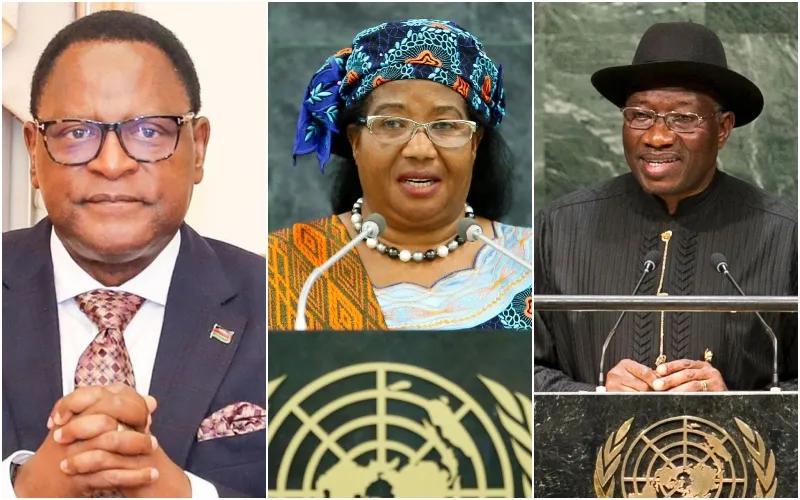
African leaders are frequently known to serve many terms, with some even clinging to power beyond their mandates.
At least seven presidents, on the other hand, served only one term and handed over office peacefully to their successors.
News 9 Africa looks at these leaders who were tossed out of office after serving one term in office and oversaw a smooth power transition.
1. Lazarus Chakwera – Malawi (2025)
Malawi’s President Lazarus Chakwera accepted loss in last week’s election on Wednesday, September 24, 2025, stating in a national speech that his adversary Peter Mutharika had a “insurmountable lead”.
The former pastor assumed power in the 2020 elections after defeating then-President Mutharika, a constitutional law specialist from the Democratic Progressive Party.
The terrible situation of the economy dominated the election in the small southern African country, with detractors accusing Chakwera of mismanagement and indecisiveness, as well as failing to combat corruption and deliver on job creation promises.
During his tenure, costs surged in the agriculture-dependent and rural nation, with inflation reaching 33% and the price of staple grain corn and fertiliser skyrocketing, a significant election issue.
2. Rupiah Banda – Zambia (2011)
In September 2011, opposition leader Michael Sata was declared the winner of Zambia’s presidential election, succeeding incumbent Rupiah Banda as the leader of Africa’s largest copper producer after polls marred by public violence.
Sata was proclaimed the winner after receiving 1,150,045 votes versus Banda’s 961,796 in 95.3% of constituencies counted. Sata garnered 43% of the vote and was challenged by several minor parties.
Banda, then the leader of the Movement for Multi-party Democracy (MMD) party, which has led Zambia since one-party rule ended in 1991, admitted electoral defeat, saying, “The people of Zambia have spoken, and we must all listen.”
“Now is not the time for violence and retaliation. “Now is the time to unite and build tomorrow’s Zambia together,” he stated during a press conference.
3. Joyce Banda – Malawi (2014)
Malawi held its general elections on May 20, 2014.
Malawi had its first tripartite elections, electing the president, National Assembly, and local councillors all on the same day.
Peter Mutharika of the Democratic Progressive Party won the presidential election by defeating incumbent President Joyce Banda.
The election was called after Bingu wa Mutharika died of a heart attack on April 5, 2012, and Joyce Banda took over the presidency two days later, in accordance with the constitution, despite protests from some ruling party officials who claimed Banda’s expulsion from the ruling party rendered her ineligible.
4. Goodluck Jonathan – Nigeria (2015)
Nigeria held general elections on March 28 and 29, 2015, marking the fifth quadrennial election since military control ended in 1999. Others choose the President and members of the House of Representatives and Senate.
Goodluck Jonathan, the incumbent president, sought a second and final term.
After losing the 2015 election to former military ruler Muhammadu Buhari of the All Progressives Congress (APC), Goodluck Jonathan became the first Nigerian president to acknowledge defeat.
It allowed the opposition party to take control in Africa’s largest democracy, which had previously endured vote manipulation and violence.
5. John Dramani Mahama – Ghana (2016)
In December 2012, John Dramani Mahama was elected president for a full term.
In 2016, he ran for re-election for a second term but was defeated by Nana Akufo-Addo of the New Patriotic Party.
This made him Ghana’s first president to not win a second consecutive term.
He was defeated by the largest margin in the west African country’s post-independence history, owing to corruption scandals and an energy crisis that had ravaged the economy.
6. Mokgweetsi Masisi – Botswana (2024)
On November 1, 2024, former Botswana President Mokgweetsi Masisi acknowledged defeat in the country’s General Election, which his Botswana Democratic Party lost by a landslide after nearly six decades in office.
With practically all constituencies tabulated, the opposition coalition Umbrella for Democratic Change (UDC) has achieved a parliamentary majority, with its leader, lawyer Duma Boko, poised to become the next president of the southern African country.
Soaring unemployment has disproportionately affected young people, fuelling a reaction at the polls against the BDP, which has ruled the 2.5 million-strong country since its independence from Britain in 1966.
The election results are also part of a larger wave of popular discontent that has swept throughout the continent, fuelled by a scarcity of good employment for the continent’s rising young population.
7. Abdoulaye Wade – Senegal (2012)
In March 2012, thousands of people celebrated in Dakar’s streets when early results revealed Senegalese opposition candidate Macky Sall defeated incumbent President Abdoulaye Wade, who sought a third term.
Sall fans gathered in the capital’s streets to chant, dance, and sound car horns.
Wade acknowledged defeat and congratulated Sall when preliminary results showed an enormous lead for his runoff opponent.
“My dear compatriots, at the end of the second round of the vote… the current results indicate that Macky Sall has won,” Wade told reporters.
How Rigathi Gachagua reacted to Malawi’s recent elections
Meanwhile, while congratulations, Malawi’s President-elect Prof. Peter Mutharika and the people of Malawi, former deputy president Rigathi Gachagua termed the development historic democratic victory.
“On your election as the 7th President of the Republic of Malawi, your win is a great victory, too consequential in the history of future African elections to be ignored by anyone. This election was more than a national triumph for the Republic of Malawi; it is a continental statement. It is a declaration that Africa, the rising continent and a home to 1.5 billion people, is no longer a playground for religious hypocrisy, conmanship, corruption, pathological lies, dictatorship, and self-serving regimes,” said Gachagua.
In a statement seen by News 9 Africa, Gachagua observed that the people of Malawi had demonstrated that the ballot remains the most powerful tool of liberation, where governments have failed to listen to their people.
“To those clinging to power through lies, state-sponsored violence and propaganda, religious hypocrisy, tribal manipulation and arithmetic, goonish tendencies, abuse of constitutions, and state capture; the bells are ringing. From Idi Amin to Mobutu, from Bokassa to Mugabe, the era of oligarchy and strongmen has collapsed under the weight of people’s power on the ballot, Gachagua added.
Gachagua, the DCP Party leader said that Malawi had reminded us that African citizens are awake. “They see. They feel. They think. They act.”
“Kenya is equally watching, ahead of the 2027 General Elections, and Kenyans are wise people. I call on the people of the republic of Kenya to draw strength from Malawi’s courage and exercise of sovereign power. Just like our Malawian brothers and sisters, we must reject fear and cynicism, reject hopelessness, and reclaim our future through democratic means. Congratulations once again, H.E. President-elect Prof. Peter Mutharika. Your victory is Africa’s victory. Let it ring loudly in the hearts of all those still waiting for justice, dignity, real leadership, and liberation,” he explained.
According to the DCP boss, President Chakwera, has exhibited great maturity for conceding defeat and calling President-Elect Prof. Mutharika and congratulating him.
“The will of the people is supreme. WANTAM IS A REALITY!” Gachagua further said.






Discussion about this post