

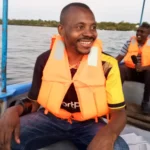
HOMA BAY, Kenya – Fish cage farming in Lake Victoria has become a very profitable venture, with many farmers enjoying improved livelihood and higher incomes due to the huge production volumes.
In the face of diminishing wild fish sources, this innovative method of aquaculture is revolutionising traditional fishing by providing a reliable and lucrative alternative.

In the five counties, namely Migori, Kisumu, Homa Bay, Siaya and Busia, that border and are covered by Lake Victoria, the government is empowering the local communities at the bottom of the pyramid to create wealth by investing in aquaculture through the provision of fish cages, quality fingerlings and feeds to scale up production and expand economic opportunities.
“We have embraced this innovative method of aquaculture because there are no longer fish in the lake because it has been overfished,” said Malit Sarah, the Homa Bay County Executive Committee Member (CECM) in charge of Blue Economy and Fisheries.
Lawi Odiembo, a small-scale fish trader in Ngeri village, disclosed that previously, they used to look for fish deep in the lake, but they could only manage to get a few grams or even fail to get any.
“After a night-long search for wild fishing in the lake, our people were getting discouraged with fishing,” added Malit.
According to President William Ruto, there is a need to scale up and broaden the space around aquaculture.
“And here in Lake Victoria, fish cages become the next step. For instance, in Homa Bay, we gave each group a cage. Each cage can hold up to 33,000 fingerlings and grow them in seven months,” announced the head of state.
Kenya Kwanza government invests in the fish cage farming
Betsy Njagi, the Principal Secretary of the State Department for the Blue Economy and Fisheries, Ministry of Mining, Blue Economy and Maritime Affairs, announced that the ruling Kenya Kwanza administration is investing close to more than Sh 500 million for the five riparian counties within the lake region.
“We are giving fishermen cages as groups formed in communities close to 109 cages for the five counties, worth more than Sh 350 million, and of course, we shall provide them with inputs, that is, the food and the seeds,” explained PS Njagi.
The very first batch of fingerlings that was stocked for the Ngeri Community Concession Group in Homa Bay County by the Cabinet Secretary for Mining, Blue Economy and Maritime Affairs, Ali Hassan Joho, was harvested in December 2025.
“The first harvest was very successful – 33 tonnes. So, 350 by 33,000 fingerlings. We gave the farmers the cages, the feeds, and the fingerlings. Seven months down the line, you have harvested more than Sh11 million. Could there be a better transformation than this, really?” posed CS Joho.
Josephat Mtende, chairperson of the Ngeri Beach Management Unit (BMU), demonstrated how harvesting fish in the cages is done.
“We begin by removing the upper net so that we can harvest the fish. After doing so, we take the fish harvest to the shores where buyers are already waiting,” Mtende explained.
Fish cage farming: a transformative move for L. Victoria counties
On June 1, 2025, Ngeri Community Concession Group received 12 fish cages, 213,000 tilapia fingerlings and 770 bags of fish feed through the support of the Aquaculture Business Development Programme (ABDP).
“Our commitment to economically empowering fishing communities through the State Department for Blue Economy and Fisheries, in partnership with the ABDP, is indeed delivering remarkable results,” noted CS Joho.
Following the harvest, CECM Malit termed the development a miracle, adding that apart from fish harvesting, community members are also happy that all their fish have been off-taken.”
“We have gotten a bumper harvest of fish, and I must say that this is a miracle to us all, including the community,” further said the overjoyed CECM.
Mercy Chepkirui, Project Lead RIO FISH, lamented that in the fish business, sometimes they lack quality fish and an adequate supply.
“But here in Ngeri, we are sure of good quality and quantity of fish, and we also have access to the cages where the community is doing their fish farming,” said Chepkirui.
Ngeri Community Concession Group is a leading example in aquaculture
Michael Omondi, Homa Bay County Project Coordinator, ABDP emphaised that the project demonstrates how sustainability can be created.
“The money that these farmers are earning will be ploughed back again to buy more fish and more fingerlings so that there is sustainability and food security for the community,” Omondi observed.
On his part, Paul Okumu, a resident of Ngeri village, revealed that as community members, they are very happy.
“We can see and feel that President Ruto’s government has remembered us, because where we are, we never imagined that such a project would ever come to us, because we are very far,” Okumu said.
CS Joho reiterated that the sale of the harvested fish had generated meaningful income for the Ngeri group.
“Just six months later, they have already achieved two successful harvests, transforming livelihoods, boosting household incomes and reinforcing aquaculture production across the County. We are creating wealth at the bottom of the pyramid,” said the CS.
Inside Kenya’s National Blue Economy Strategy 2025-2030
In February 2026, Kenya launched the National Blue Economy Strategy 2025-2030, a milestone that signals the determination to place the ocean, lakes and all aquatic resources at the centre of the national development agenda.
“For too long, the Blue economy has been treated as peripheral rather than foundational to our economic planning. This strategy corrects that. It explicitly positions the Blue Economy and fisheries as the core drivers of our growth, fully aligned with our aspirations, Vision 2030, and the Sustainable Development Goals,” said CS Joho.
Marakwet East MP Kangongo Bowen, who chairs the National Assembly’s Blue Economy, Water and Irrigation Committee, observed that this was the first time that Kenya was having a ‘serious’ conversation about the Blue Economy.
“As Parliament, we are committed to supporting the Ministry and to supporting the government to make sure that we achieve all that we want to achieve in the Blue Economy space,” MP Bowen assured guests at the launch.
Cage fish farming should be a matter of concern to the lake’s ecosystem
PS Njagi revealed that as a Ministry, they felt it was critical to have a Blue Economy strategy that the private sector, the development partners, communities, associations and the entire fraternity can unpack to raise the Blue Economy sector from the current earnings of Sh 40 billion to at least Sh 80 billion to Sh 100 billion in the next two years and Sh 350 billion by 2030.
“Kenya is a maritime nation with strategic maritime assets driving jobs, trade, food and nutrition security, climate resilience and regional integration,” added CS Joho.
The strategy explicitly positions the Blue Economy and fisheries as core drivers of our growth, fully aligned with our aspirations under the Vision 2030 and the Sustainable Development Goals.
Meanwhile, there is no doubt that fish cage farming, which has emerged as a profitable endeavour, provides a sustainable substitute for diminishing wild fish populations while also enhancing lifestyles.
Unchecked cage farming, however, poses a threat to the lake’s ecosystem due to pollution and habitat destruction, raising ongoing environmental concerns.
Long-term success still depends on striking a balance between ecological sustainability and profitability.






Discussion about this post