


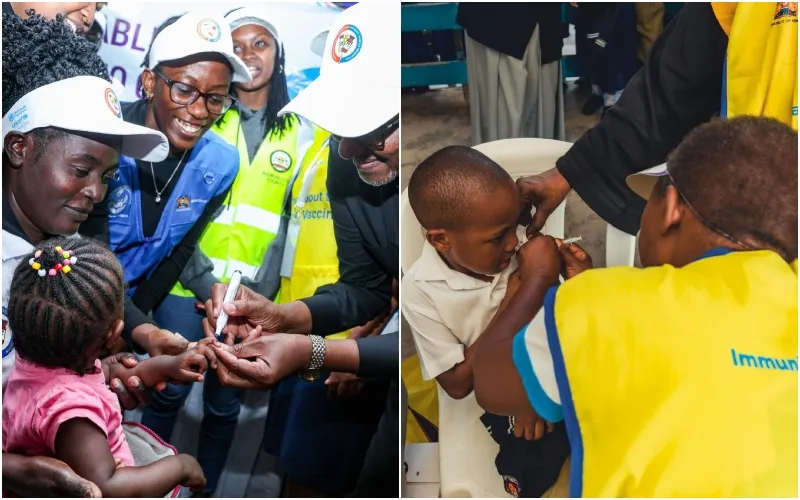
NAIROBI, Kenya – On July 5, 2025, Health Cabinet Secretary Aden Duale officially launched the Integrated Measles-Rubella and Typhoid Conjugate Campaign at Githogoro Grounds in Westlands, Nairobi County.
The life-saving initiative aims to boost child immunisation coverage and curb the burden of preventable diseases across Kenya.
Following the unveiling of this ambitious initiative, the National Vaccines and Immunisation Programme of Kenya is keen to reduce illness and death from vaccine-preventable diseases by ensuring access to safe and effective vaccines.
Elvis Wekesa, a registered nurse based at Serewo Health Centre in West Pokot County, says that in his experience, he has seen the impact of the rotavirus vaccine.
“We are having issues with access to clean and safe water. We are having a lot of diarrhoea cases in our kids, but since we started immunising the rotavirus, it has helped reduce the mortalities due to dehydration from diarrhoea, which is secondary to diarrhoea. So, I have seen the impact. I have also seen a reduced number of measles cases,” says Wekesa.
He further observes that the few measles cases in West Pokot County are due to late receiving or incomplete immunisation.
“We have reduced a lot of neonatal pneumonia. We have reduced a lot of whooping coughs, also TB in children is very minimal. So, I can attest that vaccines are very effective. We want to encourage our mothers to ensure they complete multiple viral doses and also to ensure not finish immunisation after nine months. They also need to take up to five years, where we also have vitamin A, we also have deworming to ensure the health of our children,” he adds.
Why vaccines should be made available
Lokirieriet Kaaman, a resident of Kabura area in Turkana County and mother of three, says she follows the immunisation schedule because it is important.
“Vaccines protect my children against diseases. I have not had any problem with the vaccines because the vaccines are very beneficial to my child. I decided I had to get my child to the hospital immediately after I heard about the vaccination. The hospital is quite far from home, so I slowly push the wheelchair until I get there,” she said.
Lokirieriet admits that she is grateful that the vaccines are available, but also wishes that the vaccines could get closer to them because they live quite far from where they are available.
“It would be better if the outreach efforts got to us here. I would like to extend my gratitude to all the organisations and to everyone who has made it possible for us to receive the vaccines, especially the caregivers. To everyone in the community who has not taken their children for vaccination, to make sure our children are vaccinated,” she advises.
Dorcas Tioko, mother of one daughter, aged 13 years from Kakuma, Turkana County, reveals that her daughter has never missed any vaccination, so her immunity is not bad.
“Just recently, she received the typhoid vaccine, and she also got the HPV vaccine. I advise parents to allow their children to get vaccinated and constantly follow up on the vaccines, because they help strengthen immunity against diseases. But if a child hasn’t been vaccinated and maybe they have missed some vaccines along the way, then it becomes easy for that child to get sick frequently, and they also won’t have good overall health,” says Tioko.
CS Duale has continuously reaffirmed he government’s commitment to protecting the health of children and communities, calling on parents, caregivers, teachers and religious leaders to support the nationwide vaccination drive.
“The vaccines are safe, effective and free of charge at all public health facilities and outreach sites,” the CS emphasised.
How vaccines are handled by experts
Eunice Thuo, nurse and vaccine depot manager, Mathare Sub-County in Nairobi County, deals with vaccine management and cold chain equipment management.
She discloses that vaccine management entails picking, storing and distributing vaccines to the sub-county.
“How we connect with the facilities is that we have to pick the vaccines from the regional vaccine store, then store them here and distribute them to the facilities. Facilities come and pick the vaccines of which entail faith-based, public and private facilities. They come here to collect once every month as they bring their reports,” says Eunice.
According to the medic, the steps they take to ensure that vaccines are stored safely are that they collect the vaccines from the regional stores and use cool boxes with ice packs.
“At the vaccines depot, we have the temperature monitoring devices, we have the fridge tank that we use normally for monitoring the temperatures in the cold chain equipment that we store twice a day, and then we have gone ahead and now we have another system, it’s called the remote temperature monitoring device (RTMD). So, the RTMD helps us monitor the temperatures even remotely for our cold chain equipment, meaning that our vaccines are safe,” she says.






Discussion about this post