


KAJIADO, Kenya – More than 600 Maasai are racing to dig 50,000 miniature earth dams across degraded land before El Niño rains arrive, hoping to turn destructive downpours into new grazing for livestock and wildlife.
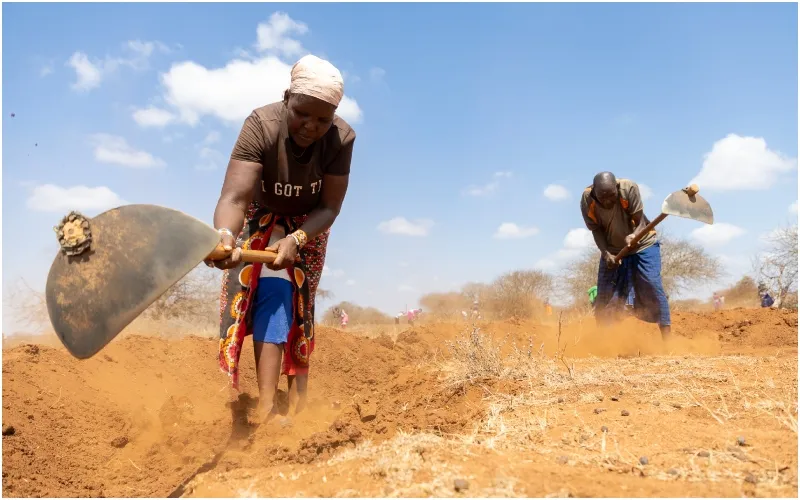
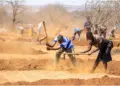
Workers hired from villages on Mbirikani ranch are carving tens of thousands of semi-circular earth banks, known as bunds, into hundreds of acres of dry ground and scattering them with indigenous grass seeds.
Bunds catch and hold rainfall, allowing it to drain slowly into the ground and nourish new grass, instead of running off the bare surfaces and causing soil erosion
The community-driven rangeland restoration initiative, implemented by Big Life Foundation with support from restoration non-profit Justdiggit Foundation and the TWENDE project, is working in four active sites to dig more than 1,000 bunds a day.
Big Life and partners pay more than KSh 9 million to 657 casual workers digging the bunds, many of them local Maasai women including widows and others who lost their livestock during recent droughts.
Eight community grass seed banks, coordinated by Big Life and run by women’s groups across group ranches in Kajiado, supply the seeds sown around the bunds, generating sustainable income from seed sales, hay baling, and integrated beekeeping enterprises.
The work builds on a five-year restoration programme from Big Life and partners including Conservation International and JustDiggit, with funding from Apple Inc and the TWENDE Project among others, that has already constructed more than 278,000 bunds across 2,300 acres – around the size of Karura Forest in Nairobi – helping regenerate grasslands while providing paid work for local communities.
Natural regeneration and controlled grazing add to the area restored with bunds, meaning rangelands essential for livestock and wildlife that Big Life has helped to restore now cover more than 17,500 acres.
“One of the biggest crises facing pastoralist communities today is pasture scarcity caused by degraded land. When heavy rain falls on bare, hardened ground, much of that water can simply run off. These bunds give it somewhere to collect and soak into the soil.
“We are preparing the land now so that when the rains come, we can make the most of every drop and give grass the best possible chance to grow. If rain falls on compacted, bare earth, that life-giving moisture is lost in minutes,” said Ernest Lenkoina, Rangelands Restoration Manager at Big Life Foundation, a community conservation organisation headquartered in Mbirikani.
The Greater Amboseli ecosystem supports Maasai pastoralist communities alongside elephants and other wildlife, but its semi-arid grasslands are under growing pressure from recurring droughts, changing land use, and degradation. Healthy pastures are essential to both livestock production and wildlife conservation.
While pastoralists eagerly anticipate the end of dry spells, severe rainfall like the anticipated El Niño presents a double-edged sword. In heavily degraded areas, bare, hardened, sun-baked soils cannot absorb water.
Bunds are shaped in wide half-moon crescents and dug where water naturally flows, acting as miniature 2.5 m-by-5 m dams that slow or stop rainwater run-off, prevent gullies from forming, and keep what topsoil remains in place.
Water settles in the bunds’ basins instead of sluicing away in flash floods, soaking steadily into the subsoil. Indigenous grasses take root and spread to regenerate the surrounding landscape.
“We cannot afford to spend more time talking about restoring our landscapes than actually restoring them. Nature has an incredible capacity to regenerate when given the opportunity. Our role is to create the right conditions, support communities, and combine indigenous knowledge with science and innovation to accelerate that regeneration.
“The time to act is now. We must move faster, scale up our efforts, and let nature do what it does best: regenerate,” said Caroline Kerichu, Southern Landscape Manager at Justdiggit Foundation, a non-profit that inspires millions to regreen degraded landscapes in Sub-Saharan Africa
Sites restored under Big Life’s earlier bund-digging programmes are now providing a vital buffer against droughts. Pasture yields have rebounded significantly in areas including Ilchalai, Loosikitok, and Olngosua, staying greener longer and providing essential forage for livestock and wildlife during dry months when untreated areas collapsed.
To ensure the newly reseeded grasses can mature and drop seed, local communities have established strict temporary grazing agreements. Community Land Management Committees (CLMCs) and dedicated rangeland scouts monitor the restoration zones, keeping livestock off recovering plots until the grasses firmly establish.
Big Life works to protect wildlife and wild lands by ensuring conservation directly benefits the local communities who share them. By employing local residents to restore degraded rangelands, the organisation provides vital household income to drought-hit pastoralists while reviving the communal pastures essential to sustain livestock, keep wild animals out of neighbouring farms, and secure peaceful coexistence.






Discussion about this post