


Bomet, Kenya – A wave of transformation is sweeping through Bomet County as Safaricom Foundation rolls out multi-million-shilling education and digital infrastructure projects that promise to redefine learning, innovation, and youth empowerment in the region.
For a community long affected by limited facilities and slow technological growth, these developments signal a new dawn of opportunity.
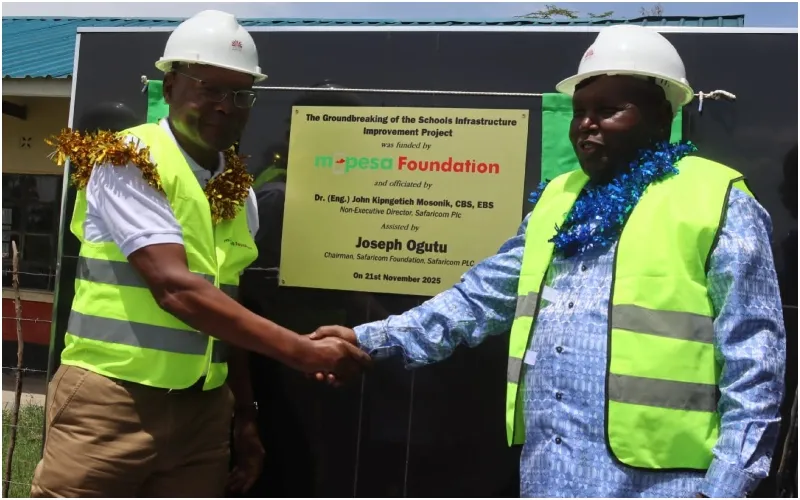
Last week, Safaricom Board member Eng. John Mosonik, together with the Foundation Chair Mr Joseph Ogutu, led a groundbreaking ceremony at Kamureito Primary School, marking the start of a KSh 66 million Infrastructure Improvement Project.
The ambitious investment will fully modernise the school from Early Childhood Development classes to Junior School, creating an environment that reflects the demands of 21st-century education.
Eng. Mosonik said the project will deliver fully furnished classrooms, a dedicated ECDE playground, new desks and chairs for Grades 1 to 9, and modern learning facilities designed to elevate academic performance and student engagement.
A computer laboratory and ICT suite equipped with 40 brand-new computers, high-speed printers, and a science laboratory will anchor the school’s shift into digital learning.
The institution will also receive a modern kitchen equipped with energy-saving cookers to enhance the feeding programme, as well as a state-of-the-art administration block to strengthen leadership and management.
“I am deeply grateful to the community members, education stakeholders, and local leaders who joined us. Your commitment affirms that education remains the most powerful tool we can give our children,” said Mosnik.
Foundation Chair Joseph Ogutu echoed the sentiment, saying Safaricom Foundation is committed to delivering a learning environment that inspires brighter futures and expands opportunities for generations to come.
While Kamureito Primary is set for a major facelift, an equally significant project is rising at Kimawit Primary School, the Kimawit Digital Hub, which is fast emerging as the region’s most advanced centre for technological training, innovation, and digital literacy.
Once completed, the hub will serve as a powerful driver of youth empowerment, providing pathways to careers and entrepreneurship in the digital economy.
Recently, the Kenya Bomet Association of Scholars and Academicians (KEBASA), comprising professors, PhDs, and university lecturers, visited the site to assess progress and explore partnerships.
Led by Eng. Mosonik, the delegation included Africa Gospel Church Presiding Bishop Dr Robert Langat and the Vice-Chancellor of Kenya Highlands University.
The scholars lauded Safaricom Foundation for what they described as a visionary initiative that aligns with modern educational needs.
“Scholars are the torchbearers of transformation,” Mosonik said after the meeting. “They shape minds, influence policy, and drive solutions in technology, governance, health, and beyond. Their support ensures we build not just infrastructure, but a culture of excellence.”
Bishop Langat added that development must integrate both intellectual growth and moral grounding, emphasising the need for education anchored in values.
The Kimawit Digital Hub will offer cutting-edge programmes in programming, digital marketing, online commerce, content development, and job-readiness skills.
The facility will link learners with mentors, innovators, and higher education institutions, while providing certifications through collaborations with various universities.
Its impact is expected to ripple far beyond Sotik Subcounty, positioning the region as a rising centre of digital excellence.
The introduction of modern classrooms and digital hubs in Bomet marks a crucial step toward closing the digital divide.
In an era where online skills determine employability and innovation shapes livelihoods, the benefits for residents, especially young people, will be far-reaching.
Students will learn in safe, modern environments, while community members will gain access to the digital knowledge and tools that power today’s global economy.
The initiatives complement government efforts under Kenya Vision 2030, which identifies digital transformation as a central driver of economic, social, and political progress.
This includes expanding broadband connectivity to rural communities, strengthening the nation’s ICT backbone, and promoting affordable internet access for schools, households, and small businesses.
As machines hum, classrooms rise, and computers are installed, Bomet stands on the brink of a technological awakening, one skill, one child, and one community at a time.











Discussion about this post