

KWALE, Kenya – Kwale County’s fisherfolk have a reason to smile after area Governor Fatuma Achani gave the Diani Pastors’ Fellowship Self-Help Group in Ukunda Ward, Msambweni Sub-County, fish value-addition equipment, such as cold chain facilities, fish processing, and vending equipment.
The equipment, which includes freezers, chillers, cooler boxes, frying pans, display boxes, solar-powered systems, lamps, umbrellas, and energy-efficient cooking jikos, is intended to lower post-harvest losses, boost fishermen’s profits, and facilitate market accessibility.
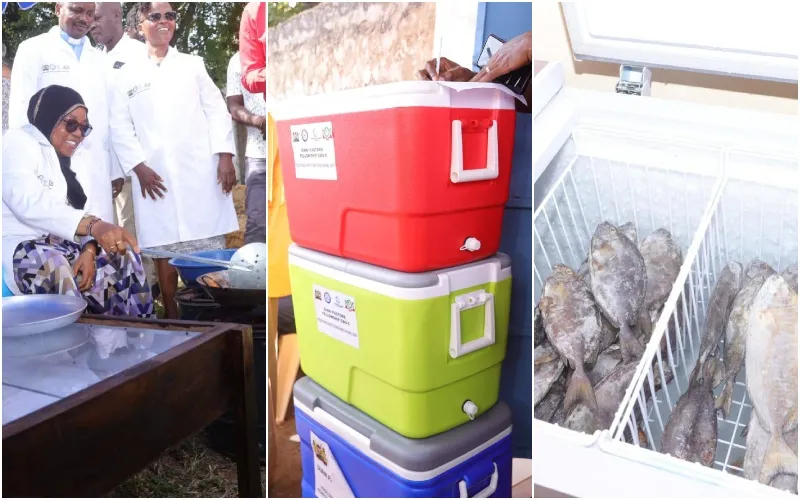
This support is a component of a World Bank-funded project run by the Kwale County Government under the Kenya Marine Fisheries Socio-economic Development (KEMFSED) Project.
Speaking during the event, Governor Achani said the equipment will not only improve the quality of fish products but also create job opportunities, especially for youth and women.
“This is not just an investment in equipment; it’s an investment in our people, especially our women and youths. By reducing fish waste and adding value to what we produce, we are building better livelihoods and growing the coastal economy,” said Governor Achani.
She also restated her administration’s commitment to growing the fisheries sector in Kwale.
“Our coastal communities have great untapped potential. By promoting sustainable fishing and providing modern tools, we can improve many lives and grow the blue economy,” she added.
Why the State Department of Blue Economy has become a game changer
Governor Achani thanked President William Ruto’s administration, pointing out that the establishment of the State Department of Blue Economy has improved the standard of living for locals.
Kwale County has already provided 48 contemporary fishing boats, 8 ecotourism boats, and 6 seaweed farming boats as part of the KEMFSED project to boost the local blue economy.
To help fisherman operate more safely and efficiently, every boat is fully furnished with fishing equipment, safety gadgets, GPS, and fish finders.
Chairman of the Diani Pastors, Danny Nganyi, thanked the County for the support stating that the project will enable them enhance their livelihood.
“This support means a lot to us. With proper storage and processing equipment, we can now sell our fish at better prices and reduce the waste we used to experience,” said Nganyi.
Why the people of Kwale have a great opportunity to improve their livelihoods
This distribution marks an important step in empowering coastal communities and strengthening the local economy.
With continued support and responsible use of the equipment, the people of Kwale have a great opportunity to improve their livelihoods and build a more sustainable future.
This comes barely a week after Governor Achani has led the stocking of 4000 fish fingerlings for 2 fishponds managed by the Amani Community Group in Maponda village, Mkongani Ward, Matuga Sub-County.
The initiative is part of a broader effort by the Kwale County Government, implemented through the Kenya Marine Fisheries and Socio-Economic Development (KEMSFED) project, funded by the World Bank.
The project aims to promote fish farming as a source of income, enhance food security, and create sustainable employment opportunities for local communities.
Why fish farming remains a strategic pillar of economic transformation
Speaking during the event, Governor Achani emphasised the county government’s commitment to empowering residents through blue economy initiatives, especially aquaculture.
“Fish farming is not just an alternative livelihood; it is a strategic pillar of economic transformation for our people. By investing in aquaculture, we are creating sustainable incomes, enhancing food security, and empowering our communities to take charge of their future. This is how we build resilience and prosperity at the grassroots level,” said Governor Fatuma Achani.
She noted that since the project’s inception, her administration has distributed over 65,000 fingerlings to at least 20 organized fish farming groups and constructed more than 58 fish ponds in key areas, including Tsunza, Msambweni, Kinango, and Lunga Lunga.
“Our focus is on long-term impact. We’re not just handing out fingerlings; we’re investing in systems that uplift communities, create wealth, and ensure that no family is left behind in our journey towards economic independence,” she added.
What Kwale Deputy Governor Chirema Kombo said about the county’s efforts
The group has also been supported with happa and pond harvesting nets, post-harvest equipment, water quality assessment apparatus, pond sampling items, personal protective equipment, and water storage equipment.
On his part, Kwale Deputy Governor Chirema Kombo lauded the county’s efforts, stating that the project will play a significant role in transforming the local economy.
“This is a big step forward for Mkongani. Fish farming will boost our economy by creating jobs, improving family incomes, and supporting small businesses linked to fish production,” said Kombo.
David Mukoma, one of the beneficiaries of the fish farming project, expressed hope that the initiative would bring significant economic transformation by providing income and nutrition to the residents.
“This project gives us hope. We now have the opportunity to earn a stable income and ensure our families have a reliable source of food. It’s a fresh start for many of us,” said Mukomba, fish farmer, Maponda Village.
The regional government maintains that fish farming initiative in Kwale County is the foundation for a thriving blue economy.
With continued support and community involvement, aquaculture in the region is poised to grow into a key pillar of sustainable development.







Discussion about this post