


NAIROBI, Kenya – The Big Life Foundation has been thrown into a state of mourning following the passing of Craig, Amboseli’s largest tusker, who died of suspected natural causes at 54 years old.
News9.africa understands that the foundation seeks to broaden the scope and depth of support for conservation, cultural preservation, poverty alleviation, education, and healthcare.
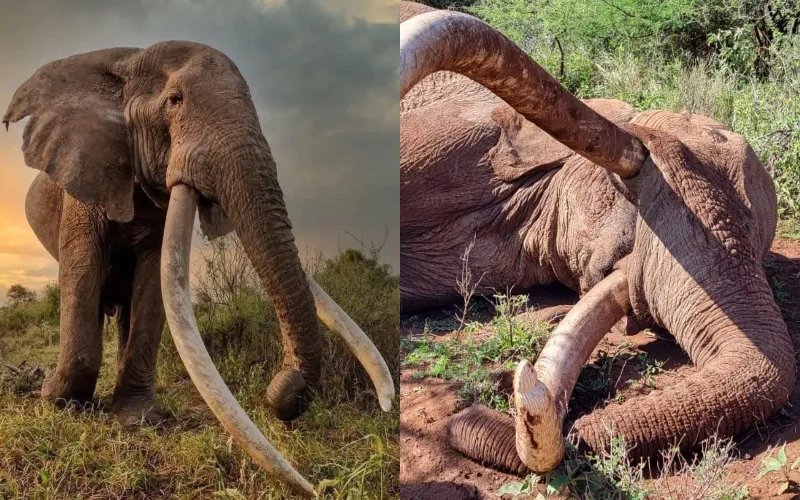
Born in January 1972 to the great matriarch Cassandra of the CB family, Craig lived a life that few elephants ever do.
“Some of you may have seen rumours of his death last November. Although untrue, it was clear that he was having digestive issues that were very serious for an elephant of his advanced age,” a statement from the Foundation reads in part.
In the statement seen by news9.africa, the Big Five Foundation revealed that Craig recovered, but it was clear that they likely had limited time left with him.
“Yesterday, he was in trouble again, collapsing intermittently, then standing and moving short distances. Big Life’s rangers stayed with him through the night, but at 03:32 AM, he lay down and didn’t get up again. Unfortunately, there was nothing that could be done,” the statement further reads.
The Foundation observed that poorly chewed material in his dung showed that he was not grinding his food properly, which is evidence of worn-down teeth.
What’s next after the passing of Craig?
Elephants get six sets of molars throughout their lives, and once their final set starts to wear, their lifespan is limited.
“We are waiting for post-mortem details, but this is very likely what led to Craig’s death,” the Foundation added, describing Craig as an icon, extremely calm around people and likely one of the most photographed elephants in all of Africa.
While confirming Craig’s death, the Kenya Wildlife Service (KWS) said, “the world has lost a true icon.”
“Craig was one of the last remaining super tuskers in Africa – a rare class of bull elephants whose two tusks weigh over 45 kilograms (100 lbs) each. Fewer than a handful remain today, making him a living monument to Africa’s natural heritage,” KWS said in a statement.
According to KWS, Craig fathered several calves, ensuring that his powerful bloodline and gentle character live on across generations.
“Beyond its extraordinary tusks, Craig was deeply loved for its remarkably calm nature. He appeared to understand his place in the world – often pausing patiently as visitors photographed and filmed him. Widely documented and admired globally, he became a true ambassador of Amboseli and a symbol of what successful conservation looks like,” KWS explained.
In 2021, Craig was proudly adopted by East African Breweries Limited (EABL) through the Tusker brand, reflecting his worldwide appeal.
How did Craig survive for 54 years?
news9.africa has established that Craig’s long life and survival to such a mature age were made possible through decades of dedicated protection by KWS, working in close collaboration with conservation partners and the local community.
“Continuous monitoring, anti-poaching efforts, habitat protection, and community stewardship ensured that Craig lived freely and safely – demonstrating what collective commitment to wildlife conservation can achieve,” said KWS.
Meanwhile, the Big Five Foundation noted that Craig coexisted peacefully with the communities in which he shared space.
“Elephants with tusks as big as his have become increasingly rare, targeted by poachers and trophy hunters, and Craig was one of the largest of those remaining. Craig was a huge presence in Amboseli and will be sorely missed. But he lived a long life and died a natural death, and no creature – human or elephant – could ask for much more,” said the Foundation.
KWS further urged the public to share memories of Craig on its social media platforms in a bid to celebrate its legacy.










Discussion about this post