

NAIROBI, Kenya – Implemented to replace the defunct National Hospital Insurance Fund (NHIF), the Social Health Authority (SHA) and its subsidiary, the Social Health Insurance Fund (SHIF), have faced severe public backlash and intense legal scrutiny.
For instance, the SHA controversy revolves around a massive KSh 11 billion medical fraud scandal, irregularities in a KSh 104.8 billion technology procurement contract, and widespread system inefficiencies that have disrupted healthcare access.
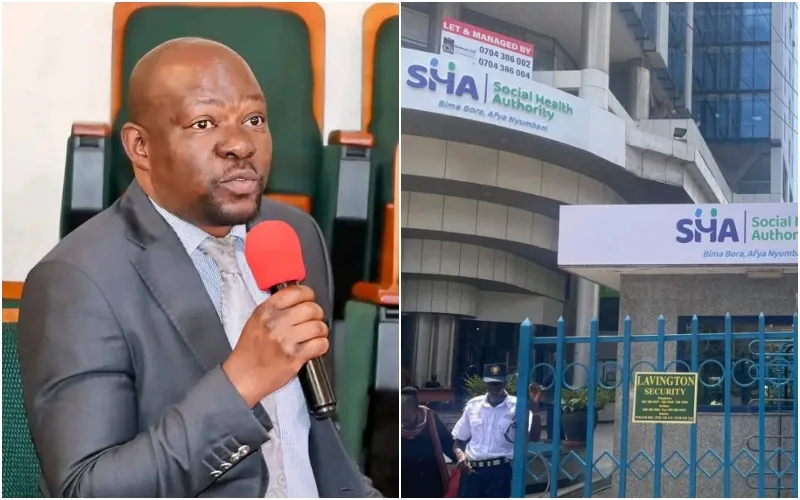
Against this backdrop, Saboti MP Caleb Amisi is now proposing radical changes to the medical scheme. The Orange Democratic Movement (ODM) MP proposed that the health fund must be individual.
“The way we have approached the contribution to share as universal health coverage is the wrong way, and this is my approach. I’ve been contributing to SHA from my payslip. I’ve never gone to a hospital, and they (SHA) benefit from it, whether private or public,” Amisi explained.
Caleb Amisi puts SHA contributions on the spot
While appearing on Radio Generation for an interview, the youthful lawmaker questioned where the SHA contributions by individuals who don’t go to hospitals end up.
“Where does that money go, and why do you condemn me to give that money? It is my view that the health fund must be an investment of that individual. If I contribute KSh 10 out of my payslip every month, that money must go to an investment kit,” added Amisi.
If, by 10 years, someone is not sick, Amisi proposed that that money must be invested and then recouped back to them because it is their money.
“If, in the course of those 10 years, it has been invested anyway, then in the ninth year, if I get sick, of course that money will not be the same as what I contributed. It is more because it has been invested. The health fund must be an investment kit by the government. Investment portfolios are many; we have bonds. We have a treasury,” he explained.
The outspoken MP allied to the ‘Linda Mwananchi’ faction further went on:
“We have so many investment kits. So that when I retire, I’ll know my investment is in that health fund. If I’m not sick, I have an option of going to recoup that money and going to build a retirement home, or I can get it and put it in another health fund, but at the same time it is still covering me. So, should I become sick, I still have that contribution. Insurance is a pool such that you contribute your Sh 10. You haven’t got sick in 10 years, but I contribute probably the same KSh 10, but every month I am in hospital. So essentially it’s like I’m using your KSh 10, his KSh 10. Do you know why it is like that? Because you’ve not formulated it into an investment portfolio.”
How Kenyans can be motivated to join SHA
If the proposal were implemented, the MP exuded confidence that a majority of Kenyans would be motivated to join SHA.
“Because I know that if I’m not unwell and those who do these things are actuaries. They could provide it in such a way that it is even stated if, in one year, you have not made a claim. This is the interest that we give you. Yes, and it can either be put on whatever you have, or it could be given to you now. You see that I would not complain; I would happily continue contributing to SHA,” the MP explained.
Meanwhile, while registration numbers on SHA are historically high, the transition faces public scrutiny over temporary digital system outages that have disrupted care access at contracted hospitals.
To protect patients, the Ministry of Health announced stringent penalties starting June 14, 2026, which will deduct up to 38% from claims of public hospitals failing to dispense prescribed medications during SHA-covered visits.











Discussion about this post