KISUMU, Kenya – President William Ruto has hailed the extension of the 264-kilometre Naivasha–Kisumu–Malaba Standard Gauge Railway (SGR).
On Saturday, March 21, 2026, President Ruto joined his Ugandan counterpart, Yoweri Museveni, in officially launching the Sh 650 billion extension of the SGR to the neighbouring country, marking a significant milestone in Kenya’s infrastructure development.
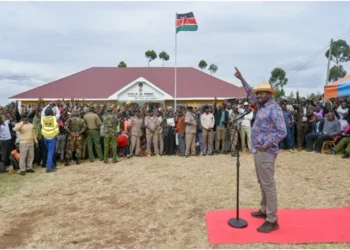
Presidents William Ruto and Yoweri Kaguta Museveni launched the Naivasha-Kisumu-Malaba SGR in Kisumu County. Photo, courtesy.
“Additionally, the presidents of Kenya, Uganda and Rwanda not only pronounced themselves on the plans to extend the Standard Gauge Railway to Kampala, Kigali and Juba but also signed the SGR protocol and tripartite agreement to ensure development and management of a seamless railway system,” explained President Ruto.
The head of state observed that it was therefore more fitting that President Museveni was present at the event to witness the vision (construction of Kisumu-Malaba SGR) taking shape.
“Thank you for your leadership, vision and steadfast commitment to the unity and integration of our region,” added President Ruto.
New dawn for our transport sector across East Africa as Kenya's President William Ruto and Uganda’s President Yoweri Museveni jointly unveil the plaque and fasten the first nut and bolt, officially launching the transformative Naivasha–Malaba–Kisumu Standard Gauge Railway… pic.twitter.com/OMTQJiZeJw
The upgrade, which is President Ruto’s most expensive infrastructure project, is expected to boost regional trade, enhance connectivity between Kenya’s interior and Uganda, and stimulate economic growth in counties like Kisumu.
What has been the impact of the SGR since its inception?
President Ruto stated that over the past 8 years, the SGR has transported more than 15 million passengers and over 45 million tonnes of freight.
“It has reduced transport costs, improved efficiency and contributed significantly to the growth of our economy. With this expansion, we expect even greater impact,” he said.
Additionally, the president said the freight costs are projected to decline by 40% – that is a turn for every kilometer while transit times for freight will reduce to nearly 30%.
“The share of cargo moved by rail will increase, easing pressure on our roads and reducing wear and tear,” he emphasised.
President Museveni: We are here to break ground for the Kisumu-Mabala SGR. This railway is part of the rationalization of our transport system especially on the Uganda side, which is irrational and wasteful. Our plan is to transfer all heavy cargo to the railway pic.twitter.com/xp9bEwfqCF
But beyond the numbers, the head of state said, lies something even greater.
“This railway will connect farmers to markets; it will move livestock and farm produce from our inland to Nairobi and onwards to Mombasa for export. Tea from Western Kenya, Kericho and other towns. Dairy from Bomet and other regions like Narok. Grains from the Rift Valley and, of course, fish from Lake Victoria will reach markets faster and more efficiently. It will power industrial growth along the corridor. From Nairobi to Naivasha to Kisumu and beyond,” he explained.
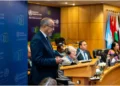
President Yoweri Museveni speaks in Kisumu
According to the president, the move will enable businesses to access inputs more and more affordably, reaching wider markets.
“It will create opportunities for our young people across construction logistics, manufacturing and service sectors, giving them a stake in the growth of our region,” stated President Ruto.
On his part, President Museveni said the railway project is part of the rationalisation of the region’s transport system, especially on the Uganda side, which he described as irrational and wasteful.
“The items being transported are concentrated on the road, i.e., passengers, light and heavy cargo, and petroleum products are all on the roads. As we speak, travelling on the road is a cocktail of items,” explained President Museveni.
President William Ruto and his Ugandan counterpart Yoweri Kaguta Museveni have officially launched the construction of the Kisumu–Malaba Standard Gauge Railway (SGR) section.#WeekendAtOnepic.twitter.com/3TT56i34Et
He indicated that plans were underway to transfer all heavy cargo to the railway.
“This is the mandate of this railway line. Then we also want to transfer all the petroleum products to the pipeline. It is dangerous to have petroleum tankers on the road because they also damage the roads and cause accidents. The railway can also combine with water transport,” explained President Museveni.
Dennis Lubanga is a seasoned journalist with over 15 years experience. He has a rich and extensive focus on politics, climate change, environment, and food security. He has previously held positions at Y News Digial (Editorial Lead), TUKO.co.ke (Current Affairs Editor) and Nation Media Group (News Correspondent). He is affiliated with respected journalism programs such as The Nature Conservancy African Journalism Programme, Thomson Reuters Foundation, and African Uncensored Investigative Journalism Programme. His work has been honored in the Annual Journalism Excellence Awards (AJEA) among other platforms.










Discussion about this post