


NAIROBI, Kenya – On Thursday, May 14, 2026, a parliamentary by-election for the Emurua Dikirr Constituency was won by David Kipsang Keter of the ruling United Democratic Alliance (UDA) party.
With 18,266 votes, or almost 62% of the valid votes cast, Keter was proclaimed the winner by the Independent Electoral and Boundaries Commission (IEBC).
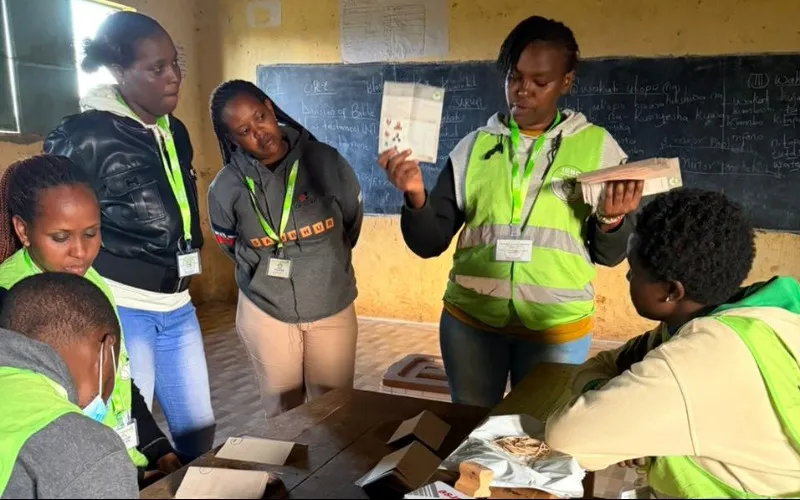
Johanna Ng’eno, the former area Member of Parliament (MP), died in a helicopter crash in February 2026, which set off the mini-election.
Voter turnout for the by-election was 66.6%. A total of 29,435 votes were cast at the 94 polling places out of the 44,353 registered voters in the constituency.
There were 29,358 valid votes in all, with 177 ballots being invalidated. A fiercely competitive grassroots campaign was launched by Vincent Kibet Rotich of the recently formed Democracy for Citizens Party (DCP).
Gaining more than 10,000 votes in a long-standing UDA stronghold attracted a lot of attention from national political observers.
Reacting to the electoral outcome, Wanjiku Thiga, the DCP National Youth Leader, said that the Rigathi Gachagua-led DCP “being a new political party and managing to wade through waters in a space that is not favourable means that Kenyans are starting to listen.”
“Kenyans want change; they want an alternative voice. They want a government that listens to them. After the Emurua Dikkir by-election, I am very optimistic about 2027 because this by-election, which was some sort of a General Election, shows politicians that political rhetoric won’t take them anywhere,” said Thiga.
Why Gen Zs don’t show up to vote in by-elections
Thiga reiterated that the by-election had also proved that young people don’t show up for by-elections.
“Their consciousness rose through the June 2024 Gen Z uprising. 2027 is the first electoral cycle that they are coming into, so they are not keen about by-elections but about the General Elections,” Thigua further explained.
As the country gears up to the August 2027 General Election, Musyoka Kalla, a lawyer by profession, opines that the by-elections that have happened before, are happening now and will happen later, are a mirror of what will happen in the forthcoming polls.
“These by-elections are providing the public with an opportunity to scrutinise the preparedness of the Independent Electoral and Boundaries Commission (IEBC) in organising the forthcoming General Election,” says Kalla.
Kalla observes that there are so many things that will be at play as Kenyans prepare for the next General election set for August 10, 2027.
“Kenyans will be interrogating the technology that is being deployed in these by-elections. Kenyans are also keenly watching how the IEBC is handling the electoral disputes stemming from the by-elections. The independence of the IEBC is also being interrogated in terms of how it will be independent,” Kalla further says.
General Elections present an uphill task for candidates
Kalla further says that the by-elections had given Kenyans an opportunity to interrogate the preparedness of the IEBC, citing the late Raila Odinga’s 2017 presidential case that confirmed that elections are not an event but a process.
“We also need to know if the IEBC is sufficiently funded to conduct the elections, and this will be demonstrated in the manner in which these by-elections are being conducted. It is rather clear that the focus will shift to areas where the by-elections are, because they are normally tricky. Sometimes there is use of public resources by the state actors involved to mobilise support for their preferred candidates who are system-friendly,” he says.
When it comes to by-elections, Kalla advises the IEBC to rein in individuals committing electoral excesses.
“During the General Election, it is unlike a by-election. Here, it’s always every man for himself and God for everyone. This means that the ability of every state actor who deploys these measures that are meant to sway votes also has its own battles to fight. General Elections are more of a reflection of the will of the people and more of a by-election to some extent,’ Kalla adds.
In April 2026, IEBC Chairperson Dr. Erastus Edung Ethekon assured Kenyans of the Commission’s commitment to delivering a credible, transparent and peaceful General Election in 2027, while calling for collective responsibility to safeguard the country’s democracy.
Speaking during a breakfast engagement in Nairobi, Ethekon said the IEBC had adopted a new approach anchored on openness, inclusivity and early engagement with partners, including the private sector, civil society and the media.
“This is a new commission with a new philosophy. We believe in being open to Kenyans because there is nothing we are hiding. We will do our job as guided by the Constitution and the law,” he said.
Political parties invest heavily in the General Elections
Leadership and Communications specialist, Advice Mundalo observes that the by-elections have proved that Kenyans are becoming ideologically driven, and the level at which people want a conversation on issues is growing every day.
“By-elections have always been indicators of the General Election. This has happened before, and it will happen again. If you look at the results from the by-elections, they show what will happen in the General Election because they are happening in a cross-section of the country and not only in one region,” says Mundalo.
Mundalo reiterates that in all by-elections, the winners are always the political parties because the contest there is always about them.
“Political parties use by-elections to prepare for the main elections. If you look at the percentage level of all winners of by-elections, they lose at the General Election. When it comes to General Elections, the conversation centres on the conduct and resources from the political parties,” Mundalo further argues.
Dr. Martin Oloo, an Advocate of the High Court and Political Analyst, indicates that there is a dire need for Kenyans to agree that they are living in a country and a world where all independent institutions are under siege.
“By-elections are the worst scenario to use in measuring the credibility of the IEBC because every force is usually deployed there. This country can only change if we make choices as Kenyans because our politicians have their interests, which they must press for for survival,” says Oloo.
Kenyans’ undoing during electoral processes
With the clock fast racing towards the 2027 political contest, Kalla maintains that Kenyans have made it a culture that they cannot participate in an election unless they are rich.
“And this is what is happening in this country. We have chosen to elect merchants. IEBC must take advantage of these by-elections to crack the whip. The law is there to do this and should be implemented,” says Kalla.
Meanwhile, Oloo warns that if people are influenced to vote someone into a position of leadership, then it simply means they won’t be able to help them because they bought their way in. “We need to sanitise how we do things in this country,” Oloo further says.
Looking at the previous by-elections, Kalla notes that the IEBC has proved that it is toothless.
“With all the powers and laws to back up reigning in the perpetrators who orchestrate the violence that was witnessed, be it in Malava, Kasipuil, or elsewhere, nothing was done,” laments Kalla.
Kalla emphasises that unless there are some divisive curbs on these electoral malpractices, then Kenya will never change.
“Some of us can dare say the 2027 presidential vote will be oddly contested. I am seeing a situation where people will dispute results if they lose. I foresaw also a situation where politicians might agree to share the spoils. In 2027, we may have a government of national unity because of the amount of money that will be spent and the values that will be made during that particular electoral process,” Kalla explains.
Why the IEBC is keen on the voter register
Still in April 2026, Ethekon revealed that the Commission had already registered over one million new voters within days of launching the enhanced voter registration exercise and is targeting at least 2.5 million in the First Phase.
He added that the voter register would undergo verification and audit before being gazetted, ahead of the 2027 elections.
The IEBC projects that the Voter Register will grow from 22.1 million in 2022 to approximately 28.5 million by 2027, with polling stations expected to increase from 46,229 to about 55,000.
He emphasised that the integrity of the Voter Register remains non-negotiable, explaining that the Commission has enhanced biometric registration systems to include iris capture in addition to fingerprints.
“The Register is the foundation of any election. We cannot compromise its integrity. That is why we are strengthening biometric identification to ensure every voter is uniquely captured,” he said.
But Oloo argues that elections are not the only way for one to prove that the government is working.
“It is about service delivery and the allocation of resources. The only reason we need leaders is that they can mediate and access these funds and resources. In 2027, some are looking for a government that works for them and some who are looking for a government that will oppress them,” observes Oloo.
Ethekon on the lessons that the IEBC has learnt
Kalla further wants Kenyans to remain optimistic that in this coming General Election, the electorate and especially the Gen Zs will put their foot down.
“And we may not see a complete overhaul or draining of the swamp, but some progress will be made,” says Kalla.
Reflecting on lessons from the 2007/2008 post-election violence, Ethekon warned against a repeat of the chaos, describing the period as “horrifying” and economically devastating.
“We must pray that the events of 2007 never return. We saw lives lost, property destroyed and the economy collapse. Elections must never again lead to such suffering,” he said.
The IEBC Chair also cited recent by-elections as a learning ground, noting that while the polls were largely successful, cases of violence, voter bribery and political interference were observed.
“We learnt valuable lessons. The elections went well, and no one accused the IEBC of stealing votes, but we witnessed incidents of violence and malpractice that must be addressed collectively,” he said.
How the IEBC is handling the electoral reforms
The Chairman clarified that while the IEBC has a mandate to enforce the Electoral Code of Conduct during the official campaign period, other institutions, such as security agencies and anti-corruption bodies, must take responsibility for handling offences outside the Commission’s jurisdiction.
“It is time every institution takes responsibility for its mandate so that together we can deliver credible elections,” he added.
On electoral reforms, Ethekon said the Commission is working with the Kenya Law Reform Commission and other stakeholders to fast-track legal amendments aimed at strengthening the electoral framework ahead of 2027.
He further disclosed that the IEBC has requested KSh 67 billion to conduct the elections, but has so far been allocated about KSh 41 billion, leaving a significant funding gap.
“Elections are resource-intensive. A large portion of the budget goes to personnel and technology required to ensure transparency and accountability,” he said.
The Chairperson also highlighted plans to expand diaspora voting from 18 to about 54 countries, in line with constitutional provisions to progressively enhance the participation of Kenyans abroad.
Why Kenyan voters are concerned about polling stations
On technology, Ethekon assured stakeholders that systems to be used in 2027 will undergo thorough testing and simulation to guarantee reliability.
“We will invite experts to interrogate the technology. If it does not work, we repeat the process until it does,” he said.
Ethekon also urged citizens to avoid misinformation, particularly regarding voter registration and results transmission, noting that election results at polling stations are public and accessible.
“Transparency begins at the polling station. Results are recorded, shared and displayed publicly. Anyone can verify them,” Ethekon clarified.













Discussion about this post