


NAIROBI, Kenya – Following record-breaking increases in fuel prices, major Kenyan urban centers came to a complete halt early this week due to deadly nationwide protests and strikes on public transport.
At least four people were killed, many more were injured, and more than 700 people were arrested nationwide as a result of the protests that erupted on Monday, May 18, 2026.
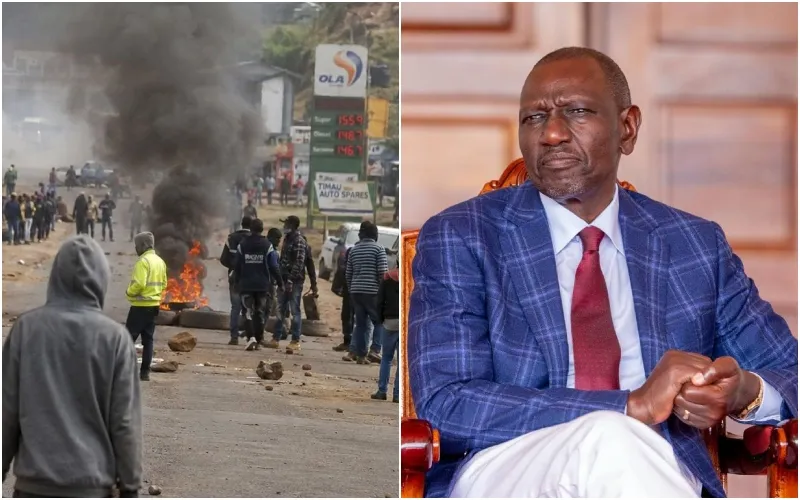
Fuel prices were raised by up to 23.5% by the Energy and Petroleum Regulatory Authority (EPRA), building on a staggering 24.2% increase from the previous month. Nairobi’s petrol prices reached all-time highs, with diesel reaching KSh 242.92 a litre.
Officials attribute the issue to supply disruptions in the Middle East brought on by the dispute between the United States, Israel, and Iran, which has essentially closed the vital Strait of Hormuz.
Citizens and opposition politicians harshly condemn the government’s high domestic fuel taxes despite the global backdrop, pointing out that landlocked neighbours like Uganda have cheaper fuel.
As President William Ruto’s ruling Kenya Kwanza administration acknowledged its inability to alter global oil shocks, the crisis brought attention to his “missing” public response, with politicians and detractors questioning his absence.
Public uproar was triggered by the president’s initial silence during the protests. In order to engage stakeholders and calm the petroleum sector, Deputy President Kithure Kindiki intervened and convened a crisis meeting with the Cabinet Secretaries of Energy, Treasury, Transport, and Interior.
In the midst of the fuel crisis, political analysts and observers questioned whether it was typical for the person who would sit in the president’s place and calm the storm to remain silent while the nation was and is still in a crisis.
How the situation unfolded in President Ruto’s absence
Policy and Governance Analyst Alenga Torosterdt observed that a ‘very deep’ confusion arose in the absence of the president in the wake of the fuel crisis in the country.
“You would ordinarily think that if there were a fuel crisis, the energy ministry would be on top of it or the national treasury perhaps, but then we had conversations with people that you really wouldn’t trust about speaking about the energy situation in the country,” said Alenga.
Rather, in an attempt to calm things down, cabinet secretaries—who are essentially the executive branch’s extension—took over.
For instance, John Mbadi, the National Treasury Cabinet Secretary, claimed that relief depends on international events like the resolution of Middle East tensions and the reopening of the Strait of Hormuz and that the government is unable to immediately reduce prices.
“The void was felt, and then this goes to the question: do we have a government where it is only the president who can speak and solve situations, and what power do the people who have been put in those offices by the president wield in his absence? Lastly, even by the time we got even a sort of a piecemeal solution to the fuel issue, we had the minister for interior speaking, and the minister for energy was just masked over there,” Alenga further said.
Alenga also questioned the expertise of Energy Cabinet Secretary Opiyo Wandayi to step in and sort out the stalemate.
“So then, for me, what I would wonder silently, even when I walk away, is whether the government can perform without the president or if we always want to wait for the president,” added Alenga, who doubles as a political communication expert.
President Ruto arrived in Baku, Azerbaijan, on Sunday, May 17, 2026, for the 13th session of the World Urban Forum.
President Ruto makes a State Visit to Kazakhstan
The head of state stated that the meeting was a ‘vital platform’ for advancing partnerships and practical solutions for sustainable urban development.
Later, the president was awarded Kazakhstan’s prestigious Order of Dostyk, First Degree, by President Kassym-Jomart Tokayev during his historic state visit to Kazakhstan.
“Kenya and Kazakhstan have also agreed to deepen trade and investment ties, position each other as strategic gateways to Africa and Central Asia and explore expanded markets for Kenyan tea and agricultural exports,” President Ruto said while in Kazakhstan.
Political analyst Benji Ndolo poked holes in President Ruto’s administration, accusing it of what he termed ‘recklessness’.
“You cannot have this reckless style of governance and then have accountability. It cannot follow that you can have this reckless approach and have an incompetent cabinet and, at the same time, be a law-abiding citizen,” Ndolo said.
Alenga also claimed that CS Mbadi proved himself to be ‘incompetent’ after saying that the government would only solve the fuel crisis after President Ruto returned to the country from his foreign trip.
“And we actually heard the minister for Treasury saying that when the president comes… so, when you look at the constitution, our president is more of a ceremonial president, like he doesn’t have to be a hands-on person. So again, I think it’s a big indictment of the officers in his government,” explained Alenga.
When the nationwide transport paralysis broke out, it left many Kenyans stranded and caused major disruptions across the economy, including school attendance.
How Kenyans go wrong during nationwide crises
Following the chaos that stemmed from the fuel crisis, Alenga, a political tech expert and one of the aspirants for the Vihiga parliamentary seat, observed that there is an air of discomfort all over the country.
“I have tried to confront the question even more by asking myself, who is going to fix this? And this is where we go wrong because each one of us has the problem statements appropriately captured, but then we throw it to one man who is at the State House, and that is where we go wrong. I believe that all these things can be fixed at the levels where they are supposed to be fixed,” explained Alenga.
Alenga emphasised that it was inappropriate to blame the presidency, not even the president, because even if Kenyans were to replace President Ruto with someone else, they would still be confronted with the same questions.
“I can assure all Kenyans that person will have sleepless nights in that office even more than the current president because if it is not happening at the ministerial level, you come up with a draft policy and say, ‘We have seen the situation, we have listened to Kenyans. Here are the proposals. I think we can tackle them,’ and then you take this to Parliament for MPs to deliberate on them,” added Alenga.
Alenga further questioned the structures that have been put in our constitution and how they are being harnessed.
“But then, when we keep just saying that this country is doing badly, the president must answer this and that; it doesn’t make sense. We want the president to literally go out to the field and address the issues facing Kenyans at the grassroots level when he has appointed people to execute that,” explained Alenga.
According to Alenga, it is high time that Parliament should rise to the occasion and address the critical issues facing Kenya, the fuel crisis included.
“What if our MPs woke up and did what they’re supposed to do? What would happen? If some of these things that we keep pushing to the door of the president were just fixed at the policy level, for instance, in the case of the fuel crisis, who really needs to talk about the fuel crisis? I am thinking that in the energy ministry, they should burn the midnight oil, and when the president comes back, they tell him, ‘Here is the proposal that we have to address this situation.’ Look at it and see what we can do about it.”
Stakeholders agree to a compromise on the crisis
The government has been utilising the Petroleum Development Levy and lowering the VAT on petroleum to help cushion consumers from the high cost of landed products.
However, Alenga reiterated that the world over, very effective leadership, in his judgement, is so because parliaments or congresses are houses of order.
“These Houses exercise checks and balances effectively. If I were the appointing authority or any president whatsoever, I would have to respect Parliament while undertaking its duties,” he added.
Ndolo further cautioned that the continuous violation of the constitution shows that the government is not even legitimate.
“If the government is continually, consecutively, conspicuously violating the Constitution of Kenya. Sometimes, even people don’t know where the president is; people don’t know who is running what. A blogger is convening meetings, and ministers are answering under him. Is that government even legitimate? The same government that we gave the benefit of the doubt,” noted Ndolo.
Meanwhile, following a crisis meeting with sector representatives, EPRA announced revised pump prices that will remain in effect through June 14, 2026.
Further, a committee was formed to address other grievances within the transport sector—such as traffic matters and insurance—to prevent further industrial action.
Still, the government and transport stakeholders have agreed to a compromise that suspended the strike for a week to allow further negotiations.









Discussion about this post