


TADJOURA, Djibouti – For many years, the illegal Eastern Route has made millions of migrants extremely vulnerable to physical abuse, extortion, and human trafficking.
The Eastern Route, which is associated with the Red Sea crisis, entails risky travel from the Horn of Africa to the Arabian Peninsula, mostly from Ethiopia via Bosaso in Puntland to ports in Yemen and then to Saudi Arabia.
But after the Tadjourah Call to Action was successfully adopted, the irregular migration, an illicit journey—one of the most dangerous migrant corridors in the world—might be something of the past.
Still, the adoption of the Tadjourah Call to Action marked the successful conclusion of a recent High-Level Technical Experts Meeting on Irregular Migration and Migration Management along the Eastern Route (Red Sea Route Crisis) at Tadjourah.
The Tadjourah Call to Action aims to advance rights-based migration governance while stepping up efforts to stop irregular migration, human trafficking, and migrant smuggling.
Tens of thousands of young people undertake this journey every year in search of economic opportunities, motivated by poverty, violence, and climate shocks.
After passing through Ethiopia on foot and by car to coastal transit hubs in Djibouti (like Obock) and Somalia (like Bossaso), migrants brave perilous Gulf of Aden sea crossings into Yemen before making an attempt to cross the border into Saudi Arabia.
The corridor is infamously lethal. Due to severe maritime conditions, famine, and brutality from armed groups or smuggling networks, thousands of migrants have perished or vanished.
What migrants are subjected to in the Middle East
Many migrants who make it to the Middle East are subjected to huge forced returns, systematic incarceration, violations of human rights, and deportations to Somalia and Ethiopia.
The management of irregular migration along the Eastern Route was discussed by the Government of Djibouti, the Intergovernmental Authority on Development (IGAD), the International Organisation for Migration (IOM), the European Union, JICA, Sida, INTERPOL, Japan, Sweden, and a number of other partners.
The meeting, which took place from April 27 to 30, 2026, brought together IGAD technical specialists, member state leaders, and representatives from regional and international organisations that specialise in marine security and migratory governance.
Strengthening regional collaboration to address the irregular migration situation on the Red Sea Route was the meeting’s primary goal.
Said Nouh Hassan, the Chairperson of IGAD and Minister of Interior of the Republic of Djibouti, formally inaugurated the conference.
“The Eastern Route remains one of the busiest yet most dangerous migration corridors, where migrants are exposed to trafficking in persons, smuggling, violence, death from the desert temperatures, drownings at sea and various forms of exploitation,” the minister highlighted in his opening remarks while pointing out the scale and urgency of the situation.
According to the IOM Migration Along the Eastern Route 2026 Report, outgoing movements along the Eastern Route increased by one-third (+34%) between 2024 (178,300) and 2025 (238,000) for the period January-June, driven by increased arrivals in Yemen via new landing points in Ta’izz, faster transit through Obock to avoid border authorities, and a moderate rise (+6%) in exits from Ethiopia.
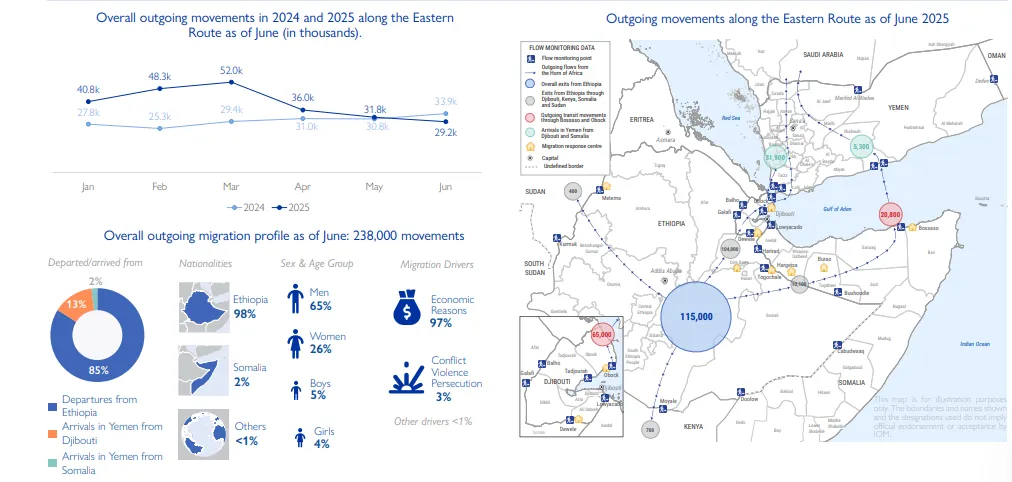
More recent trends show a one-third decline (-31%) in movements between the first (141,000) and second (97,000) quarters of 2025.
This decrease is partially attributed to the suspension of data collection in Yemen since April, which limits visibility into actual movement volumes, seasonal slowdown post-Ramadan, intensified enforcement operations against irregular migration in Djibouti and Somalia, and adverse weather conditions in key transit areas.
Returning Ethiopian migration trends
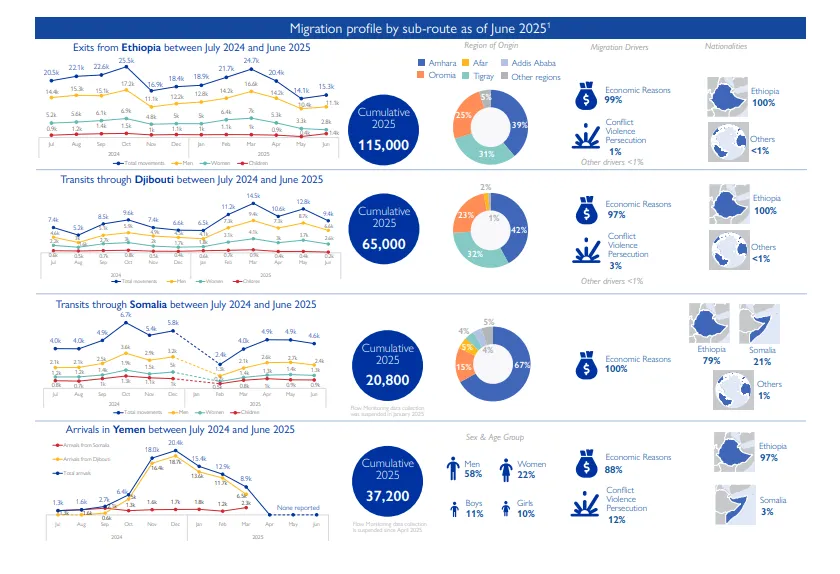
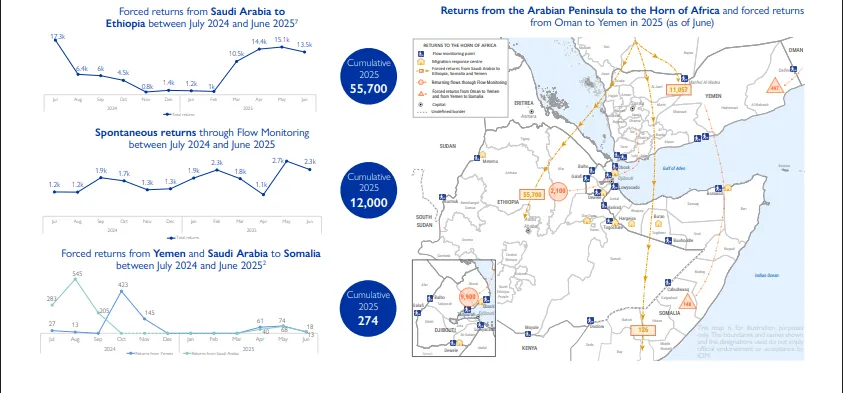
As of June 2025, (55,700), there was an overall decrease in the number of Ethiopian migrants forcibly returned from Saudi Arabia (-2% from 2024); however, returns of boys (+31%) and girls (+18%) increased. Returns surged between the first (12,800) and second (42,950) quarters of the year, with most returnees heading to conflict-affected regions of Amhara (36%), Tigray (35%), and Oromia (25%), which also host large displaced populations (1.7 million).
The number of migrants spontaneously returning, as tracked through flow monitoring in Obock, increased (+62%) from 7,400 in 2024 to 12,000 in 2025 for the period January-June. Additionally, around 21,500 return movements from Djibouti to Ethiopia were reported, although it remains unclear what proportion of these migrants were initially en route to the Arabian Peninsula or had been residing in Djibouti.
The minister, while addressing the delegates in Tadjourah, stressed the need for collective and coordinated action to protect migrants and combat criminal networks. He also underlined the specific challenges faced by Djibouti due to its strategic geographic location, calling for increased support to strengthen the infrastructure and migrant reception and assistance capacities of the government and communities.
Between 2024 and 2025, recorded arrivals in Yemen from the Horn of Africa more than tripled from January to June (from 10,400 to 37,200). This increase is mainly due to underreporting of arrivals from Djibouti for most of 2024, caused by limited access to new landing points along the Ta’izz Governorate until September 2024. However, the suspension of flow monitoring data collection since April 2025 due to funding constraints has resulted in a data gap for the second quarter of the year.
Speaking on behalf of the IGAD Executive Secretary, Mohamed Ware, the IGAD Deputy Executive Secretary emphasised the urgency of a collective response to the Red Sea humanitarian crisis.
“The particular focus is on strengthening cooperation among IGAD Member States as well as transit and destination countries, including the Republic of Yemen and the Kingdom of Saudi Arabia,” explained Ware.
As of June 2025, approximately 800 stranded migrants were in Djibouti (+8% from May), with a notable rise in stranded girls (from 19 to 57). In Somalia, 3,400 stranded migrants were reported (-10% from May), including a significant increase in stranded boys (+85%). While the number of stranded migrants in Yemen is difficult to estimate, the January 2025 Humanitarian Needs and Response Plan indicates approximately 132,300 stranded migrants in the country.
Coordinating regional and international efforts
Ambassador Moussa Ali Meigague, Director of the Health and Social Development Division at IGAD, highlighted the importance of coordinating regional and international efforts, notably through existing legal and policy frameworks such as the United Nations Convention against Transnational Organised Crime, the IGAD Convention on Extradition (2012) and the IGAD Convention on Mutual Legal Assistance in Criminal Matters (2012).
Through the report, IOM also revealed that the number of people seeking assistance at MRCs increased (+78%) compared to the previous quarter. Women and girls more than doubled (+158%), while men and boys increased with a smaller change (+60%).
The number of children receiving assistance doubled (+111%) from the previous quarter, with a pronounced increase in girls (+184%). Of the girls receiving assistance, more than half (61%) were under 14 years of age, compared to two-fifths (44%) of boys.
This suggests a population facing heightened exposure to exploitation, underscoring the need for comprehensive protection and assistance measures. Additionally, around half (49%) of children receiving assistance were unaccompanied, with variation across MRCs in Djibouti (48%), Ethiopia (64%), and Somalia (25%).
The legal, humanitarian, institutional, security, and socioeconomic aspects of the migratory problem were also investigated by experts.
The United Nations Convention against Transnational Organised Crime, the Global Compact for Safe, Orderly, and Regular Migration, and the IGAD Regional Migration Policy Framework are just a few of the regional and international pledges made by participants to protect migrants and combat human trafficking and smuggling.
The extent of the Eastern Route migrant catastrophe has deeply alarmed experts.
More than one-third of the more than 500,000 migratory trips between the Arabian Peninsula and the Horn of Africa in 2025 involved women and children, according to data given during the meeting.
Challenges along the Eastern Route
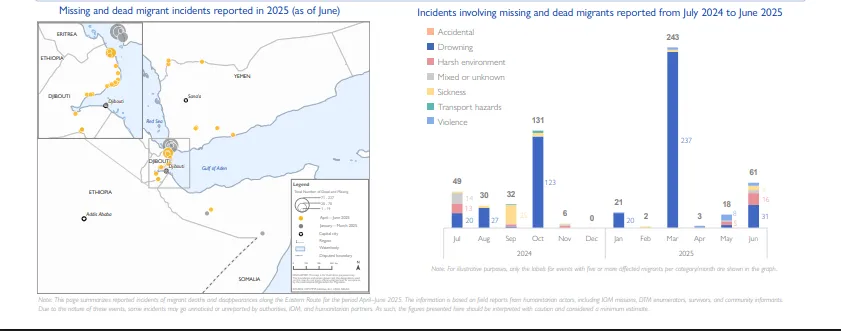
The growing number of fatalities and disappearances along the route also worried participants. The Eastern Route saw 922 migrant deaths or disappearances in 2025, the highest number since comprehensive data gathering started in 2014, according to the IOM’s Missing Migrants Project. Between 2014 and 2025, almost 4,300 migrants died en route.
During a field visit conducted in Obock-Godoria on 28 April 2026, experts observed more than 500 migrants waiting to cross the Red Sea towards Yemen, illustrating the magnitude and urgency of the situation. The Experts visited a Mass Grave in the desert of 34 drowned migrants.
In response to these challenges, participants called for strengthened:
- Peace and security;
- Resilience against natural disasters;
- Regional and cross-border cooperation and integrated border governance;
- Protection mechanisms for vulnerable migrants;
- Maritime security, search and rescue capacities on land and sea;
- Voluntary return and reintegration programmes;
- Legal and institutional frameworks to combat trafficking in persons and smuggling of migrants;
- Youth mobilisation and innovation for green jobs/employment
- Migration data collection and analysis systems.
IOM also shows that the number of people seeking assistance at MRCs increased (+78%) compared to the previous quarter. Women and girls more than doubled (+158%), while men and boys increased with a smaller change (+60%). The number of children receiving assistance doubled (+111%) from the previous quarter, with a pronounced increase in girls (+184%). Of the girls receiving assistance, more than half (61%) were under 14 years of age, compared to two-fifths (44%) of boys.
This suggests a population facing heightened exposure to exploitation, underscoring the need for comprehensive protection and assistance measures. Around half (49%) of children receiving assistance were unaccompanied, with variation across MRCs in Djibouti (48%), Ethiopia (64%), and Somalia (25%).
Also, during the second quarter of the year (2025), at least 78 migrants died or went missing while travelling along the Eastern Route in Djibouti (66), Yemen (11), and Somalia (1). As of June 2025, 348 migrants have died or gone missing along the Eastern Route, compared to 310 during the same period in 2024.
International Migration Review Forum
The Swiss Embassy in Ethiopia, which also participated in the IGAD High-Level Meeting in Tadjourah, welcomed the Call for Action to strengthen migration governance along the Eastern Route.
“Human mobility challenges along the Eastern Route continue to underline the importance of regional cooperation,” the Embassy posted on its official X account (formerly Twitter).
IGAD’s official regional contribution to the second International Migration Review Forum (IMRF), which was held from May 5 to 8, 2026, at the United Nations Headquarters in New York, USA, was the Tadjourah Call for Action on the Red Sea Route Crisis and the Report of Progress on the Implementation of the Global Compact on Migration (GCM).
Based on the values of shared responsibility, regional solidarity, and human dignity, the High-Level Team of Experts reaffirmed their shared commitment to advancing safe, orderly, and regular migration.
Following three days of discussion, Mohamed Houmed Abass, the Prefect of the Tadjourah Region and the current Chairman of IGAD, presided over the final session on behalf of the Government of the Republic of Djibouti.
As of June 2025, outgoing movements (238,000) accounted for over half (55%) of all those reported in 2024 (430,200).
IOM is now warning that if the current migration trends continue, movements along the Eastern Route are likely to remain similar to 2024. However, increased violence and displacement in the region, along with a shifting policy landscape, may result in higher rates of internal migration and movements toward the Arabian Peninsula.












Discussion about this post