


Kericho, Kenya – Along the busy Londiani Junction, where trucks roar past, and travellers stream in and out, stands a row of humble grocery stalls run mostly by women.
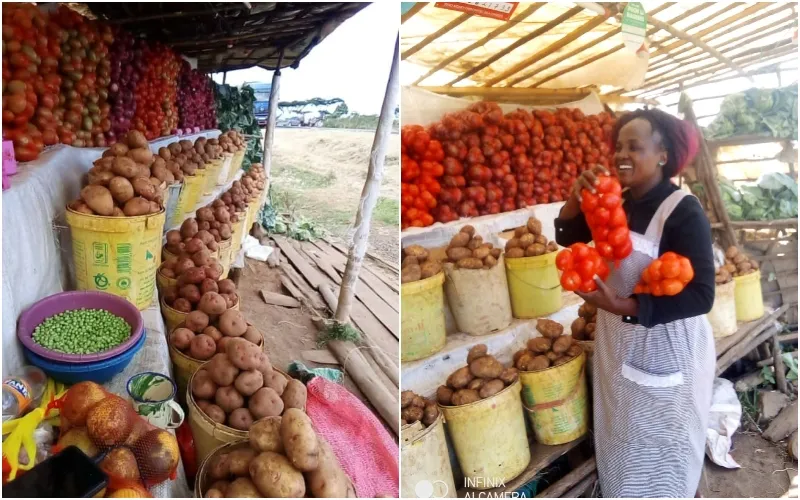
These women, popularly known as Mama Mboga, wake up before dawn to provide the fresh vegetables that feed the community.
One of them is Sharon Langat, widely known as Sharon wa Lipa na M-Pesa. For more than fifteen years, she has stood behind her stall, serving hundreds of customers each week and keeping the local food chain alive.
Her story is a testament to resilience, dignity in labour, and the silent economic engine women continue to power.
Encounter by chance
Sharon never planned to become a vegetable trader. Armed with a diploma in accountancy, she hoped for formal employment. But when job opportunities failed to open up, life pushed her towards entrepreneurship, and she embraced it fully.
“One day, as I was walking to the shop, a big car stopped, and the driver asked if I could get fresh cabbages for him. He took my number and said he would pass by every Friday. That is how everything started,” Sharon recalls with a smile.
Today, Sharon stands as one of Londiani’s most recognisable vendors.
A business that sustains a family
To Sharon, her stall is more than an income source it is the backbone of her household.
“My business pays school fees, provides food, rent, and all necessities. I even have a daughter in university, and I cover everything she needs from this stall,” she says proudly.
Her days begin at 5:00 am. After preparing her children for school and finishing house chores, she arrives at her stall by 7:30 am. Fresh stock arrives at 8:00 am, sourced directly from local farmers.
“I call the farmers on the phone, and they bring me what I need. Technology has made things much easier,” she says.
By 6:30 pm, she does stock-taking and hands the stall over to her night assistant. Sharon is not just self-employed; she has created employment for others.
Strength in the face of harsh realities
Despite her optimism, Sharon’s business journey has been anything but smooth. The most painful challenges come not from weather or drought but from authorities.
“My grocery is on a KeNHA reserve. They sometimes pressure us, and on two occasions they carried everything from my stall. Nobody compensated me. I almost lost hope,” she recounts.
The loss of stock forced her into loans from shylocks, quick cash with crippling interest, dragging her into a cycle that nearly killed her business.
Competition from large-scale farmers selling at low prices adds to the strain. And when prices rise at the source, she feels the pinch immediately:
“Sometimes farmer prices are so exaggerated and unreal, making it hard to get good selling prices.”
A mother strengthened, not broken
Yet, despite these pressures, Sharon insists the business has never negatively affected her life.
“It has strengthened me. I interact with people from all over Kenya and even outside the country. People with big titles come to my stall, and I appreciate them all.”
She also makes sacrifices to keep operations running, including losses through M-Pesa reversals.
“Some clients send money, then reverse it. You run at a loss. But I still take a loan to restock because I don’t want to disappoint my customers.”
A pillar in the community
Sharon’s stall is more than a business. It is a lifeline for many. She regularly extends help to neighbours, offering credit or supporting farmers by buying their produce in advance.
“Mama Mboga feeds many families and supports local farmers. When there’s an emergency, we give credit even if the crops are not ready. I am proud of the role we play.”
A cry for government support
Sharon believes small-scale traders like her are overlooked, despite forming a vital part of the country’s food system.
“We need micro-finances that are simple to apply for, low-interest, and processed quickly. We also need protection from harassment by county officers and KeNHA.”
Her vision extends further.
“The government can build a large store where we can safely keep our goods during seasons of abundance. We also need better market spaces with accessible washrooms.”
And if she met the President?
“First, I would thank him for the peace in the country. Then I would ask him to buy me a piece of land and give me at least one million shillings to start planting my own vegetables.
Dreams beyond the stall
If her income increases, Sharon hopes to eventually step back from the daily grind.
“I would like to employ more people so that I can work from home while the business continues to run.”
Her message to young women and aspiring traders?
“Go for it. Be hardworking. It is not hard to start.”
The silent engines of local economies
Sharon’s story mirrors that of many women who keep roadside towns like Londiani running. They feed the nation, support local farmers, and sustain their families with dignity.
Yet, they remain unsupported, unprotected, and unrecognised. Their resilience is unmatched, but it should not be taken for granted.
As the sun sets on Londiani Junction, one thing becomes clear: Women like Sharon are not just vendors, they are the quiet pillars of Kenya’s economy. They deserve structured support, humane policies, and a government that sees their worth.












Discussion about this post