


LUSAKA, Zambia – The standoff between Zambia and the United States over a proposed multi-billion-dollar health aid package and a parallel critical minerals agreement has sparked national debate about sovereignty, transparency and the future of international partnerships.
This resulted in petitions challenging the agreement and questioning the government’s failure to disclose the contents of the deal.
The litigators, including health advocates, governance experts and civil society organisations, urged the authorities to prioritise citizens at the centre of decisions involving both public health and strategic national resources.
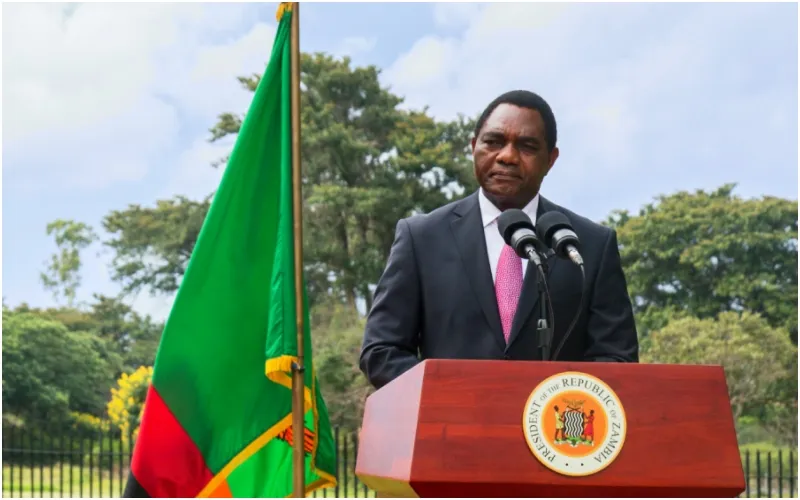
President Donald Trump’s administration proposed a five-year U.S. health aid package worth over $2 billion to his Zambian counterpart Hakainde Hichilema, aimed at supporting about 1.3 million HIV patients and other healthcare beneficiaries in the Southern African nation.
However, the deal hit a snag after Lusaka raised concerns over some provisions reportedly requiring extensive health data sharing and preferential access to the country’s critical minerals by American firms.
In May 2026, Zambia suspended the talks with Washington DC. Foreign Affairs Minister Mulambo Haimbe said the demand to share health data will violate the rights of Zambians, calling for fresh talks on the two deals done independently.
Earlier, reports showed that U.S. officials were planning to withhold health aid to Lusaka, in a move to pressure authorities into accepting the terms to access minerals.
Health Gap reported on a leaked State Department MOU, which showed that Washington could demonstrate its seriousness by scaling back support if negotiations failed to advance.
Stakeholders, including Civil Society Organisations in Zambia, now want the debate to lean more on protecting the interests of Zambians, rather than diplomatic disagreements.
In an exclusive interview, Quince Mwabu, Executive Director of Medical for Quality Healthcare in Zambia (MQHZ), said the country must balance the benefits of international health cooperation with the need to protect citizens’ rights and national priorities.
“International partnerships play an important role in strengthening our health system. However, as discussions continue around the proposed Zambia-US health cooperation framework, we believe it is essential that Zambia’s health data remain fully protected and under the country’s control,” Mwabu said.
Mwabu noted that health information is highly sensitive and any data-sharing arrangement must be transparent, narrowly defined and supported by strong legal safeguards.
“Our health data is sensitive information, and any data-sharing arrangements must be transparent, limited to legitimate public health purposes and supported by stronger privacy, cybersecurity and oversight safeguards,” he said.
He warned that the prolonged uncertainty surrounding major health financing commitments could place additional pressure on programmes supporting HIV, tuberculosis, malaria, maternal and child health services.
This will end up affecting service delivery, access to essential medicines, disease prevention programmes and broader health system strengthening efforts.
Mwabu emphasised the need to protect health data, noting that it should not be viewed as a competing objective to goog international relations.
“We believe international cooperation can bring significant benefits to the health sector, but these benefits should be achieved in a manner that protects public trust and advances Zambia’s long-term health priorities,” he said.
The CSOs also questioned why the agreements were negotiated largely outside public scrutiny.
In March 2026, a coalition of Zambian civil society organisations called for the suspension of the health agreement until its contents were fully disclosed and subjected to parliamentary oversight.
The coalition argued that lifesaving health assistance should never be used as leverage for access to mineral resources and warned that secrecy could undermine both health governance and national sovereignty.
The organisations, including Chapter One Foundation and the LCK Freedom Foundation, filed a suit challenging the government’s refusal to disclose the contents of the MOU. The matter, which is currently before the courts, will be heard on July 22, 2026.
The groups maintained that citizens have a right to know the terms of agreements that could affect healthcare financing, data governance and mineral resource management.
Martin Sikonda, Programmes Officer at the Jesuit Centre for Theological Reflection (JCTR), shared that transparency is non-negotiable.
“Contents of such agreements should be made public before they are signed. Critical minerals are a national resource that belongs to all Zambians. Therefore, citizens, Parliament, civil society organisations and affected communities should have an opportunity to understand and scrutinise any proposed agreement,” Sikonda said.
Sikonda argued that agreements negotiated behind closed doors create risks of weak accountability and unfavourable outcomes for the country.
“When agreements are negotiated behind closed doors, there is a risk of weak accountability, unfavourable terms for the country and the exclusion of citizens from decisions that affect their future,” he said.
He pointed to Botswana and Ghana as examples of African countries that have strengthened public confidence through transparency and citizen participation in resource governance.
“Citizens should not only hear about such agreements after they have been signed. They should be part of the conversations before decisions are made,” Sikonda added.
Beyond disclosure concerns, the stakeholders also questioned what preferential access to minerals could mean in practice.
Political anthropologist and mining expert James Musonda said granting preferential access would effectively place the United States at the front of the queue for Zambia’s strategic minerals.
“So preferential access, as used in this context, means that the U.S. needs to have priority access to the minerals before they reach the global market,” Musonda explained.
He warned that such arrangements could restrict Zambia’s ability to negotiate freely with other international buyers and investors.
“It is a lock-in. It undermines your sovereignty. In practice, preferential access to critical minerals means that you lose your rights to the minerals because before you go onto the global market, you first have to ask the U.S,” Musonda said.
Human rights organisations and global health advocates also criticised the secrecy surrounding the agreements.
Efforts to reach constitutional lawyer Josiah Kalala of the Chapter One Foundation were unsuccessful, as he indicated that the matter remains before the courts.
The U.S. Embassy in Zambia dismissed reports of existing critical mineral access provisions in the deal.
Spokesperson Naomi Mattos, who is also the Public Affairs Counsellor in the U.S. Embassy in Zambia, argued that the MOU is only anchored on data-driven impact and accountability metrics.
“There are no critical minerals provisions in any of the America First Global Health MOUs, including the one we have proposed with Zambia.
“The proposed MOU offered to Zambia is based solely on data-driven impact and accountability metrics and is intended to build durable healthcare infrastructure that will empower Zambia to reduce its dependence on external health assistance,” Mattos assured in an exclusive interview.
The spokesperson noted that Zambia has been a longstanding recipient of U.S. foreign assistance, especially in global health and HIV treatment and like all health assistance recipient nations, it received the MOU under the America First Global Health Strategy.
She added that the agreement will build on U.S. commitment to the Zambian people and provide a generous multi-year aid package of global health resources.
Mattos added that discussions on the health MOU with Zambian authorities are ongoing, expressing positive optimism towards the agreement.
The dispute comes as Zambia seeks to position itself as a key player in the global energy transition. The country is Africa’s second-largest copper producer and possesses significant reserves of cobalt, lithium, nickel and rare earth minerals that are increasingly sought after for electric vehicle batteries and renewable energy technologies.
By Justina Matandiko, a journalist based in Zambia.









Discussion about this post