


KAKAMEGA, Kenya – In response to concerns that misinformation could undermine Kenya’s biotechnology agenda, the government has stepped up efforts to raise public awareness of and acceptance of genetically modified organisms (GMOs).
The National Biosafety Authority (NBA) is spearheading the program, which aims to raise public understanding of contemporary biotechnology and its potential to solve low agricultural productivity, pest and disease control, food insecurity, and climate change.

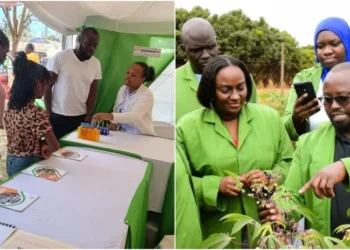
Speaking during a science café held at Bukura Agricultural College in Lurambi, Kakamega County, NBA acting chief executive officer Dr. Ann Karimi announced that the authority was turning to youths to rewrite the narrative.
“We are seeking to have the youth be our ambassadors so that they realise the role that the authority occupies when matters of regulation are concerned, and the message is that GMOs that are approved by NBA are safe,” said Dr. Karimi.
Scientific literacy and accurate communication are crucial to the nation’s adoption of biotechnology, according to Dr. Karimi, who bemoaned the fact that misinformation still feeds popular cynicism.
“The approved GMOs have undergone very rigorous tests, and they continue to be monitored and surveyed. Now, we want to ensure that we have a big stock of ambassadors who really understand matters GMO, especially at the Bukura Agricultural Institute, because it is a leading learning institution that offers a course in biotechnology, and we hope that as an organisation we shall be able to step up the manpower development in the area of biotechnology,” she added.
Why the NBA works closely with learning institutions
To ensure that Kenyans understand the significance of biotechnology in food security, environmental sustainability, and economic development, Dr. Karimi claims that public awareness, scientific literacy, and evidence-based communication are still crucial.
She said the authority is working with institutions of higher learning to promote biosafety education and equip students with skills needed for the responsible use of biotechnology.
Dr. Karimi went on to say that to maintain training programs in biotechnology and biosafety, the NBA is also looking to work with schools and universities through Memoranda of Understanding.
“As an authority, we recognise that equipping educational institutions, researchers, lecturers, and students with the necessary knowledge, skills, and practical exposure in biosafety and biotechnology is essential to the future of safe and responsible biotechnology,” she stated.
Citing the licensing of genetically modified crops like Bt cotton as proof of Kenya’s science-driven approach, she pointed out that contemporary biotechnology is still crucial in tackling the country’s agricultural problems.
Dr. Karimi further asked the public to depend on scientific evidence rather than myths and misconceptions when forming opinions about GMOs.
Common misconceptions about GMOs often stem from confusion regarding how modern biotechnology works. Major scientific bodies confirm that commercial GMOs are just as safe as conventionally bred crops. They undergo over a decade of rigorous testing by regulatory agencies like the USDA before reaching the market.
The list of persistent myths surrounding GMOs
Many of the most persistent myths surrounding GMOs, which have been easily debunked by scientific consensus and agricultural data, include the following:
- Myth: GMOs are unsafe to eat and cause diseases like cancer.
- Myth: Genetic modification leads to higher pesticide use.
- Myth: GMOs are purely corporate schemes and not natural.
- Myth: All fruits and vegetables that look unique are GMOs.
However, Dr. Karimi disclosed that, as an authority, they are conducting nationwide public awareness forums that are free to the public and seek to help the NBA continue with the discussions and conversations around GMOs.
“We want to ensure that every Kenyan is armed with information that is neutral and allows them to make decisions whether to adopt the technology or not. But let the technology be one of the solutions around food security,” explained Dr. Karimi.
As debate around GMOs rages on, the NBA is urging Kenyans to take a fresh look at the technology with climate change threatening agricultural productivity and food demand on the rise.
Questions have been raised in public discourse about whether science offers a solution many are yet to embrace.
Why Kenya should embrace GMO technologies
The NBA observes that climate change, crop diseases, and a growing population have made it necessary for the country to embrace innovative agricultural technologies.
This even as it emerges that Kenya will have to embrace GMO technologies to sustainably feed its rapidly growing population amid increased food demand.
Director of Legal Services at the NBA Moses Sande notes that the country needs technologies that can help reduce crop and livestock losses to droughts, diseases, and other challenges that are brought about by climate change.
Sande also says that awareness creation is necessary to address the misconceptions surrounding GMOs and prepare the country for future food challenges.
“There is quite a bit of misinformation and misconceptions about GMOs, but we want to assure Kenyans that the reason why we have NBA in place, set up by the government with well-staffed scientists who are well qualified, is to ensure that any GMO that is out there in the market is safe for all Kenyans,” Sande explains.
Sande also observes that whenever a trader or a researcher wants to put their product, which is a GMO, on the market, they first must seek approval from the authority.
“We check and inspect to ensure that the product is certified by the NBA and that it is safe for public consumption,” he adds.
Inside the mandate of the Kenyan GMO ambassadors
Meanwhile, Paul Njogu, the principal and chief executive officer of Bukura Agricultural College, reiterated Dr. Karimi’s remarks and urged students to become biotechnology ambassadors in farming areas.
“To be good ambassadors of promoting the safe use of biotechnology, including GMOs, students need to understand both the science and the safety mechanisms that the NBA uses to regulate biotechnology,” he stated.
He encouraged learners to acquire relevant skills and maintain good attitudes towards biotechnology, noting their importance in transforming agriculture and enhancing sustainable food production.
These ambassadors, a majority of whom are students, are expected to champion evidence-based discussion, share real field data from Kenyan trials, and advocate for policies that ensure GMO technology serves smallholder farmers—not just large agribusiness.









Discussion about this post