


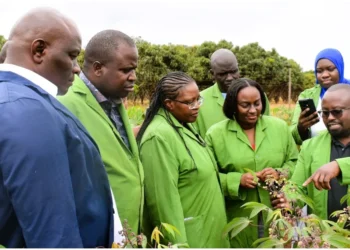
MURANG’A, Kenya – In Kandara, Murang’a County, a small team of scientists recently completed working on what they hope will be the cassava of the future. To the untrained eye, the thick and long-stemmed root is a genetically modified cassava variety developed in Kenya to resist the devastating cassava brown streak disease (CBSD).
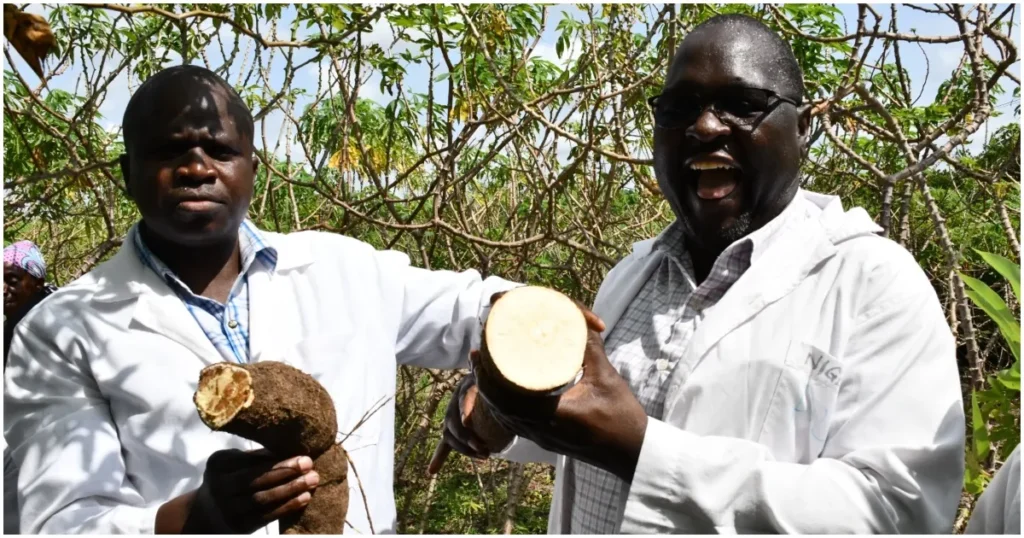
CBSD causes root necrosis (rotting) and leaf symptoms, causing heavy losses for conventional farmers. The newly developed KingaKuu cassava variety uses gene-silencing biotechnology to block the viruses that cause this disease.
The team of scientists and researchers at the Kenya Agricultural and Livestock Research Organisation (KALRO) based in Loresho, Nairobi, has spent over a decade fine-tuning their flagship product with year after year of selective breeding.
The name itself combines the Swahili words ‘Kinga’ (shield) and ‘KUU’ (main or chief). Developed through the Virus Resistant Cassava for Africa (VIRCA) project, it has undergone rigorous field trials in Kandara, Mtwapa (Kilifi), and Alupe (Busia), regions regarded as Kenya’s cassava belts.
Cassava is a crop widely grown across Kenya, particularly in Western Kenya and coastal counties like Kilifi, Kwale, and Taita Taveta. It thrives in well-drained soils and requires minimal labour. According to experts, farmers can achieve high yields of up to 28 tonnes per acre by utilising disease-resistant varieties and proper farm management.
Leading varieties such as Tajirika, Karembo, and Karibuni flourish in Western Kenya, mature in 8 to 12 months and produce up to 68 tonnes per hectare.
On the flipside, the KingaKUU cassava variety typically takes 8 to 12 months to reach general maturity for harvesting, and it can safely remain in the ground longer if needed without spoiling rapidly.
Dr. Paul Kuria, the lead research scientist at the KALRO/KingaKUU Project, says KingaKUU is the first-ever genetically modified cassava variety to reach the current stage that it is. He reveals that the new cassava variety started as a proof of concept and a very virus-resistant cassava for Africa.
“These varieties have very high resistance to cassava brown streak and cassava mosaic disease, and it’s been a journey for over a decade for us to be able to reach the KingaKUU stage, where the materials are going to be released to the farmers. The VIRCA project has taken close to 10 years, starting as a proof of concept,” explains Dr. Kuria.
Benefits of the cassava plant to the human body
Uganda’s Ministry of Agriculture, Animal Industry and Fisheries (MAAIF) says that cassava is a vital global staple food providing carbohydrates to over 500 million people daily.
Cassava provides high-energy carbohydrates, immune-boosting vitamin C, and gut-healthy fibre. It acts as a natural gluten-free alternative and supplies essential minerals like potassium and magnesium.
- Nutrition and Digestion Energy source: Delivers a dense supply of calories and complex carbohydrates to fuel daily physical activity.
- Gut health: Contains dietary fibre and resistant starch that feed good bacteria in the large intestine and support regular digestion.
- Gluten-free option: Serves as a safe grain-free and gluten-free substitute for people with celiac disease or gluten sensitivities.
- Immunity and Wellness Immune Support: High levels of vitamin C act as an antioxidant to protect cells from damage and strengthen the body’s defence systems.
- Collagen production: Vitamin C aids in making collagen, which keeps skin, bones, and tissues strong and healthy.
- Blood pressure support: Supplies potassium to help relax blood vessel walls and maintain a healthy heart rate.
However, experts warn that raw or improperly prepared cassava contains dangerous levels of toxic compounds and must always be thoroughly peeled, soaked, and cooked before eating.
According to Dr. Catherine Taracha, a former regulatory lead of the KingaKUU Project, the journey started with a cassava in a small little tube.
“And that led to plantlets. And then there was evaluation in the greenhouse. We got wonderful results. We then decided, ‘Now let’s take them to the confined field trials, both here in Kenya and in Uganda. For a certain number of generations, we’ve been able to take it to evaluate the cassava in the field,” explains Dr. Taracha.
The scientists finished the project with a regulatory trial which they say was ‘very’ successful in Kandara, adding that the region hasn’t experienced the disease incidence – the same case as in Serere, Uganda.
Scientists move to solve the CBSD using modern technology
Against this backdrop, Prof. Douglas Miano, the principal investigator of the KingaKUU Project, discloses that they started working on how to solve the problem of CBSD around 2008. Apart from being resistant to CBSD, KingaKUU also matures in 8 to 12 months.
“We had worked before on trying to come up with a transgenic variety for cassava mosaic disease. But then the cassava brown streak disease emerged as an even bigger threat. So we decided to solve the CBSD using modern technology and still now try to improve on the traditional method of this CMD using conventional breeding, which was what there was already a solution for,” Prof. Miano says.
So since that time, Prof. Miano reveals that from about 2008, he has been working consistently with fellow scientists on the project “day by day, month by month and year by year, coming through and moving from one step to the other”.
“The first phase was, first of all, to say which science can help us solve the problem because there was no source of resistance to it,” says Prof. Miano.
The scientists under the stewardship of Dr. Kuria argue that KingaKUU cassava combines resistance to CBSD and CMD, plus all other farmer-preferred characteristics, and is suitable for all cassava-growing regions across East Africa.
“For the development of cassava brown streak disease-resistant cassava under the flagship of KingaKUU, we used the natural strategy that plants use for defence against the viruses whereby we took a piece of the viruses that cause cassava brown streak disease and integrated it into the cassava and then advanced the cassava into the breeding programme, whereby we were able to restore or to have farmer-preferred qualities like the high starch content and high yield and also test it for adaptability in different agroecologies,” explains Dr. Kuria.
According to Dr. Kuria, the reason why the scientists are using modern biotechnology, which they say mimics the natural antiviral defence, is because they looked through the cassava germplasm, or the cassava genome, throughout the world.
“And at that particular point there were no cassava varieties that were resistant to cassava brown streak disease. So the only strategy that had remained was to use biotechnology to tackle the challenges of cassava brown streak disease,” Dr. Kuria further says.
The new KingaKUU variety, which is poised to safeguard yields, increase earnings, and enhance food security, comes at a time when the government, through the National Biosafety Authority (NBA), has assured Kenyans that GMOs are safe for both human and animal consumption, urging the public to disregard misinformation surrounding the technology.
The NBA is a state corporation in Kenya established under the Biosafety Act No. 2 of 2009 to exercise general supervision and control over the transfer, handling, and use of genetically modified organisms (GMOs). Its primary objective is to safeguard human and animal health while ensuring adequate protection of the environment from potential risks associated with modern biotechnology.
Step-by-step on how to plant the cassava stick as a crop
The NBA chairman, David Wamatsi, says the government is committed to ensuring food security through science-driven solutions and expert guidance.
“We want to ensure Kenyans that whatever is in the country, like this KingaKUU cassava that is produced here, is safe for the Kenyan population and ready for the environment,” explains Wamatsi.
Hannington M. Obiero, a cassava agronomist at the KingaKUU Project, emphasises that cassava is a crop which is planted or established using cuttings, and the GMO cassava that they have developed is actually resistant to cassava mosaic and brown streak diseases.
“When you plant the stick, it’s like any other traditional cassava variety that we have been growing with the same winter nose and all that kind of thing, but the only important thing is that this particular GMO cassava is totally resistant to cassava brown streak and cassava mosaic disease even when you plant it in a very intensive area that has a lot of the diseases,” Obiero explains.
Margaret Karembu, the Director of ISAAA Africenter and Communications Lead, KingaKUU Project, discloses that the project is now at a stage where all the experimental trials and all the testing have been done and have been ascertained.
“We are just waiting for farmers to start getting the varieties once we get authorisation from the variety release committee of the Kenya Plant Health Inspectorate Service and also the National Biosafety Authority. So, it’s a time when we are anticipating very strong support,” adds Karembu.
Kenyan farmers speak out on local cassava varieties
Kilifi County cassava farmer Hellen Hadija describes the losses she has experienced as a result of CBSD.
“I devoted a lot of effort and resources to fighting the cassava brown streak disease during the first year. I lost everything when I began harvesting my cassava because this disease had attacked the plant. Hadija bemoans, “I lost everything.”
Due to the ongoing decline in yields, farmers have reduced or stopped producing cassava, which has made food insecurity in the region worse.
Francis Nyarotso, a seasoned cassava farmer in Kakamega County, said he now knows what it takes to grow and produce high-quality cassava.
“From my perspective, I have gotten an understanding that soon enough, I will be harvesting a cassava variety that has been approved and is safe for human consumption and is also resistant to diseases, which could have made me face the previous challenges,” adds Nyarotso.
Makueni County cassava farmer Ednah Mwakali says she is eager to plant the new variety on her farm and is confident that it would provide enormous profits.
“I have my own farm, and I had decided that I was going to plant at least 5 acres, but last year’s drought disappointed me; now with the new KingaKUU variety, I am going to do it without regrets,” discloses Mwikali.
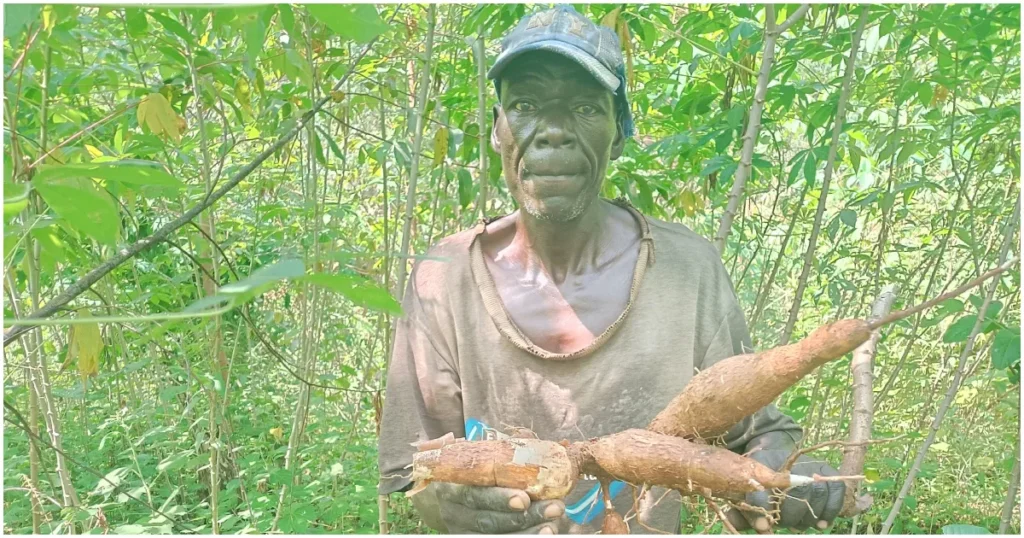
According to Dr. Taracha, during this journey, they have had several high moments.
“The highest moment was when the National Biosafety Authority actually gave us a stamp of approval to do environmental release. That means we have been compliant and done exactly what we’re supposed to do according to the biosafety law,” recalls Dr. Taracha.
Dr. Teresia Munga, the lead breeder at the KingaKUU Project/KALRO, narrates that in the 15 years that she has been involved in the KingaKUU project, her proudest moment was when they got a go-ahead from the National Environment Management Authority (NEMA) and the National Biosafety Authority to continue with the NPT.
“Because the National Performance Trial is a culmination of all our efforts,” says Dr. Munga.
Developing KingaKUU was a proud moment for the experts
For Dr. Miano, she is proud of being among the experts who took the process through the regulatory system to the point that one can say that cassava is now ready not only for the country’s assessment but also for the whole world because people are going to use the cassava not only in Kenya but also wherever people would want to use the cassava.
“So, that was another one of the biggest milestones; everybody who assessed our work said that this work has been done to international standards and it is actually ready. So, the NBA is now coming to say that it’s actually ready. That was, I think, the highlight. Maybe we didn’t celebrate the way we should have because we are looking at the next opportunity, but it was a big highlight. ‘The fact that we could be able to have cassava ready and accepted as safe and also ready for production’, explains Dr. Miano.
Dr. Miano further reiterates that he cannot fail to say, especially for what the team is doing with other partners in other countries.
“Some of them could not be able to continue because of the challenges of the legal systems. But now, when we are told to do the environmental impact assessment, of course, getting the licence from the people who are the institutions which are responsible for giving the licence for EIA – that is, NEMA in Kenya – is the first step,” Dr. Miano noted.
He emphasised that getting the licence was very critical for the scientists and researchers because they also agreed with NEMA and the NBA that it’s actually safe.
“And that’s why we could be able to plant this one. Otherwise, we couldn’t have been able to plant if we did not get the licence from NEMA,” Dr. Miano adds.
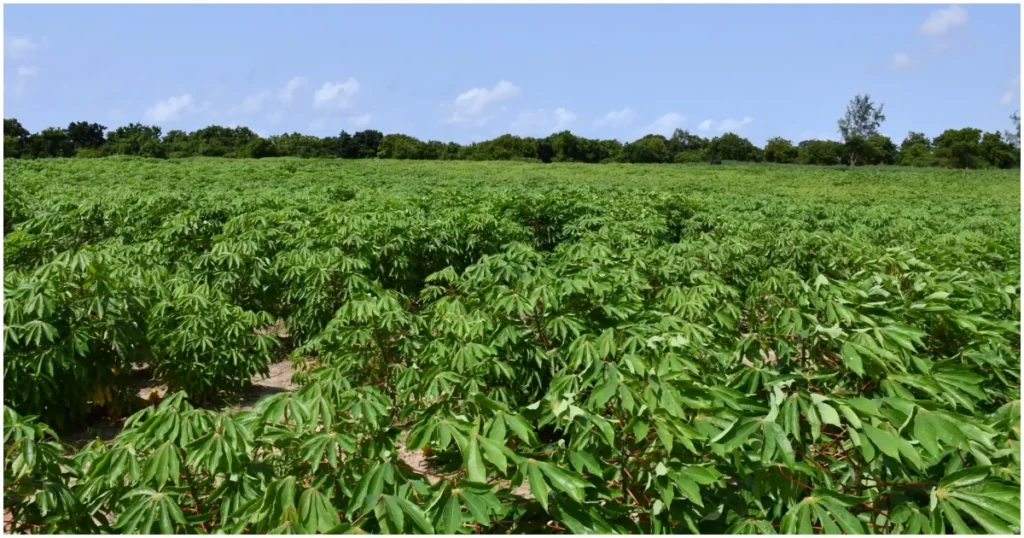
Dr. Karembu recounts the major milestones they have had in communicating about KingaKUU.
“One is engaging with the different stakeholders from the whole cassava value chain. Number two is getting the farmers to be involved in selecting varieties, which we call ‘participatory varietal selection’, and we used a gender-responsive approach where we now know that we have varieties the youth are very interested in and the women and the men. The third one, and very importantly, was engaging with the stakeholders during times of very difficult challenges of personal communication during the pandemic, where we were able to engage with the different stakeholders through virtual platforms, and during that time we realised there was such a great need for information everywhere in the country about KingaKUU,” says Dr. Karembu.
Against this backdrop, she discloses that the team identified the challenges, the concerns, and the interest.
“So, we were also able to give very good feedback to the regulators in terms of what the stakeholders were very concerned about with the KingaKUU variety,” recalls Dr. Karembu.
How local farmers will access the KingaaKUU cassava variety
Dr. Kuria reveals that they are currently at the tail end of the project, whereby now the next phase they are going into is to go to the National Variety Release Committee for the Ministry of Agriculture to commercialise the varieties, and then from there they will be able to officially release the varieties to the farmers.
“At the moment, what we are doing is to have a strategy for seed multiplication for the KingaKUU varieties. So we’ve been able to do this work at KALRO Mtwapa. When the varieties are released by the National Variety Release Committee, the farmers will easily have access to cuttings,” explains Dr. Kuria.
Dr. Kuria also says the other strategy is to have sustainable seed production, adding that they have been able to work with other partners whereby they’ve been able to establish cassava seed entrepreneurs throughout major cassava-growing regions, and those are going to be the first entrance for seed.
“So they’ve been able; they’ve been trained by KEPHIS, they have been registered, and now what we are waiting for is that moment where the seed is going to be released officially, and then we engage our cassava seed entrepreneurs who are going to now engage in the business of sustainable cassava seed production,” adds Dr. Kuria.
Dr. Taracha emphasises that looking at the KingaKUU cassava variety, it’s a product of many years of hard work.
She further says that these many years of hard work are now translating into a product that they’re going to give the small-scale farmers.
“The small-scale farmer is going to have increased production because of this cassava. He’s going to use Excel for the excess that he makes and will have money in his pocket. This cassava makes me feel very, very proud that I’ve been able to contribute towards increasing the livelihood of farmers in Kenya,” Dr. Taracha further says.
Dr. Miano adds that looking at the KingaKUU as a cassava variety that is resistant to diseases, and mainly the diseases that are in the region, she feels proud that she has been associated with it.
“Despite the struggles that we’ve gone through and the ups that we have had with it, at the end of the day, I can see we are coming to achieve what we are focused on achieving. And it’s so you, so I feel so proud of the team that has been working with this. Some started, and then they retired in the process. They left us to continue, and now we are coming to the end of the stage where we are giving it to the farmers. I think it makes me feel very proud. It makes me feel, also, that my contribution to society is big. And I think there is nothing more that you can look for than to see the product being with the farmers, and then our joy will be complete,” Dr. Miano explains.
Kenya to release historical global cassava GMO
Dr. Kuria emphasises that as a scientist, having gone through the research phase and having seen the KingaKUU cassava variety from the inception, for him it’s such a joy to be able to show that they can be able to use technology or advanced biotechnology to be able to solve the issues that are affecting local farmers.
“And at the end of it all, we want to have a food-secure country. And also, with the excess of cassava, we can also go into industrial production. So it’s been a challenging journey. It’s not been easy, but we’ve overcome most of the issues that were along the way, and it’s a happy moment for me and for KALRO to see that in the next few months, we are going to release the first-ever genetically modified cassava in the world. So it’s going to be released here in Kenya. So we are going to make history as the first research institution to release genetically modified cassava in the world,” indicates Dr. Kuria.
On her part, Dr. Ann Karimi, NBA acting CEO, announced they are conducting nationwide public awareness forums that are free to the public and seek to help the authority continue with the discussions and conversations around GMOs.
“As an authority, we aim to ensure that every Kenyan is armed with information that is neutral and allows them to make decisions on whether to adopt the technology or not. But let the technology be one of the solutions around food security,” says Dr. Karimi.
Director of Legal Services at the NBA, Moses Sande, notes that the country needs technologies that can help reduce crop and livestock losses to droughts, diseases and other challenges that are brought about by climate change.
Sande also says that awareness creation is necessary to address the misconceptions surrounding GMOs and prepare the country for future food challenges.
“There is quite a bit of misinformation and misconceptions about GMOs, but we want to assure Kenyans. That’s why we have the NBA in place, set up by the government with well-staffed scientists who are well qualified, to ensure that any GMO that is out there in the market is safe for all Kenyans,” explains Sande.
Inside the extensive steps that GMO-related crops must undergo
Whenever a trader or a researcher wants to put their products, which are GMOs, on the market, Sande indicates that they first must seek approval from the NBA.
“We check and inspect the product, that the product is certified by the NBA, and that it is safe for public consumption,” he says.
Sande further discloses that all GMO-related crops undergo extensive inspection, testing
and verification before being approved for commercial release and consumer use.
“The Kenya Plant Health Inspectorate Service (KEPHIS) and the Directorate of Veterinary Services (DVS) are among the key institutions collaborating with the National Biosafety Authority to ensure safety and security in service delivery,” Sande adds.
He further observes that several African countries have adopted GMO technology as part of efforts to address climate change and strengthen food security. He cited South Africa, Nigeria, Ethiopia and Sudan as examples of nations that have embraced the technology.
Flour is one of many value additions that may be made to the cassava value chain, according to Dr. Paul Ronoh, principal secretary of the State Department for Agriculture in Kenya.
“I am requesting that everyone involved in this value chain, from the farmers to the global markets, ensure that they follow the proper criteria. Dr. Ronoh adds, “I want to reassure you that we will fully support the implementation of root tubers as a means of achieving food security.”
Dr. Ronoh further asks KALRO and the Kenya Plant Health Inspectorate Service (KEPHIS) to act swiftly to ensure that the specific varieties of cassava are identified, classified, and concluded in accordance with their definitions.
However, the final phase of the KingaKUU varietal release has been affected by the ongoing court of appeal injunctions related to commercialisation and importation of biotech products. The scientists exude confidence that the matter will be resolved ‘soon’, allowing the process to move forward.
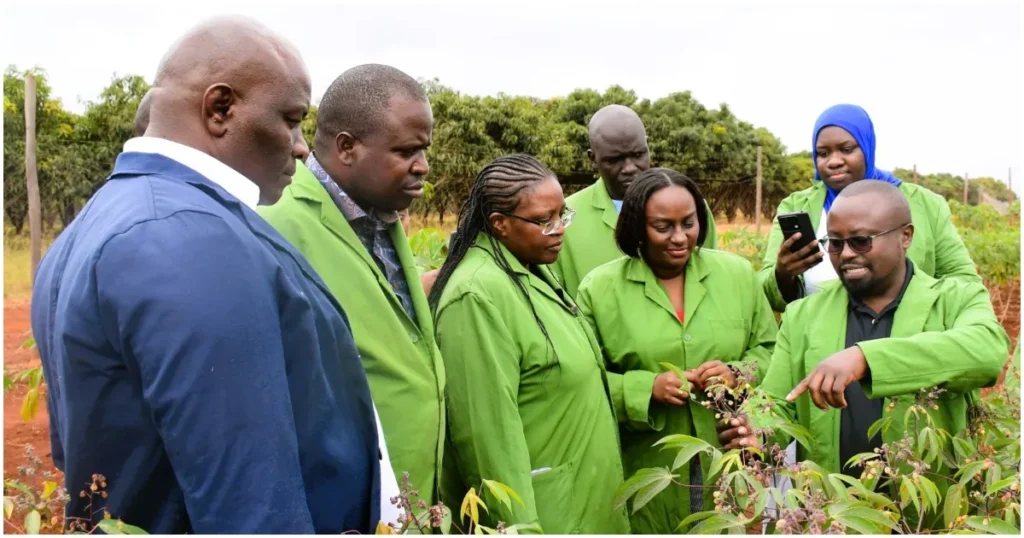
This comes at a time when it is emerging that the crops we eat now might not seem much different from those of the future. Apples might stay red, and maize will probably turn yellow. However, modifications to the plants that produce them, such as making them more resilient to droughts or resistant to viruses and fungi, are currently taking place in laboratories and farms worldwide.
Like the KingaKUU cassava variety, the story of humanity’s global expansion is entwined with our capacity to consistently produce food for ourselves. Although agriculture has constantly changed due to both a changing climate and people’s needs, this fact will almost certainly remain the same.








Discussion about this post