


NAIVASHA, Kenya – President William Ruto continues to face a complex running mate dilemma for his 2027 re-election bid, driven by the need to balance a fractured Mt. Kenya vote, the political integration of the Orange Democratic Movement (ODM) into his government, and internal coalition power-sharing agreements.
Even as senior ODM leaders demand it, it is now emerging that the deputy presidency is a major source of conflict inside the UDA-ODM alliance structure. They contend that their support should be rewarded with more than just Cabinet positions.
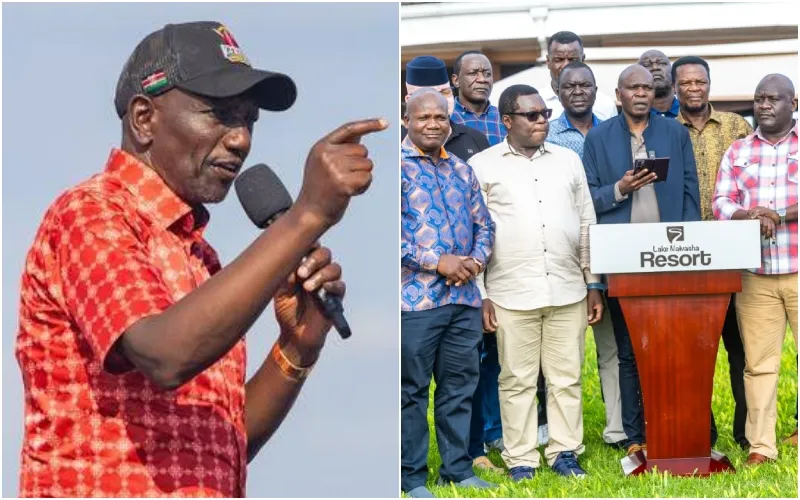
Enter now, Western Kenya leaders who have stepped up calls for the region to be considered for the DP position in Ruto’s 2027 re-election strategy. This is a development that is increasingly shaping internal coalition negotiations within the Kenya Kwanza alliance.
The push emerged during a high-level meeting in Naivasha, Nakuru County, comprising Members of Parliament and governors drawn from the counties of Trans Nzoia, Bungoma, Busia, Vihiga and Kakamega.
They were led by National Assembly Speaker Moses Wetang’ula, Co-operatives and Micro, Small and Medium Enterprises (MSMEs) Development Cabinet Secretary Wycliffe Oparanya, and more than 28 MPs drawn from the Western Kenya Parliamentary Caucus.
Other Western Kenya leaders who were in Naivasha
The leaders, alongside Governors Fernandes Barasa (Kakamega), Kenneth Lusaka (Bungoma) and Wilberforce Otichillo (Vihiga), argued that Western Kenya, given its electoral strength and growing political alignment with the Kenya Kwanza administration, deserves a more prominent stake in national leadership, including the second-highest office in the land.
“We demand the running mate position for President William Ruto because we have the requisite numbers and capability for that position,” read part of a statement delivered by Lugari MP Nabii Nabwera.
Among the MPs present were John Waluke (Sirisia), John Makali (Kanduyi), Martin Pepela (Webuye East), Didymus Barasa (Kimilili), Daniel Wanyama (Webuye West), Fred Kapondi (Mt. Elgon), Catherine Wambilianga (Bungoma CWR), Oku Kaunya (Teso North), Mary Emase (Teso South), Geoffrey Mulanya (Nambale), and Odanga Geoffrey (Matayos).
Others were Raphael Wanjala (Budalang’i), Joseph Maero (Butula), Innocent Mugabe (Likuyani), Emmanuel Wangwe (Navakholo), Christopher Aseka (Khwisero), Benard Shinali (Ikolomani), Elsie Muhanda (Kakamega CWR), Charles Gumini (Hamisi), Beatrice Adagala (Vihiga CWR), Kakai Bisau (Kiminini) and Beatrice Elachi (Dagoretti North), among others.
Addressing journalists at Lake Naivasha Resort, the legislators maintained that Western Kenya has remained politically consistent in its support for successive administrations but has historically been under-represented in top national appointments.
Why Western Kenya should produce Kenya’s DP
They argued that it was time for the region to produce the country’s Deputy President.
“We are not asking for favours. We are demanding recognition based on our numbers, contribution to national development and political support,” added Nabwera.
The leaders pledged continued unity and committed to strengthening the region’s influence in national decision-making, saying cohesion would be key to securing a stronger voice in future political arrangements.
“We reaffirm our unwavering commitment to the unity of the Western Region. We stand together as one people, one voice and one purpose. The diversity of our communities is our strength, and we pledge to set aside our political differences in the interest of the greater good of our people,” Nabwera further said.
They also called on the government to fast-track completion of ongoing development projects in Western Kenya, including infrastructure, health, education, water and agriculture programmes, while pledging to hold state agencies accountable for timely delivery.
“We commit to holding all government agencies accountable for working closely with the national government to ensure timely service delivery,” Nabwera further said.
Inside the renewed push for the DP position
The group also reaffirmed their support for President Ruto’s re-election bid, citing what they termed increased engagement and improved resource allocation to the region under his administration.
“We express our full and unequivocal support for the reelection of President Ruto. Under his leadership, the Western Kenya region has witnessed meaningful engagement and increased resource allocation, which has never been witnessed before. We believe that continuity of leadership is essential to safeguarding the gains already made and unlocking the full potential of our region,” stated Nabwera.
The renewed push is expected to add a new layer of complexity to the 2027 succession dynamics within the Kenya Kwanza coalition, where various regions are already positioning themselves for influence in the next electoral cycle.
The impeachment of former Deputy President Rigathi Gachagua, Ruto’s former running mate, left a significant leadership vacuum in the vote-rich Central Kenya region. Even if Kithure Kindiki, the current deputy president, is a strong candidate to keep the position, an essential political obstacle still stands in the way of his ability to completely unite and deliver the region.
President William Ruto’s tough balancing act
Mount Kenya leaders have traditionally viewed the Deputy President position as central to maintaining their political leverage, while Coast region leaders and other allied blocs are also seeking stronger representation in the next administration.
Figures from Western Kenya (like Musalia Mudavadi) and lower Eastern Kenya (like Wiper leader Kalonzo Musyoka) are regularly mentioned in political debates, suggesting that Ruto’s inner circle is seeking new vote blocs to counter anticipated losses in Central Kenya.
The ruling United Democratic Alliance (UDA) party has previously hinted at the possibility of choosing a female running mate, which places active regional leaders like Kirinyaga Governor Anne Waiguru and Homa Bay Governor Gladys Wanga on the list of potential compromise candidates.
However, Western Kenya’s demand could significantly reshape coalition negotiations as President Ruto balances competing regional interests in a bid to maintain internal cohesion ahead of the polls.
The developments come amid rising political realignments across the country, with leaders increasingly holding regional consultations as the 2027 election cycle gathers momentum.





Discussion about this post