


NAIROBI, Kenya – In what appears to be a worrying trend for air travellers and aviation enthusiasts alike, Kenya Airways recently grounded one of its aeroplanes after the airline suffered its third bird strike in May 2026.
The incident unfolded on Sunday, May 24, 2026, at around 10:02pm, when flight KQ421, on a scheduled flight from Entebbe to Nairobi, experienced a bird strike after takeoff.
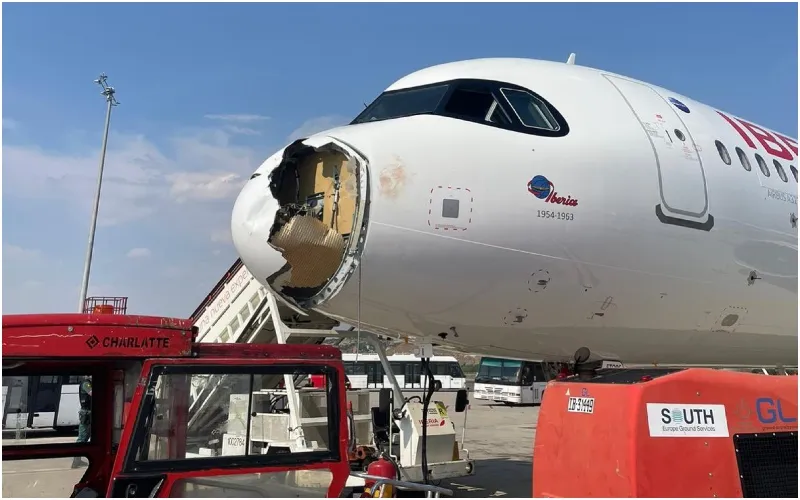
In a statement, the airline confirmed that following the safety procedures and informing the passengers onboard, its crew elected to return to Entebbe International Airport, landing safely at 10:41pm.
All passengers on board were reportedly shaken but unhurt, and the airline said in its priority statement that everyone, including the crew, safely disembarked.
“The bird strike affected the aircraft’s steering components and our engineers and airport officials are working round the clock to return the aircraft to service as soon as possible. We estimate the aircraft should be back to service by 8am later today,” the statement reads in part.
As a result of the bird strike, the airline announced that some of its scheduled flights for the day would experience some delays as it moved to recover the network.
“We sincerely apologise for the inconvenience caused to our guests and reassure them that their safety and that of our staff remain our number one priority. Our teams are in contact with the affected guests and are working diligently to provide the necessary care and assistance for their comfort,” the statement from Corporate Communications further reads.
Kenya Airways’ crew prioritises safety
Chief Corporate Affairs Officer of Uganda National Oil Company Tony Otoa, who was on the affected flight, lauded the crew and the pilots, terming them superb.
“They were very calm and did their best to land the plane. They prioritised our safety. When they announced that the hydraulics had failed and they were flying on manual mode midway through the flight, I grabbed my rosary and prayed,” recalled Otoa.
Otoa also praised aviation authorities at Entebbe International Airport, saying that they were helpful too in the aftermath of the incident.
“When some things happen in life, I always say there is a reason for them happening. This, for me, was the universe saying, ‘Momento Mori!!!’Thanks again to the pilots and the crew on Kenya Airways KQ 421,” added Otoa.
On May 14, 2026, Kenya Airways reported yet another service disruption on the Abidjan – Dakar – Abidjan – Nairobi route due to a bird strike incident.
“We wish to inform our customers that one of our aircraft operating into Abidjan experienced a bird strike upon landing earlier today. As a result, there will be disruptions to the Abidjan – Dakar – Abidjan – Nairobi service as the aircraft undergoes the necessary technical inspections and maintenance in line with safety and operational procedures,” the airline said.
The management of Kenya Airways maintained that the safety of its guests and crew remains its highest priority.
Aircraft declared Aircraft on Ground (AOG)
Still, on May 9, 2026, the airline experienced service disruption on the Cape Town-Nairobi route due to a bird strike incident.
“We confirm that earlier today, one of our aircraft operating from Nairobi to Cape Town experienced a bird strike incident upon arrival in Cape Town. The aircraft landed safely at Cape Town International Airport at approximately 1:55pm,” the airline said in a statement.
Following a technical assessment, KQ indicated that the aircraft was declared Aircraft on Ground (AOG) due to the significant damage to the radome.
“In line with standard safety and operational procedures, the aircraft is currently undergoing the necessary inspections and maintenance. Our technical teams are working around the clock to recover the aircraft back to Nairobi within the next 24 hours,” the airline further said.
These incidents have reignited discussion about air safety and bird strike prevention, especially involving large birds like vultures, which are less common but more dangerous.
Global wildlife strikes in aviation have reached an average of 71,500 reported incidents annually, with birds accounting for about 96% of these collisions. Because many strikes go unreported, experts estimate the actual figure can reach upwards of 20,000 incidents per year.
Bird strikes cost the global aviation industry well over 1.2 billion USD annually. This staggering financial toll encompasses direct aircraft repair (such as engine replacements and windshield damage), emergency landings, flight delays, schedule disruptions, and passenger accommodations.
While bird strikes are relatively frequent, they usually occur during takeoff and landing and rarely cause major damage.
Why Entebbe attracts large flocks of birds
However, the Jeju Air crash in 2024 and a near-miss involving a Spanish Air Force jet in July 2025 illustrate their potential severity.
Entebbe International Airport is near Lake Victoria and wetlands, which attract large flocks. Seasonal migration, weather and airport habitats make them more likely there. KQ’s Cape Town incident aligns with this.
Félix Houphouët-Boigny International Airport in Abidjan is located about 41 minutes to 1 hour 18 minutes from Banco National Park, a primary rainforest reserve in the heart of the city that is home to numerous wildlife species.
Airports use radar, noise deterrents, and habitat tweaks to reduce these risks but can’t eliminate them. Globally, the aviation industry records about 1.2 billion to 2.2 billion USD in damages and delays annually, with roughly 71,500 wildlife and bird strikes reported each year.
Data from the International Civil Aviation Organisation (ICAO) and the Federal Aviation Administration (FAA) shows that 96% of all wildlife strikes involve birds.
Experts say more robust wildlife control systems are needed near airports.
For instance, Spain has taken steps, such as installing its first avian radar system at Bilbao Airport in 2022—technology already in use at major European hubs like Frankfurt and Amsterdam—to better detect and prevent bird-related hazards.
Inside Nigeria’s flight disruption incidents
The KQ incidents are not isolated cases. On May 1, 2026, Nigeria’s Air Peace Airlines encountered flight disruption on its London-Lagos operations due to a bird strike.
“We wish to inform our esteemed passengers that our London (Gatwick) – Lagos service today experienced a bird strike. In line with standard safety protocols, the affected aircraft has been grounded for comprehensive inspection and necessary checks by our engineering team in London,” the airline announced.
In a statement signed by Osifo-Whiskey Efe, the spokesperson of Air Peace Limited, the airline empathised with passengers affected by any inconvenience caused by the unforeseen incident while appreciating their patience.
“Passengers affected have been communicated our next line of action as we work diligently to minimise disruptions across our network. Air Peace remains unwavering in its commitment to the highest standards of safety and operational excellence. Thank you for your understanding,” Osifo-Whiskey said.
Earlier, on April 3, 2026, Uganda Airlines also reported having experienced a disruption on its morning flight from Johannesburg to Entebbe, which occurred approximately 45 minutes after takeoff due to a bird strike, resulting in a shattered windshield.
The airline disclosed that the flight crew made the decision to return to OR Tambo International Airport (JNB), where the aircraft landed safely.
“We confirm that all guests and crew are safe. The safety and security of our passengers and staff remain our highest priority,” a statement from the airline reads in part.
How airlines are facing turbulent times
While reacting to these incidents, Amos Kasera, an aviation enthusiast, said:
“Just a string of bad luck. It’s impossible to outmanoeuvre a bird strike. If anything, airports have a responsibility to manage their habitat by limiting the presence of birds since over 90% of bird strikes happen during landings and take-offs,” he explained.
Dr. Marcel Mbamalu, a distinguished Nigerian communication scholar, journalist, and entrepreneur, observed that airlines are fighting bird strikes, fuel shortages, and an operating environment that chews up cash.
“Bird strikes aren’t a PR issue. They’re a life-and-death issue. When a bird hits an engine on takeoff or landing, it can shred turbine blades, knock out sensors, and compromise the whole aircraft,” explained Dr. Mbamalu.
Dr. Mbamalu, who boasts three decades of experience in the media industry, noted that it is against this backdrop that global aviation rules are strict.
“Even a minor hit means the plane is grounded until Boeing engineers and certified technicians say it’s safe. “Safe” is not negotiable,” he added.
While reflecting on the Jeju Air Flight 2216 in December 2024, Dr. Mbamalu reiterated that a bird strike in South Korea led to a failed landing, a runway overrun, and a fireball that killed 179 people.
What happens when an aeroplane suffers a bird strike
During the tragic air accident, two people survived. Investigators found bird remains in both engines.
“That’s what happens when a strike goes wrong. In that context, Air Peace grounding the plane wasn’t an overreaction. It was the bare minimum,” Dr. Mbamalu added.
A bird strike happens when a bird collides with an aircraft, mostly affecting engines, wings, or cockpit windshields during takeoff, descent, or landing.
While modern aircraft are engineered to withstand these impacts, they are still a major concern because they can force precautionary emergency returns, cause costly structural repairs, and disrupt flight schedules.
When a bird strike is detected, flight crews and airlines act to ensure passenger safety through standardised protocols. If a windshield shatters or an engine is damaged, pilots immediately follow protocols to return to the departure airport or divert to the nearest suitable landing strip.
Grounded aircraft are classified as “Aircraft on Ground” (AOG) and undergo rigorous technical assessments. Planes are not cleared to fly again until the airframe, engines, and radar domes are thoroughly inspected for damage.
Airports actively move to combat bird strike incidents
At this moment, airlines normally deploy backup aircraft or arrange alternative travel options to help passengers reach their destinations, though delays are often unavoidable.
To minimise the bird strike risks, airports globally actively work to deter birds from runways by using pyrotechnics, sound cannons, and trained raptors (falcons) to scare away flocking birds. Modifying the environment around airport vicinities to make the area less attractive to wildlife (e.g., controlling grass lengths and eliminating standing water) is highly recommended.
Travellers are advised that should their flight be delayed or diverted due to a bird strike, they will generally not be entitled to standard regulatory financial compensation (such as EU261). This is because regulatory bodies view bird strikes as an “extraordinary circumstance” that is entirely outside the airline’s control.
However, affected passengers are usually entitled to duty of care, which includes meals, refreshments, and hotel accommodations during extended delays. Although none of the recent incidents resulted in casualties, industry experts warn that the pattern of recurring disruptions can no longer be dismissed as isolated events.
Modern jet engines are built to withstand certain bird impacts without catastrophic failure, which explains why most bird strike cases do not lead to accidents. However, aviation’s safety culture demands that every suspected bird ingestion be treated with the utmost seriousness.
These latest occurrences underscore the delicate balance airlines must maintain between operational efficiency and safety compliance. For passengers, the event serves as a reminder that while delays can be frustrating, precautionary checks are a critical part of modern aviation’s layered safety system.
Kenya Airways concluded its statement by thanking passengers and the public for their understanding as it worked to restore normal flight schedules once inspections were completed and the affected aircraft were cleared for service.













Discussion about this post