


Editor’s note: In this piece of work, Kimutai Kirui explains why the P3 Form is a crucial document for survivors of gender-based violence (GBV) and vulnerable victims, serving as a vital link between reporting an offence, preserving evidence, and ensuring accountability. Kirui further says that any obstruction to accessing this document not only complicates procedures but also constitutes a denial of justice.
County hospitals charge up to KSh 2,500 to fill P3 forms. On the other hand, Moi Teaching and Referral Hospital (MTRH) in Eldoret, Uasin Gishu County, charges KSh 10,000 to fill out the P3 form.
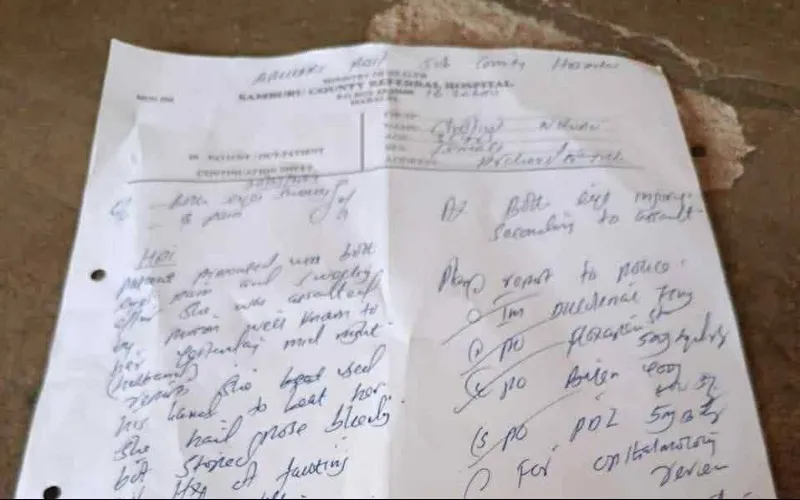
Though police request clients to do a photo or download P3 forms from the cybercafé, issuance at the station should be a free service. Uasin Gishu County must follow suit.
Justice begins with evidence
For survivors of gender-based violence and other vulnerable victims, the P3 Form is often the first critical link between reporting an offence, preserving evidence, and securing accountability.
When access to that document is obstructed by unlawful charges or administrative barriers, the consequence is not merely procedural—it is the denial of justice itself.
The High Court has already affirmed that the P3 Form is a public service that must be issued and completed free of charge.
The question now is not what the law is, but whether its implementation will match its promise.
The implementation of the High Court’s ruling on the P3 Form in Uasin Gishu and across the North Rift must be pursued with urgency. For many survivors of gender-based violence (GBV) and other vulnerable persons, access to justice begins with access to evidence.
The P3 Form is not a mere administrative document; it is a critical medico-legal instrument linking medical examination, police investigation, prosecution, and judicial determination.
“In Legal Resources Foundation Trust v Attorney General & 2 Others (2019), the High Court held that charging for the P3 Form is unconstitutional!”
The Court affirmed that the P3 Form is a public service that must be issued and completed free of charge, consistent with Article 48 of the Constitution, which guarantees access to justice.
Yet reports persist that P3-related charges continue to be levied in some institutions. Where access to evidence is conditioned upon the ability to pay, access to justice itself is compromised.
Evidence before liability
Criminal liability is not established by the mere reporting of an offence.
An Occurrence Book (OB) entry records a complaint and initiates investigations, but it is not evidence of guilt.
Prosecution depends upon witness statements, forensic findings, documentary records, digital material, and the integrity of the chain of custody.
Criminal proceedings are undertaken by the state through the Office of the Director of Public Prosecutions (ODPP).
The justice system rests not on allegations but on admissible and credible evidence.
The P3 form in the criminal justice system
In cases of rape, defilement, assault, and other offences involving bodily injury, the P3 Form occupies a pivotal evidentiary role.
It documents:
- Physical injuries
- Clinical observations
- Forensic findings
- Medical opinions relevant to the alleged offence
Together with witness testimony and other evidence, it forms part of the evidentiary foundation upon which prosecutorial decisions and judicial findings are made.
Its value lies not merely in documentation but in transforming medical findings into legally admissible evidence.
Alongside the P3 Form, clinicians complete the Post Rape Care (PRC) Form, creating a comprehensive medico-legal record that supports both treatment and prosecution.
Why timely access matters
- Evidence is perishable.
- Injuries heal. Biological traces degrade. Memories fade.
- Delays in medical examination or barriers to obtaining medico-legal documentation can weaken otherwise credible cases and frustrate the administration of justice.
For this reason, access to P3 and PRC services is not simply a medical issue—it is a criminal justice imperative.
A constitutional question
The issue extends beyond procedure and administration.
It touches directly on constitutional guarantees of access to justice, equality before the law, human dignity, and effective legal protection.
When a survivor is unable to obtain a critical evidentiary document because of unlawful charges or institutional barriers, the consequence is not merely inconvenience. It is the potential denial of justice.
Conclusion
The criminal justice system is an evidentiary continuum. From first report to final judgement, every stage depends upon the collection, preservation, and presentation of evidence.
The P3 Form sits at the centre of that process. It is the bridge between injury and proof, between investigation and prosecution, and often between allegation and accountability.
Court judgements achieve their true purpose through implementation. Rights that exist only in law but remain inaccessible in practice are rights denied.
Ensuring free and accessible P3 services is therefore not simply compliance with a court order—it is the fulfilment of a constitutional obligation.
The author is Kimutai Kirui, a Kenyan political analyst and human rights activist known for his work in Uasin Gishu County, where he has championed justice in cases ranging from police brutality to land disputes affecting widows.
Views expressed in this article are solely those of the author and do not represent the editorial position of news9.africa.













Discussion about this post