


KILIFI, Kenya – The government, through Kenya Ports Authority (KPA), is investing in specialised port management training to improve logistics efficiency, boost regional trade and strengthen its position as a gateway for international commerce.
The government said developing a skilled workforce is critical to maximising returns from investments in ports, roads, railways and other transport infrastructure as Kenya seeks to expand manufacturing and attract investment.
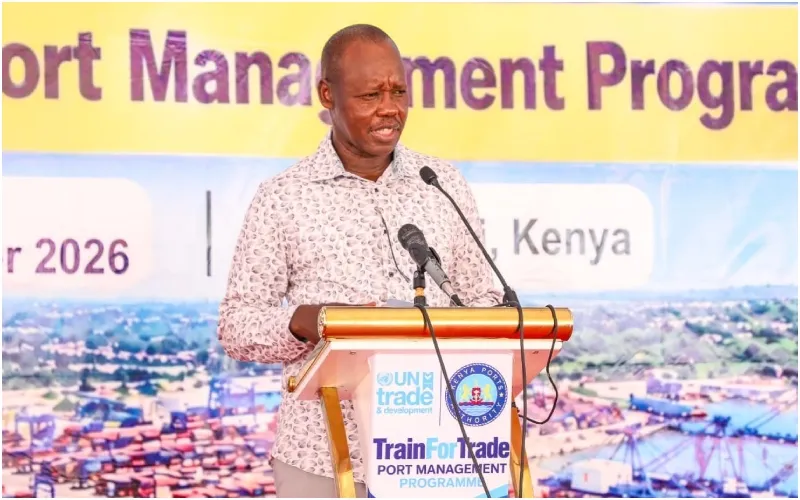
The initiative, spearheaded through the United Nations Conference on Trade and Development (UNCTAD) TrainForTrade Modern Port Management Programme, launched in Kenya on Monday, October 12, in Kilifi County.
Speaking during the launch, Kenya Ports Authority (KPA) Chief Executive Officer Captain William Ruto said professional training was essential to improving port performance and maintaining global competitiveness.
“To remain competitive, ports must invest in skills and practical training development. As KPA, we are committed to investing in skills development training for our employees to boost productivity,” Ruto said.
He disclosed that eight senior managers had already undergone training under the programme, while another 38 participants were expected to benefit as KPA seeks to align its operations with international best practices.
Ruto said the training would strengthen operational planning, decision-making, customer service and innovation across the authority’s ports and logistics operations.
“For KPA, this programme is not simply an academic exercise. It is a practical investment designed to strengthen performance across our ports and logistics operations,” he said.
The programme will equip port professionals with skills in port operations, international trade and transport, commercial and financial management, performance measurement, environmental sustainability and human resource development.
Principal Secretary in the State Department for Transport Mohamed Daghar, represented by Ministry of Transport Director Pius Kaura, said modern port management had evolved beyond handling ships and cargo to include technology, risk management and coordination across logistics networks.
“Modern port management is no longer simply about managing berths, cargo-handling equipment and vessels. It is about managing connectivity, information, risks, relationships and value,” Daghar said.
He said efficient ports were essential to Kenya’s economic competitiveness and the implementation of the African Continental Free Trade Area (AfCFTA), which seeks to expand trade among African countries.
However, Daghar noted that trade agreements alone could not guarantee the smooth movement of goods without efficient ports, reliable shipping services, faster customs processes and effective road and rail connections.
“Trade agreements and policies by themselves are not enough to transport physical products. It requires an integrated ecosystem of efficient ports, reliable sea freight, fast-tracked customs and inland road and rail networks linking harbours directly to markets,” he said.
Daghar said the training would help develop professionals capable of coordinating different parts of the logistics chain, improving service delivery and reducing the cost of moving goods.
He added that Kenya’s ambition extended beyond building modern transport infrastructure to developing the expertise needed to manage complex logistics systems and drive innovation across the region.
“Through programmes such as TrainForTrade, Kenya continues to align itself with global standards while strengthening local expertise,” he said.
The government called on Kenyans to become a regional centre of excellence in maritime training, logistics management and transport sector development.
The initiative comes as the Port of Mombasa continues to record growth in cargo throughput and container traffic, reinforcing its position as a major gateway to East and Central Africa.
KPA revealed that it is exploring opportunities at the Port of Lamu and other facilities as regional logistics, industrial and energy developments create new demands for specialised management skills.
Ruto said port managers were operating in an increasingly complex environment characterised by changing trade patterns, supply chain disruptions, technological advances, environmental obligations and rising customer expectations.
He said participants would be expected to apply their knowledge to real operational challenges, with case studies and dissertations developed during the course providing practical solutions for port operations and logistics management.
A UNCTAD representative, Mark Assaf, said Kenya and Africa more broadly had immense untapped potential in the marine economy that could be harnessed to drive trade and sustainable economic growth.
The programme reflects a broader push by African ports to improve competitiveness as regional integration creates opportunities for increased cross-border trade.
For Kenya, better port management and coordination between maritime transport, customs and inland logistics could help reduce bottlenecks, speed up cargo movement and strengthen the country’s appeal to businesses seeking efficient routes into regional markets.
Daghar said the Ministry of Roads and Transport and the State Department for Transport remained committed to strengthening professional standards, skills development and institutional performance.
He officially declared the UNCTAD TrainForTrade Modern Port Management Programme open, marking the start of the initiative in Kenya.







Discussion about this post